Specialty Cooking Appliances: Which Ones Are Worth the Space?
Specialty cooking appliances give a particular job its own heating surface, vessel, or controlled process. The right one depends on the food you make repeatedly, the quantity you prepare, and whether its extra setup, cleaning, and storage are justified by what it does differently.
When does a specialty cooking appliance earn its space?
A dedicated appliance is worth considering when it makes a regular cooking task easier or provides a useful capability that your existing cookware cannot readily match. That might mean a broad cooking surface, automated dough preparation, a temperature-controlled water bath, or outdoor smoke and flame. For an occasional dish that already turns out well in a pan or oven, another appliance may add more work than value.
| The cooking job you repeat | Appliance family to consider | What changes | Check before dedicating space |
|---|---|---|---|
| Grilled sandwiches, vegetables, or small cuts of meat | Indoor electric grill or contact press | A ridged or two-sided heated cooking surface | Smoke, grease collection, ventilation, and plate cleaning |
| Pancakes, multiple breakfast portions, or cooking in a separate heated pan | Electric griddle, skillet, or wok | A flat surface or self-heated cooking vessel | Usable area or depth, storage footprint, and surface care |
| Deep-fried foods, steamed dishes, or broth-based meals at the table | Deep fryer, food steamer, or electric hot pot | A dedicated oil, steam, or liquid-heating setup | Liquid handling, capacity, and cleanup after each use |
| Frequent loaves, waffles, or shaped breakfast foods | Bread machine or breakfast maker | Automated dough stages or a food-specific cooking mold | Batch size, fixed shape, and removable parts |
| Homemade ice cream, sorbet, or frozen drinks | Frozen dessert maker | Freezing and mixing suited to a particular frozen texture | Bowl prefreezing, freezer space, or built-in refrigeration |
| Repeated low-temperature water-bath cooking | Sous vide cooker | More precise control of bath temperature | Suitable vessel and packaging, plus safe time-temperature procedures |
| Grilling, smoking, or high-heat pizza outdoors | Outdoor grill, smoker, or pizza oven | A fuel- and heat-specific outdoor cooking environment | Permitted placement, fire precautions, and fuel management |
A three-question fit test
- What will you cook regularly? Name actual dishes and serving quantities. Start with the cooking action, not a list of advertised programs.
- What does the full setup require? Check both operating and storage space. Count the accessories and supporting equipment, such as an ice cream freezer bowl, a sous vide container, or outdoor fuel.
- Will you accept the cleanup? Consider grease trays, oil disposal, removable cooking plates, dough pans, cooling time, and parts that must be washed and dried. An appliance that is tedious to reset may be less useful than its cooking function suggests.
Important: Fuel-burning outdoor grills and smokers are not indoor cooking appliances. Charcoal and gas grilling equipment must be used outdoors in a safe location, never inside a home or garage.
Indoor grills and contact presses: what changes indoors?
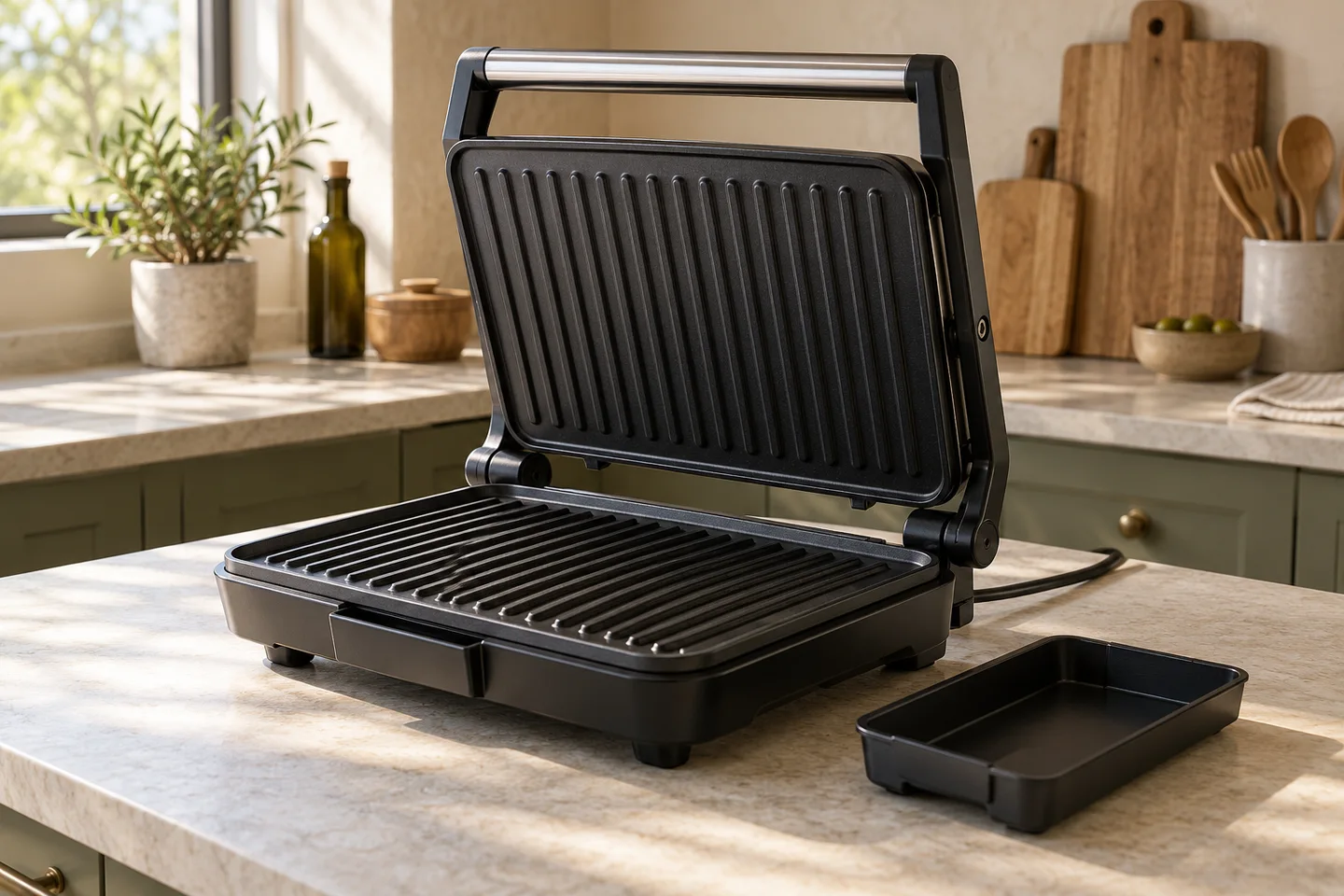
An open electric grill heats food from a lower cooking surface, while a contact grill closes a heated upper plate onto the food. A panini press is a contact-grill format designed primarily for sandwiches. These devices suit different food shapes and turning habits, but none reproduces the combustion, smoke, or open-flame cooking of an outdoor grill.
Open electric grills
An exposed heated plate or grate lets you arrange food, turn it, and remove pieces individually. It is useful for vegetables, patties, and fillets when you want access to the cooking surface throughout the process.
- Cooking method: Heat comes principally from below; turn food as needed.
- Useful design: A grease channel or removable collection tray keeps rendered fat away from the main cooking area.
- Tradeoff: More exposed cooking can mean splatter, and each piece must be turned and checked for doneness.
Contact grills and panini presses
Closing the lid brings a second heated plate into contact with the food. This suits pressed sandwiches and relatively even-thickness pieces that can meet both plates without being crushed.
- Cooking method: Upper and lower plates transfer heat at the same time.
- Useful design: A floating or adjustable hinge accommodates different sandwich thicknesses more evenly than a rigid lid.
- Tradeoff: A heavy or poorly adjusted lid can compress delicate foods; tall or irregular pieces may not contact both plates uniformly.
Convertible grill-griddle appliances
Some contact-grill designs open flat or accept interchangeable smooth and ridged plates. Opening flat changes the cooking arrangement from a closed press to two exposed surfaces; smooth plates are better suited to foods such as pancakes and eggs that do not benefit from grill ridges.
- Check: Verify the actual hinge positions, usable heated area, and whether the plates can be removed.
- Tradeoff: Extra cooking configurations may also mean more plates and accessories to store and clean.
Does "smokeless" mean no ventilation is needed?
No. A low-smoke or "smokeless" label does not guarantee that cooking releases no smoke or airborne particles. Fat, food residue, cooking temperature, and charring all affect emissions. Use effective kitchen ventilation, avoid deliberately burning food indoors, and clean grease and residue from the appliance after it cools.
For day-to-day use, check that grease can drain into an accessible tray, food-contact plates can be cleaned without damaging their coating, and the appliance has enough clearance to open safely. Unplug it and let it cool before cleaning; only wash removable parts in a dishwasher if their instructions permit it.
Food safety: Grill marks and browned surfaces do not establish that meat or poultry is safely cooked. Check the food's internal temperature with a suitable food thermometer.
Griddles, skillets, and electric woks for broad or deep cooking
An electric griddle provides a broad, mostly flat surface; an electric skillet adds deeper sides and usually a lid; an electric wok has a curved or sloped bowl for moving food through the heated area. Choose the vessel shape around your usual cooking motion. A wide surface helps with separate portions, while depth matters for sauces, braising liquids, and ingredients that need frequent stirring.
| Appliance type | Cooking shape | Well-suited tasks | Main limitation |
|---|---|---|---|
| Electric griddle | Broad heated plate with a low rim or grease channel | Pancakes, eggs, flat sandwiches, and batches of similar foods | Little room for simmering liquids; edge-to-edge dimensions may overstate usable flat space |
| Electric skillet | Flat-bottomed heated pan with raised sides and often a lid | Pan-frying, sautéing, simmering, and browning followed by covered cooking | Less uninterrupted flat cooking area than a similarly sized griddle |
| Electric wok | Deep, sloping heated bowl | Stir-frying cut vegetables and proteins, tossing noodles, and other dishes that benefit from frequent movement | Heating patterns and sustained high-heat ability vary considerably by base and element design |
Electric griddles: check usable surface area
The relevant size is the flat area available for food, not the appliance's outside width. A large housing, grease channel, or raised edge can reduce the space available for pancakes or sandwiches. Check that the portions you normally cook can sit without crowding, with room to turn them. A grease tray should be accessible after the surface has cooled.
Electric skillets: check depth and lid fit
The raised sides hold liquid and help contain stirring and splatter. A fitted lid makes an electric skillet useful for braising and simmering after browning food. Compare the flat bottom's usable area as well as the pan's depth; a stated capacity alone does not tell you how many pieces can brown in one layer. Observe the appliance's maximum fill guidance when cooking liquids.
Electric woks: check the heat source, not just the bowl
The sloping walls make it easy to push and turn cut ingredients, but the width across the rim is not the same as the hottest cooking area. Some electric woks heat through an attached element, while others use a separate induction base with a compatible wok. Their heating patterns, response to added food, and ability to sustain a hot stir-fry vary; an electric wok should not automatically be expected to reproduce the heat of a dedicated high-output wok burner.
For stir-frying, prepare the ingredients before heating and cook manageable batches so the food can move and the cooking surface can recover heat. If you mainly sauté in a flat pan, a skillet you already own may meet the same need.
Surface and cleanup checks
- Cooking finish: Follow the utensil and cleaning rules for the actual coating or bare-metal surface. Nonstick coatings and seasoned steel do not have identical care needs.
- Removable controls: A detachable heat probe may allow the pan to be washed separately, but the probe, cord, and powered base must not be immersed. Dishwasher compatibility is appliance-specific.
- Counter setup: Use a stable, heat-resistant surface, allow the required clearances, and keep cords away from heat, water, and the counter edge.
Fryers, steamers, and electric hot pots do different jobs
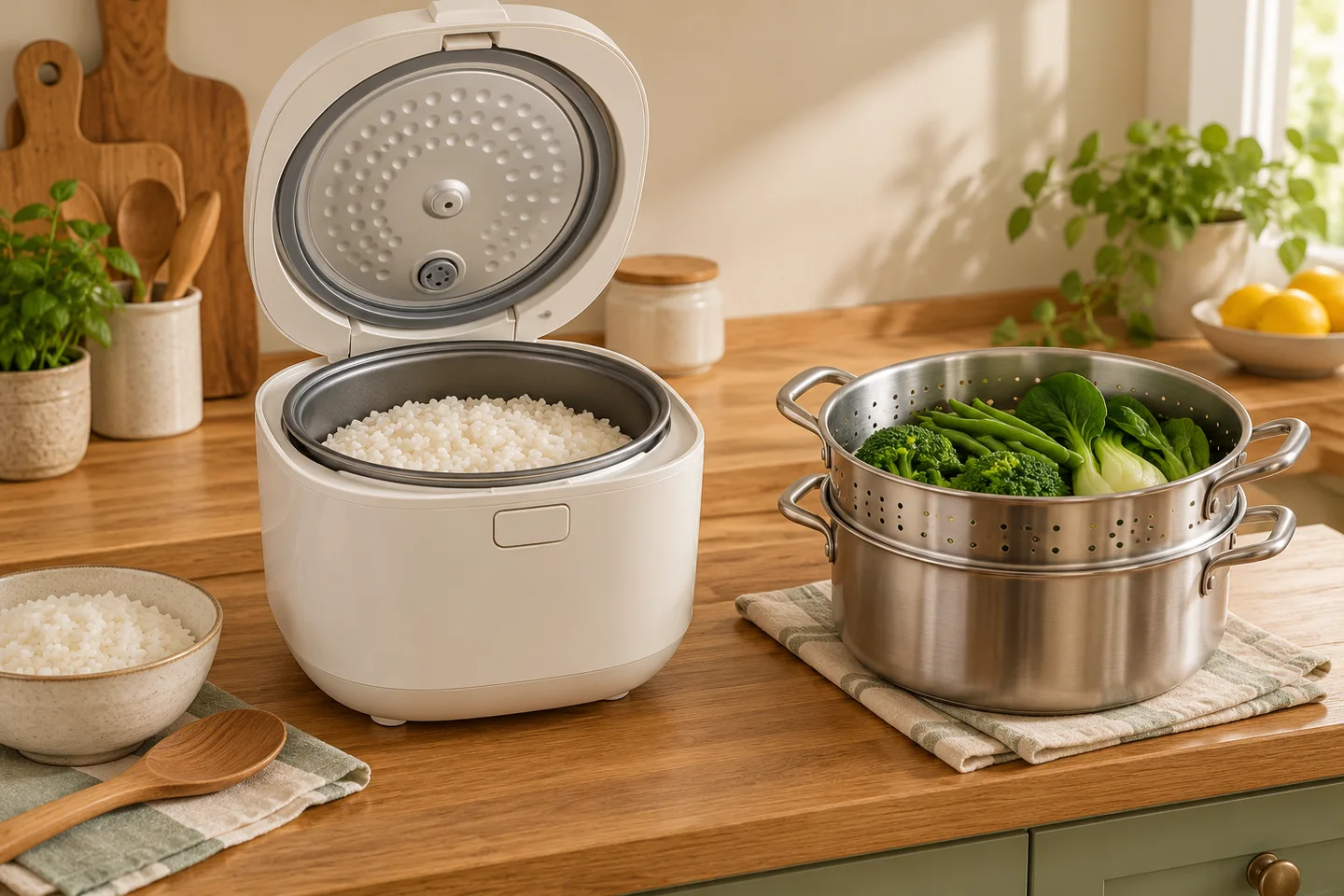
A deep fryer immerses food in hot oil, a food steamer surrounds food with steam from heated water, and an electric hot pot heats broth or another cooking liquid in a vessel suited to shared meals. Their main difference is what transfers heat to the food. Some appliances support more than one mode, but only use a mode and liquid that the manufacturer explicitly allows.
| Appliance | What surrounds the food | Particularly useful for | Check first |
|---|---|---|---|
| Deep fryer | Hot cooking oil | Immersion-fried potatoes, battered foods, and other foods intended for a crisp fried exterior | Oil fill limits, basket load, temperature control, and cooled-oil handling |
| Electric food steamer | Steam generated from a water reservoir | Vegetables, dumplings, seafood, and several foods cooked in separate tiers | Reservoir size, tier arrangement, steam escape, and cleaning access |
| Electric hot pot | Heated broth or other cooking liquid | Tabletop soups and meals where ingredients are added and cooked during serving | Usable liquid volume, simmer control, stable placement, and raw-food separation |
Deep fryers: oil and basket capacity are different
An oil-volume rating describes the liquid a fryer holds; it does not establish how much food can be added safely in one batch. Follow the appliance's minimum and maximum oil markings and the separate basket-loading instructions. Wet food can make hot oil foam or splatter, while crowding can disrupt cooking and cause overflow.
- Useful features: Adjustable oil temperature, a basket that drains above the oil, and removable parts that allow access to cooled oil and food residue.
- Ownership work: Let the oil cool completely before filtering or disposal. Do not pour used oil into a sink drain.
- Different process: An air fryer moves heated air around food; it does not perform deep frying by oil immersion.
Food steamers: tiers and water supply determine the workflow
Dedicated electric steamers typically heat water below perforated baskets. Stacked tiers can separate foods, but the tier location, food thickness, and total load can affect cooking time. Check how easily the reservoir can be filled or refilled and whether baskets can be rearranged without unsafe exposure to steam.
A pot with a steamer insert or a multicooker's steam mode may be sufficient for occasional single-batch steaming. A dedicated multi-tier steamer becomes more useful when you regularly cook separate foods at once. For meat, poultry, and seafood, a timer is not a substitute for verifying safe internal temperature.
Electric hot pots: the meal happens at the table
An electric hot pot maintains a heated cooking liquid while diners add ingredients. Some have a divided vessel for separate broths; others resemble a deep electric skillet and may serve additional cooking purposes. Check the volume below the safe fill line, the ability to maintain an appropriate simmer, and how the removable vessel is cleaned.
Place the appliance on a stable, heat-resistant table where its cord cannot be snagged. Keep raw meat and seafood on separate plates, use separate utensils for raw and cooked food, and verify that foods are fully cooked before serving. A shared pot does not remove ordinary food-safety requirements.
Hot-oil safety: Never add water to hot frying oil or use water on an oil fire. Do not leave a working deep fryer unattended, and allow the oil and appliance to cool before moving or cleaning them.
Bread machines and breakfast makers: repeated recipes first
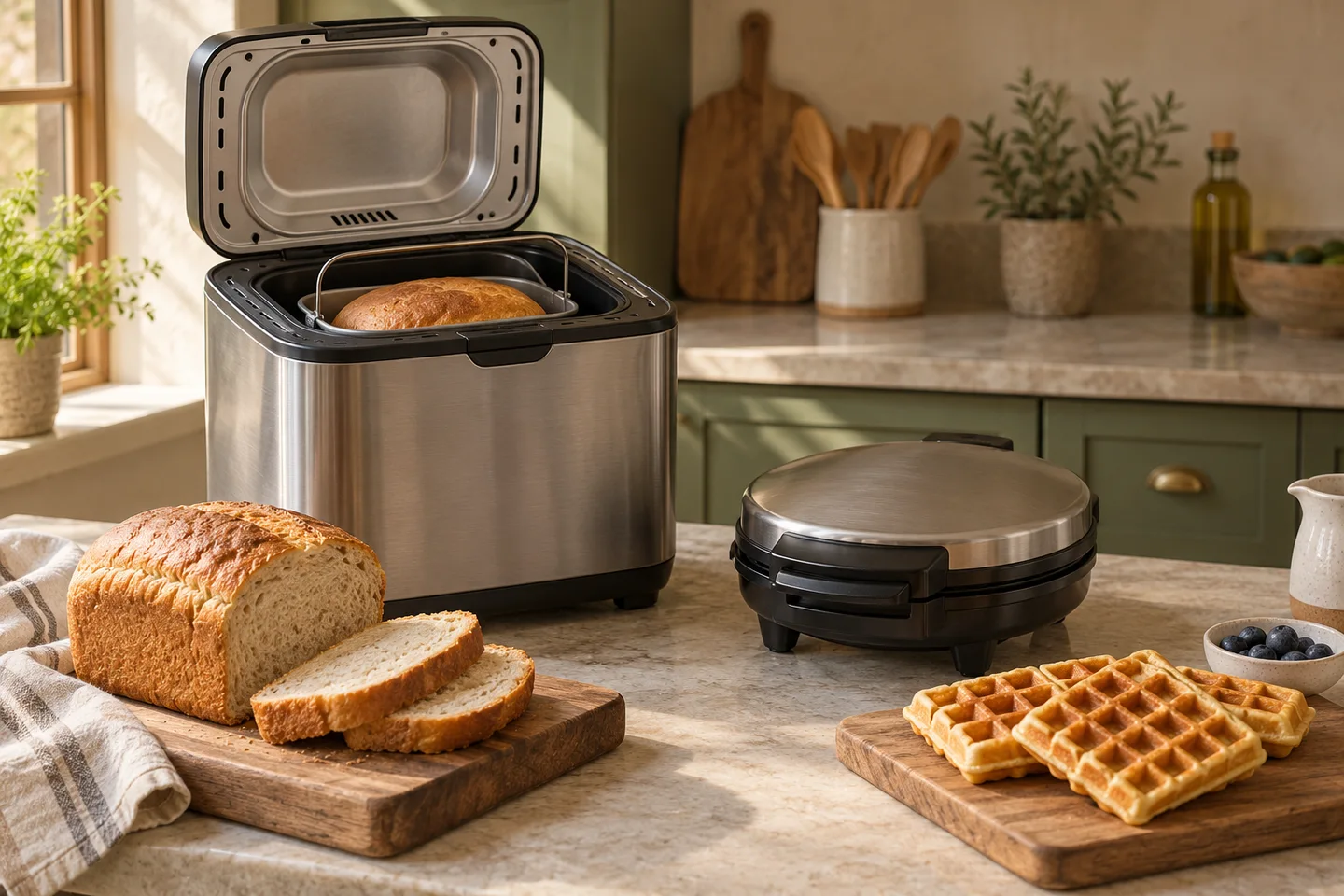
A bread machine reduces the work of mixing, kneading, and raising yeast dough, and can also bake a loaf. Waffle makers, sandwich makers, and small shaped-batter appliances do something narrower: they cook food against plates or inside molds. The right choice depends on whether you regularly want help with bread dough, a particular breakfast shape, or several portions made the same way.
Bread machines: a baked loaf or dough for the oven?
The program matters as much as the pan. On a full bread cycle, a machine mixes and kneads ingredients, manages the rise, and bakes in its own pan. A dough cycle mixes, kneads, and provides an initial rise, leaving you to shape and bake rolls, pizza, or another loaf style separately.
- Check capacity by recipe: Match the recipe's flour quantity and dough type to the machine's stated limits. A loaf-size label alone does not tell you whether every recipe will fit or rise properly.
- Choose the cycle for the result: A basic loaf program is not a substitute for shaping steps or baking conditions required by every artisan bread recipe. A dough-only cycle offers more control over the final shape.
- Count the cleaning: The baking pan and kneading paddle need attention after use. Check how the paddle detaches and which parts may be immersed or machine-washed.
Do not use a delayed-start cycle to leave perishable ingredients such as fresh milk, eggs, or cheese unrefrigerated for hours. Follow the machine's ingredient-order and delayed-start instructions.
Waffle makers: the plates set the shape and batch size
A waffle maker surrounds batter with patterned hot plates. Shallower grids make thinner waffles; deeper Belgian-style grids form thicker waffles with deeper pockets. The plate layout also determines whether you cook one large waffle or several smaller portions per batch.
Check the cavity depth, batter capacity, browning adjustment, and whether overflow has a place to collect. Removable grids can simplify washing, but fixed nonstick plates may need wiping in place after cooling. A preheat indicator signals a heating condition, not necessarily that the waffle is fully cooked.
Sandwich makers and breakfast rings are not waffle makers
A sandwich press heats bread and fillings between plates, sometimes sealing or dividing the sandwich into pockets. A breakfast sandwich maker with stacked rings or an egg-cooking plate assembles a more specific layered portion. Neither performs the same job as patterned waffle plates, unless the appliance explicitly accepts interchangeable cooking plates.
For repeated breakfasts, check the bread dimensions the device accepts, how many portions can cook at once, and whether raw eggs are cooked through before serving. Overfilling fixed molds makes closing and cleaning harder. A skillet or a press already in your kitchen may be more adaptable if the ingredients and portion shapes change often.
Mini-donut and cake-pop makers: useful only for the mold
These appliances heat batter in small, shaped cavities. They make plate-cooked treats, not deep-fried donuts, and their fixed wells limit the shape and quantity of each batch. Look at the number and size of cavities, whether the plates can be removed, and how easily baked-on batter can be cleaned from the edges.
Across this group, a dedicated appliance is easiest to justify when the recipe and serving size repeat often. If each meal needs a different shape or preparation method, a general-purpose pan, oven, or mixer may cover more of the work.
Frozen dessert makers and the preparation they require
The main difference between frozen dessert makers is when and where the ingredients are frozen. A freezer-bowl machine needs a bowl frozen in advance, a compressor machine refrigerates its own mixing vessel, and a frozen-base processor works on a mixture already frozen solid. Refrigerated slush machines are designed for drinkable ice crystals rather than scooped ice cream. The preparation method matters more than the number of dessert names on the controls.
| Freezing method | What must be ready | Suited to | Main constraint |
|---|---|---|---|
| Prefrozen-bowl churner | A thoroughly frozen insulated bowl and prepared dessert base | Churned ice cream, frozen yogurt, and sorbet | Freezer space and time to refreeze the bowl between batches |
| Compressor churner | Prepared base and a machine with built-in refrigeration | Churned desserts without prefreezing a bowl | Counter space and manufacturer-specified ventilation clearance |
| Frozen-base processor | A recipe mixture frozen solid in its dedicated container | Reprocessed frozen desserts and selected frozen drinks | Containers occupy freezer space; the machine does not freeze a liquid base for you |
| Refrigerated slush maker | A compatible liquid mixture | Sippable slush and similar frozen drinks | Sugar and alcohol content can prevent the intended texture or operation |
Churning and processing are different steps
Churning cools a liquid mixture while moving it, limiting the buildup of large ice crystals and incorporating air. The result is often soft when the cycle ends. For a firmer, scoopable texture, transfer it to a suitable container and harden it further in the freezer.
A frozen-base processor instead breaks down a previously frozen block. Its preparation happens before the machine runs, and some mixtures need another processing pass to reach the intended consistency. Neither method guarantees a particular texture from every recipe: the amounts of water, fat, sugar, and other ingredients also matter.
Prepare the cold parts before starting
- Reserve freezer space. A freezer-bowl churner needs room for the entire bowl, often well before dessert day. A frozen-base processor needs room for its filled containers. Follow the specified freezing position and minimum preparation time.
- Prepare and chill the mixture. Many churned recipes work best with a thoroughly chilled base. If making a cooked custard, cool it promptly and refrigerate it before churning.
- Check the working fill limit. Leave the space required by the appliance for movement and expansion. The bowl's physical volume is not necessarily the permitted starting mixture volume.
- Plan for serving and cleanup. Decide whether the dessert will be served soft or stored for further freezing. Wash paddles, lids, containers, and dispensing parts as instructed; freezer bowls and powered bases are not automatically dishwasher-safe.
Is a frozen drink maker the same as a blender?
No. A blender chops or blends ice, frozen fruit, and liquid; it does not freeze the mixture. A refrigerated slush maker cools and stirs a compatible drink until ice crystals develop. Sugar lowers a mixture's freezing point, while alcohol can inhibit freezing. Some machines cannot process plain water or sugar-free drinks as slush, so check their actual recipe restrictions before use.
Food safety: Freezing does not make raw eggs or unpasteurized dairy safe. Use pasteurized dairy and, for mixtures containing uncooked or lightly cooked egg, pasteurized eggs or egg products. Keep prepared bases refrigerated until processing.
Sous vide equipment and controlled water-bath cooking
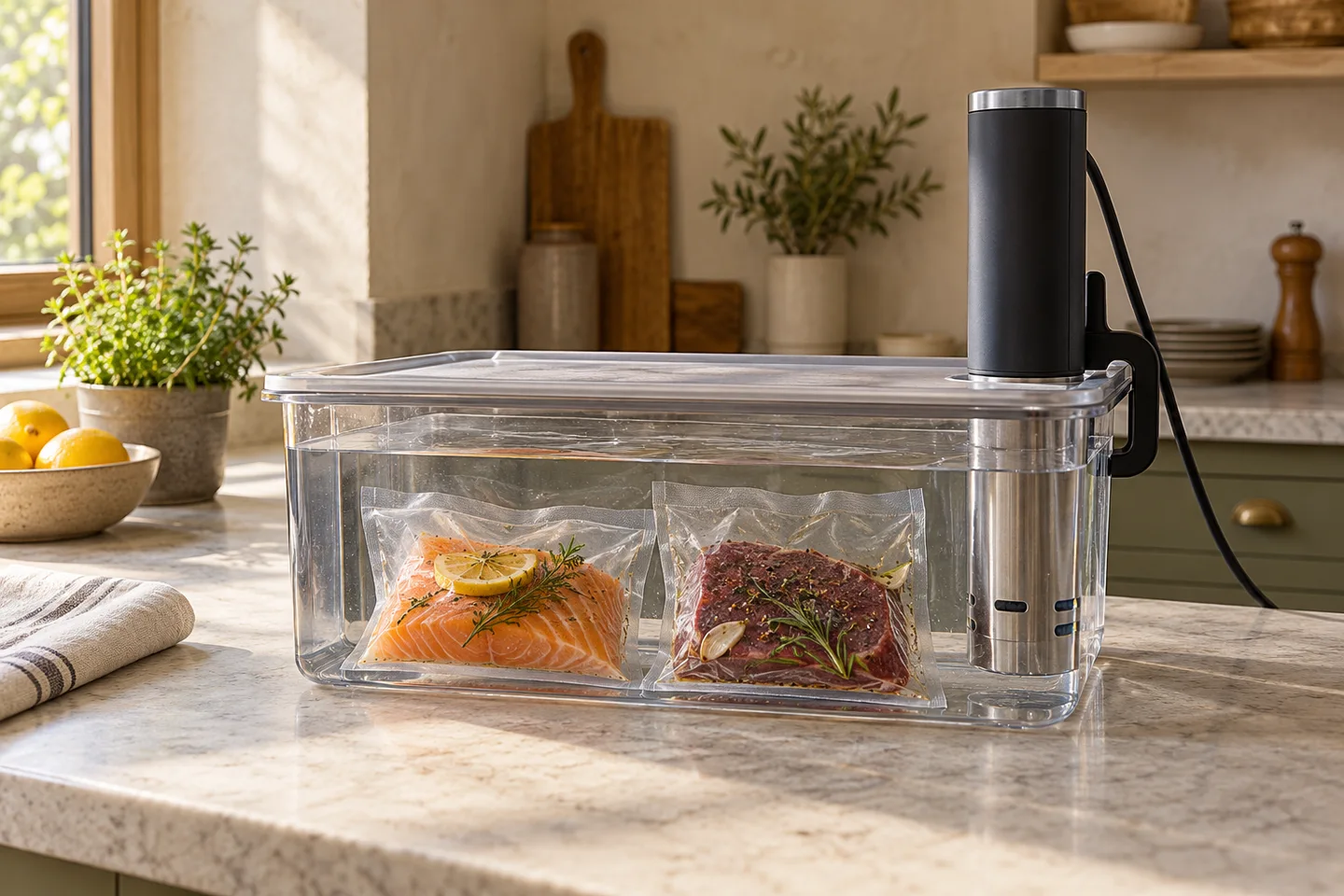
Sous vide cooking holds packaged food in a temperature-controlled water bath. The equipment maintains the water temperature; safe cooking still depends on how long the food takes to heat through and, where needed, how long it stays at an appropriate internal temperature. An immersion circulator provides the heater and pump for a separate vessel, while a self-contained water bath includes its own tank.
| Setup | How it works | Main advantage | Main limitation |
|---|---|---|---|
| Immersion circulator | Clamps to a compatible pot or container, heats the water, and circulates it | Vessel size can be chosen around the food and serving quantity | Requires a suitable container, adequate water depth, and room for circulation |
| Self-contained sous vide water bath | Combines a heated tank, controls, and usually a lid in one appliance | Integrated vessel with a defined working capacity | Fixed tank size takes storage space; circulation and bag arrangement depend on the design |
What a usable setup needs
- A stable water vessel: Match its depth and volume to the equipment's permitted range. For an immersion circulator, the water must stay between the marked minimum and maximum levels, including after food is added.
- Suitable food packaging: Use bags or reusable containers explicitly rated for the intended cooking temperature. A vacuum sealer can remove air and make consistent seals, but compatible resealable bags can also work with the water-displacement method. An ordinary storage bag is not automatically suitable for heated immersion.
- Space around each portion: Keep bags fully submerged and avoid tightly overlapping them. Trapped air can make bags float, while crowded food restricts water contact and changes heating behavior.
- A lid for longer cooking: A compatible cover can reduce evaporation. Check water level during extended runs and do not let the circulator run dry.
Does an accurate bath setting guarantee safe food?
No. Bath temperature is not the same as the temperature at the center of a thick piece of food. Heating time changes with thickness, shape, starting temperature, and how the food is arranged. At some lower cooking temperatures, an appropriate time at temperature can achieve the necessary pathogen reduction, but that requires a validated food-specific process, not a guess based on the display.
Use a reliable time-temperature procedure for the particular food and portion thickness, or follow the standard safe minimum internal-temperature guidance for conventional cooking. Do not assume a recipe for a thin steak also applies to thick poultry or ground meat. A timer, bag seal, or even water temperature does not independently prove that the food received a safe heat treatment.
What the water bath does not finish
Water-bath cooking does not brown the outside of a steak or chop the way a hot pan or grill does. If a browned crust is desired, remove the cooked food from its bag, dry the surface, and sear it separately using an appropriate hot cooking surface. That additional step, plus sealing, setup, and bag cleanup, belongs in the space and effort calculation.
Food safety: Vacuum sealing does not make food shelf-stable. Serve safely cooked food promptly, or cool it rapidly and refrigerate or freeze it according to safe food-handling guidance. Do not leave sealed cooked food at room temperature for storage.
Outdoor grills, smokers, and pizza ovens
Outdoor cooking equipment differs in how it produces heat, moves smoke, and handles longer cooking sessions. A grill is primarily a grate-based cooker that can expose food to direct or indirect heat. A smoker emphasizes sustained indirect heat and wood smoke, while a pizza oven uses a heated cooking floor and intense surrounding heat. Fuel type affects lighting, control, cleanup, and where the equipment can safely operate.
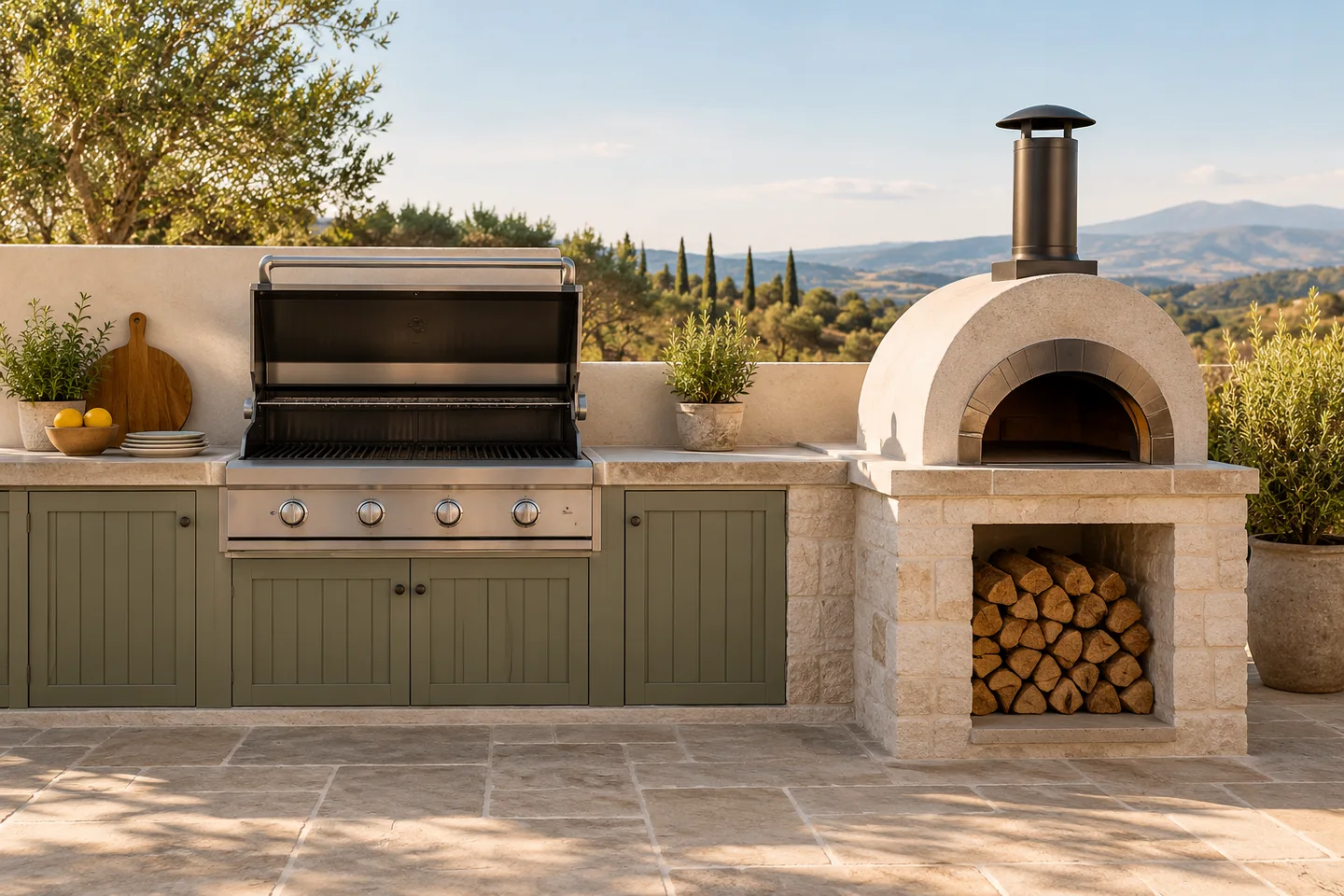
| Outdoor appliance | Heat and fuel arrangement | Suited to | Ongoing work |
|---|---|---|---|
| Gas grill | Gas burners heat grates; separate burner zones may allow indirect cooking | Regular grilling of vegetables, patties, steaks, and mixed-size portions | Fuel supply, burner and hose inspection, grease-tray cleaning |
| Charcoal grill | Burning charcoal supplies heat; fuel placement and vents control direct and indirect zones | Grilling with a live coal fire and occasional covered cooking | Lighting, managing airflow, replenishing fuel, disposing of cooled ash |
| Wood-pellet grill or smoker | A powered feed system typically moves wood pellets into a fire pot while a fan circulates heat and smoke | Repeated covered roasting and smoke-focused cooking | Dry pellet storage, electrical access, fire-pot and grease maintenance |
| Dedicated wood or charcoal smoker | Fire or embers heat a separate or offset cooking area indirectly | Longer smoking sessions with active fuel and smoke management | Monitoring chamber temperature, airflow, fuel, and ash |
| Outdoor pizza oven | Gas, wood, charcoal, or another permitted heat source warms a cooking floor and chamber | Pizza and other foods suited to a hot deck or stone | Preheating, turning food, managing fuel, and cleaning the cooking floor |
Direct grilling and slow smoking use heat differently
Direct grilling places food over an active heat source for browning and relatively quick cooking. Indirect grilling places food away from the strongest heat and uses a covered cooking chamber to finish larger or more delicate portions. Some lidded gas and charcoal grills can do both when their burner or coal arrangement provides separate zones.
Smoking is principally an indirect, longer process. A covered grill can sometimes be configured to smoke, but a dedicated smoker gives that task its own chamber and fuel arrangement. Compare the ability to monitor cooking-chamber temperature and keep smoke and heat moving around the food. A chamber thermometer monitors the cooker; a separate food thermometer is still needed to establish safe internal doneness.
Pizza ovens need a ready cooking floor, not just a hot flame
A pizza oven depends on heat stored in its stone or other cooking floor as well as heat above the pizza. Preheat the floor according to the oven instructions; a hot air reading alone does not establish that the deck is ready. Check the usable floor dimensions, space to turn a pizza, and where a peel and other hot tools can be set down safely.
Gas-fired designs use a controllable burner, while wood- and charcoal-fired designs require fuel and airflow management. A multi-fuel label does not mean every fuel is permitted without the correct burner or conversion parts. Follow the appliance's approved fuel configuration.
Is there a safe place to operate it?
Before choosing a fuel-burning appliance, confirm an open-air location with the clearances required by its instructions and applicable building or property rules. Keep grills and pizza ovens away from combustible siding, railings, overhead structures, and branches. Do not operate fuel-burning outdoor cookers in a home, garage, tent, porch, balcony, or other confined space; gas, charcoal, wood, and pellets can create fire and carbon monoxide hazards.
- Gas: Check hoses and connections for damage and follow the specified leak-check and lighting procedures.
- Charcoal or wood: Have a safe place for hot tools and fuel. Coals and ash must cool completely before disposal in an appropriate metal container.
- Pellets: Confirm the required electrical supply and protect stored fuel from moisture; follow shutdown and ash-cleaning instructions.
- Any outdoor cooker: Keep children and pets clear, stay with a lit cooker, and remove grease deposits that could ignite.
If outdoor cooking is occasional, the full routine of fuel, weather exposure, preheating, ash or grease disposal, and storage may matter more than the cooking surface alone.
Capacity, counter space, and cleanup across appliance types
Capacity labels describe different things across specialty appliances. A cooking-surface measurement, vessel volume, loaf size, batch yield, and water-bath capacity cannot be compared as if they all represented servings. The useful measure is how much of the food you actually prepare can cook safely in one run, with enough room to turn, stir, rise, circulate, or drain as the process requires.
| Appliance family | Capacity detail that matters | What a headline size may miss | Cleanup or storage to allow for |
|---|---|---|---|
| Grills, griddles, and waffle makers | Usable heated area or number and shape of cavities | Housing width, raised edges, grease channels, or space to turn food | Food-contact plates, hinges, grease trays, and spare grids |
| Electric skillets, woks, and hot pots | Flat cooking base, vessel depth, and permitted liquid fill | A wide rim does not equal a wide browning surface | Removable controls, lids, broth residue, and coating care |
| Deep fryers and food steamers | Safe oil or water levels plus food-basket or tier capacity | Liquid volume does not establish food load; stacked tiers affect access | Cooled-oil handling, baskets, reservoirs, and possible scale buildup |
| Bread machines and molded breakfast makers | Recipe flour limit or actual portions per cooking cycle | Nominal loaf weight or outside dimensions do not establish recipe fit | Kneading paddle, baking pan, fixed molds, and crumbs or batter |
| Frozen dessert makers | Permitted starting mixture, finished yield, and required freezing containers | A full bowl may need expansion space; freezer accessories also occupy storage | Churning paddles, dry freezer bowls, processing containers, or dispensing paths |
| Sous vide equipment | Water-level range, vessel depth, and room around submerged bags | Container volume is not the same as usable food capacity | Cooking vessel, sealing equipment, bags, and mineral deposits |
| Outdoor grills, smokers, and pizza ovens | Actual grate zones, rack arrangement, or usable stone floor | Total grate area may include warming space; oven openings limit handling | Fuel, grease or ash, hot tools, covers, and safe outdoor storage |
Measure the stored appliance and the working setup
- Check its resting footprint. Measure the cabinet, shelf, or counter space available for the appliance itself, including its handles, feet, and other fixed projections.
- Check operating clearance. Account for an opened lid, steam release, ventilation openings, removable baskets, and space to load or lift food. Follow required heat and fire clearances rather than treating a tight physical fit as permission to operate.
- Count supporting items. Add the freezer bowl, spare plates, hoses, fuel containers, vacuum-sealing supplies, cooking racks, or pizza tools the chosen process actually needs.
- Check access to power and water. Position electrical appliances near a suitable outlet without routing cords across hot surfaces or walkways. Equipment that must be filled, drained, or cleaned also needs a practical route to the sink.
Consider the reset between batches
The time spent cooking is only part of the routine. A second waffle batch may simply need more batter, while a freezer-bowl dessert maker may require its bowl to be frozen again. A fryer may be ready for another load but still demand cooled-oil filtering and disposal later; a pellet smoker may need fire-pot and grease-path cleaning after its shutdown procedure.
Check which food-contact parts detach, which may be immersed, and whether dishwasher permission applies to those exact parts. Nonstick surfaces, seasoned metal, insulated freezer bowls, powered bases, and cooking stones do not share one cleaning method. If the normal post-meal cleanup is more than you are willing to repeat, a multiuse pan or oven may remain the more practical choice.
Safe operation and care across specialty appliances
Safe cooking requires more than the correct setting on an appliance. Check that the equipment can operate in its intended location, that hot oil or water stays within its limits, and that the food receives the necessary cooking treatment. Timers, ready lights, surface browning, and water-bath displays do not by themselves establish safe doneness.
Before switching on the heat
- Check the equipment and its location. Use a stable, suitable surface with the required clearances. Inspect the cord, plug, controller, lid, and any gas connection for visible damage. Do not operate damaged equipment or bypass a safety device.
- Keep the electrical path safe. Keep cords away from hot surfaces, water, and edges where they may be pulled. Use an appropriate outlet; GFCI protection is important for countertop cooking areas. Follow the appliance's instructions on extension cords and electrical supply.
- Respect the fill and load markings. Leave space for steam, rising dough, hot oil movement, or circulating water as applicable. Never use one appliance's capacity or operating limits as instructions for a different type.
- Separate raw and ready-to-eat foods. Keep raw meat, poultry, and seafood away from cooked portions, utensils, and serving plates. Wash hands and food-contact surfaces after handling raw ingredients.
Check food temperature, not just appearance
Use a food thermometer in the thickest relevant part of meat, poultry, or fish, away from bone where applicable. For conventional consumer cooking, these are key safe minimum internal-temperature benchmarks:
| Food | Minimum internal temperature |
|---|---|
| All poultry, including ground poultry | 165°F (74°C) |
| Ground beef, pork, veal, or lamb | 160°F (71°C) |
| Beef, pork, veal, or lamb steaks, chops, and roasts | 145°F (63°C), followed by at least a 3-minute rest |
| Fish and shellfish | 145°F (63°C) |
Time-temperature pasteurization processes such as sous vide can use different validated combinations of internal temperature and holding time. Do not treat a lower bath setting, a sealed bag, or a recipe timer as proof of equivalent food safety without a reliable procedure for the food and its thickness.
Treat oil, steam, and outdoor fuel as separate hazards
- Hot oil: Keep water and wet utensils out of frying oil. Never use water on an oil or grease fire. Turn off the heat if it can be done safely; if the fire cannot be controlled safely, leave the area and call emergency services.
- Steam and hot liquids: Open lids away from the face, avoid leaning over steam vents, and let full vessels cool before moving or draining them.
- Outdoor flames and embers: Use fuel-burning cookers only in permitted open-air locations. Keep clear of combustibles and do not leave active grills or smokers unattended. Let charcoal and ash cool fully before disposal.
Clean, dry, and inspect before storage
Complete the appliance's required shutdown and cooling sequence; unplug countertop appliances as instructed. Remove grease and food residue from accessible surfaces after they cool. Wash only the parts that the instructions identify as washable; motor housings, electrical probes, controls, and connectors must not be immersed. Avoid abrasive tools on coated plates, freezer bowls, and cooking stones where they can damage the surface.
Empty and clean water reservoirs as directed, and descale equipment when mineral buildup requires it. Keep fuel and accessories in their appropriate dry storage locations. If a cord, coating, seal, heating element, or other safety-critical part is damaged, stop using the appliance until the issue is resolved according to its service instructions.