Kitchen Appliance Comparisons: Find the Right Tool for the Job
Kitchen appliances often overlap in what they can make, but differ in cooking method, usable capacity, preparation, cleanup, and space requirements. The most useful comparison starts with a dish or routine you repeat, then identifies which appliance functions actually matter for that job.
Start with the kitchen task
Match the appliance to the result you want and the work you want it to handle. An air fryer and a toaster oven can both reheat food, but their airflow, baskets, and trays suit different portions and shapes. Likewise, a blender and a food processor can both make some dips, yet smooth purees and evenly sliced vegetables call for different tools. Start with the task, then compare the space and effort each option requires.
| Your recurring task | Appliance families to compare | What should decide |
|---|---|---|
| Crisp small portions or reheat foods that should stay crunchy | Air fryer, toaster oven, full-size oven | Air circulation, usable basket or tray area, and batch size |
| Cook foods immersed in hot oil | Deep fryer, air fryer | Oil immersion versus hot-air cooking; the results are not identical |
| Make rice and everyday one-pot meals | Rice cooker, multi-cooker | Dedicated rice programs versus a broader range of cooking functions |
| Cook moist stews, beans, and braises | Pressure cooker, slow cooker | Shorter pressure-cooking time versus a long, low-heat cooking schedule |
| Make smoothies or juice | Blender, juicer | Blending the ingredients into a drink versus separating juice from pulp |
| Chop, slice, shred, mix, or knead | Food processor, stand mixer, blender | Cutting attachments, final texture, and whether the job is mixing or processing |
| Prepare dough or complete a loaf | Stand mixer, bread machine | Mixing and kneading versus an automated bread-making cycle |
| Make daily coffee | Drip brewer, pod brewer, espresso machine, superautomatic machine | Batch size, drink style, preparation steps, and cleaning |
| Store extra food or chilled drinks | Refrigerator, freezer, beverage cooler | Safe food-storage temperature, frozen capacity, or beverage organization |
| Choose a primary cooking surface | Induction, gas, radiant electric cooktop | Cookware compatibility, ventilation, and utility connections |
| Handle dishes in a small kitchen | Dishwasher, handwashing | Plumbing and installation space, dish load, and hands-on work |
Three checks before adding another appliance
- Name the missing function. List the dishes you actually make and identify what your current equipment cannot do well. An extra cooking preset is not a meaningful difference if it does not change the result or workflow.
- Check usable space, not just advertised capacity. Compare the food or cookware you need to fit, the unit's footprint, ventilation or clearance instructions, and where removable parts will be stored.
- Count the whole routine. Consider loading, active attention, cooking or processing, cleanup, and putting the appliance away. A device that simplifies one step may add work elsewhere.
Air fryers, toaster ovens, and full-size ovens
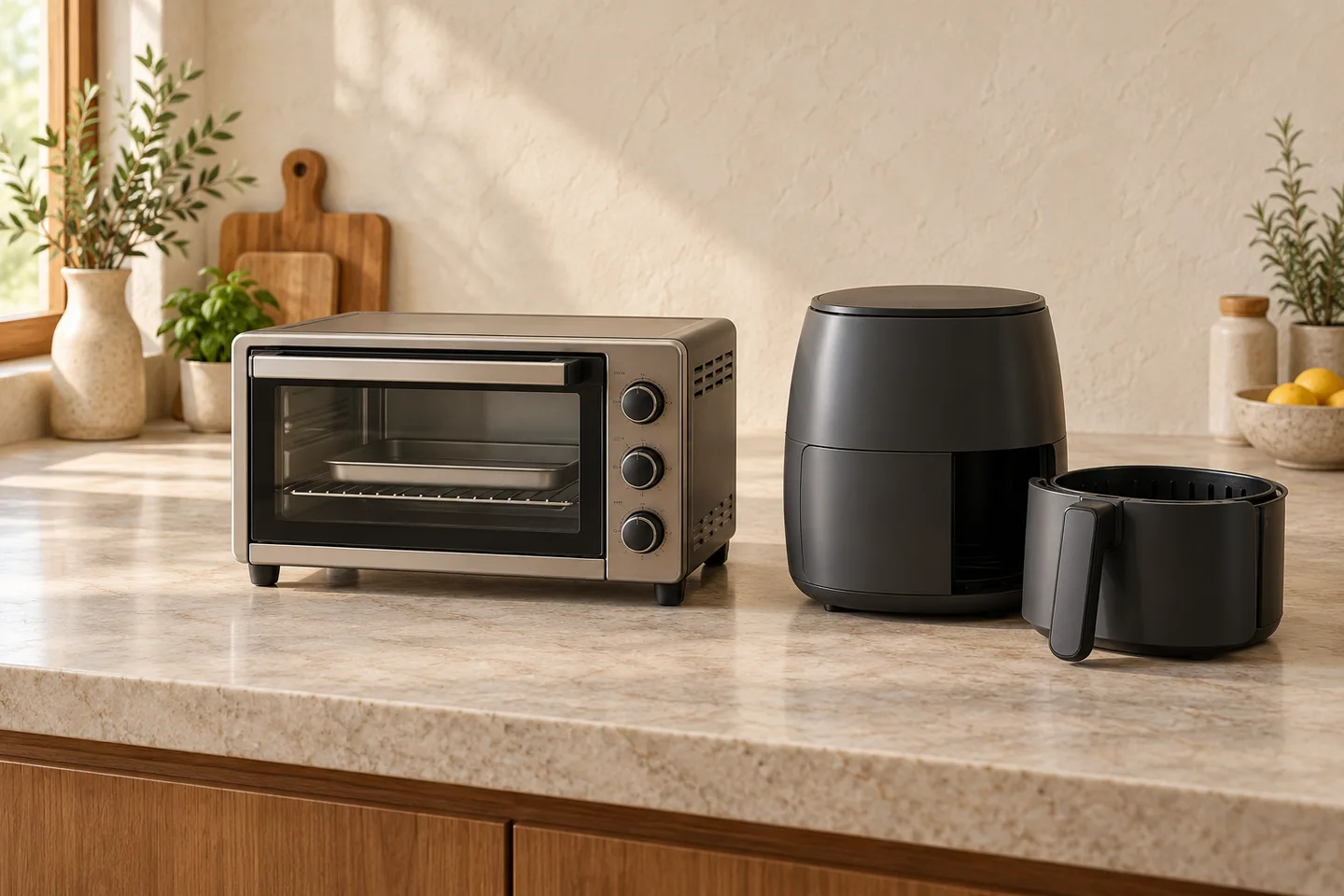
Basket air fryers, toaster ovens, and full-size ovens use dry heat, but they differ in how air moves around food and how much usable cooking area they provide. A basket air fryer emphasizes fast-moving hot air around relatively small portions. A toaster oven uses racks or trays for toasting, baking, and broiling, sometimes with a convection fan or air-fry mode. A full-size oven accommodates larger pans and meals. None replaces deep frying exactly, because a deep fryer cooks food immersed in hot oil rather than circulating air.
Basket air fryers
A fan moves hot air around food in a perforated basket or on a raised cooking surface. The exposed surfaces brown and crisp as moisture leaves them.
- Useful for: Small batches of potatoes, wings, vegetables, and reheated foods that benefit from a crisp exterior.
- Check: The food needs room for air to move. Crowded baskets may require multiple batches, shaking, or turning.
- Tradeoff: A deep basket can have less usable flat cooking area than its advertised volume suggests.
Toaster ovens and countertop convection ovens
These appliances place food on a rack or tray near heating elements. Some circulate air with a fan; others rely more heavily on radiant heat. A countertop oven with an air-fry setting overlaps with a basket air fryer's cooking method, but its tray shape and airflow path still matter.
- Useful for: Toast, open-faced sandwiches, small casseroles, flat foods, and baking pans that fit inside.
- Check: Measure usable rack width, depth, and height rather than relying only on external dimensions or a capacity label.
- Tradeoff: A flat tray accommodates different food shapes, but crowded trays can restrict browning and airflow.
Full-size ovens
A full-size oven provides a larger enclosed cooking space for roasting, baking, broiling, and cooking food in larger pans. Convection-equipped ovens add fan-driven circulation; conventional settings rely on heating elements or burners without that forced airflow.
- Useful for: Sheet-pan meals, large casseroles, roasts, bread, and multiple dishes that cannot fit in a countertop unit.
- Check: Pan dimensions, rack positions, and clearance above the food determine what actually fits.
- Tradeoff: The extra chamber space is useful for large loads but often unnecessary for a single small portion.
Deep fryers
A deep fryer surrounds food with hot cooking oil. This is a different cooking medium from the moving air in an air fryer, so similar-looking food may differ in crust, texture, and oil content.
- Useful for: Recipes where immersion frying is central to the intended result.
- Check: Oil level, food moisture, batch size, and the manufacturer's loading instructions.
- Tradeoff: Handling, filtering or replacing, and disposing of used oil add work and burn or fire risks.
Match the food to the cooking space
| Food or task | Where to start | Main fit question |
|---|---|---|
| A small batch of crispy potatoes or wings | Basket air fryer or countertop convection oven | Can the pieces sit with enough space for airflow? |
| Toast or an open-faced sandwich | Toaster oven | Is there a suitable rack position and direct toasting or broiling mode? |
| A casserole, loaf, or pie | Countertop or full-size oven | Does the pan fit with the required clearance? |
| Several trays of food or a large roast | Full-size oven | Can the pans and racks be arranged without blocking needed circulation? |
| A recipe that depends on oil immersion | Deep fryer | Is the hot-oil workflow appropriate for the food and kitchen? |
Food safety: Browning is not proof that meat or poultry is fully cooked. Check the required internal temperature with a food thermometer, and follow the food's cooking instructions. Avoid overfilling an air-fryer basket because restricted airflow can leave food unevenly cooked.
Rice cookers, multi-cookers, pressure cookers, and slow cookers
These appliances can all prepare moist foods, but their controls and cooking schedules are different. A rice cooker automates heating and moves to warming or a completed state when its cooking cycle ends. A multi-cooker combines several functions in one vessel, sometimes including pressure cooking. A pressure cooker uses trapped steam to cook moist foods at elevated pressure and temperature, while a slow cooker heats covered food gently over a longer period. Choose by the meals you repeat and when they need to be ready.
Dedicated rice cookers
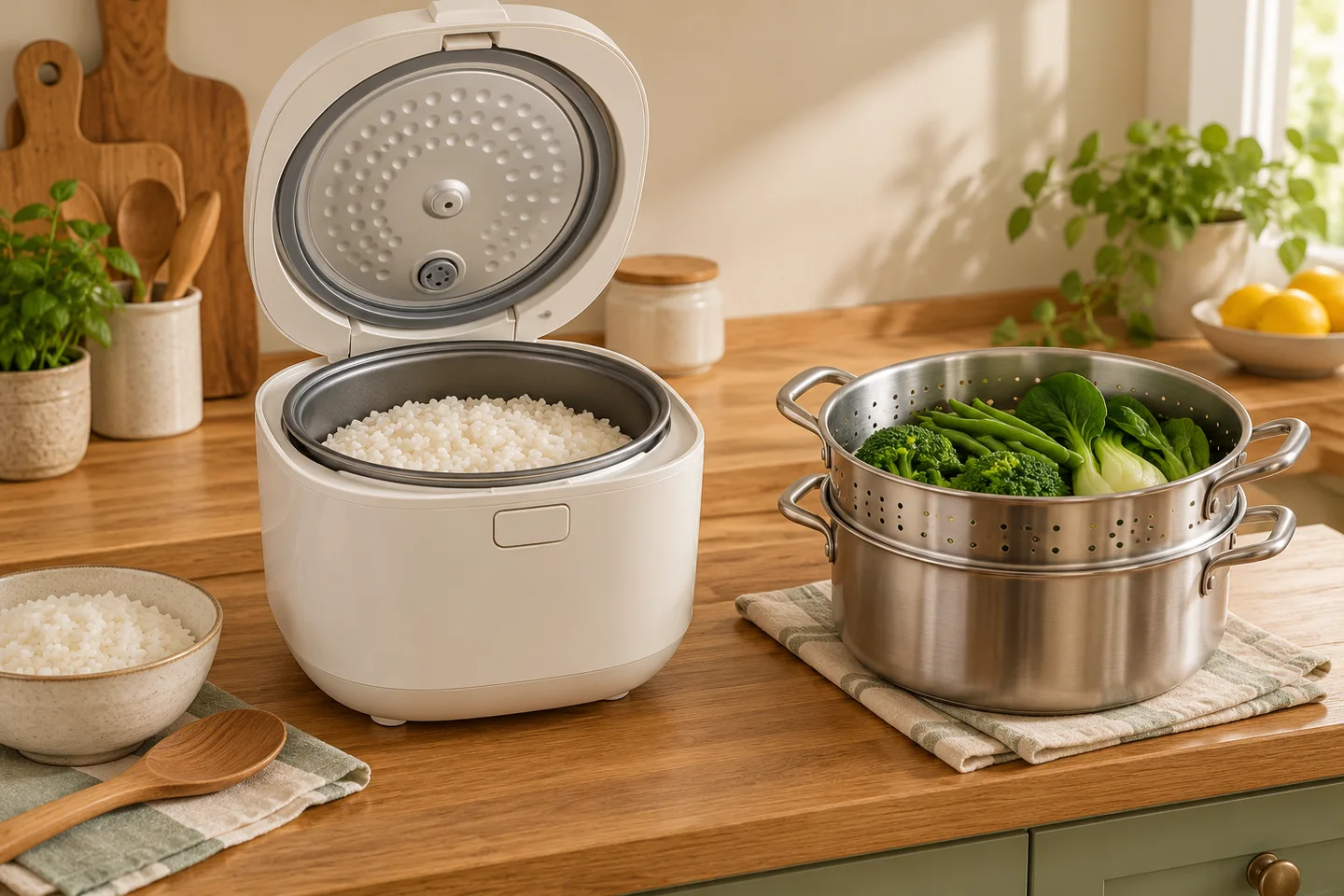
A rice cooker heats rice and water in an inner pot and controls the end of its cooking cycle. Basic designs respond to a temperature rise as water is absorbed; more advanced controls may manage soaking, heating, and steaming for different rice types.
- Useful for: Households that prepare rice frequently and want a repeatable, largely automatic routine.
- Check: Whether capacity refers to uncooked rice, the minimum batch, supported grain programs, and cleaning of the lid and inner pot.
- Tradeoff: Rice-focused programs may be more relevant than a long list of unrelated functions, but a rice cooker does not automatically provide pressure cooking or sauteing.
Multi-cookers
"Multi-cooker" describes a combination of cooking functions, not one specific heating method. Some are electric pressure cookers with saute, steam, rice, and slow-cook settings. Others offer multiple nonpressure functions. The actual lid design and available modes determine what the appliance can do.
- Useful for: Switching between rice, soups, beans, and one-pot meals without storing several separate cooking vessels.
- Check: Whether pressure cooking is actually supported, which lid or valve each mode needs, and how the inner pot and sealing parts are cleaned.
- Tradeoff: One pot serves multiple recipes, but it cannot prepare two different dishes independently at the same time.
Pressure cookers
A pressure cooker seals in steam and increases the cooking temperature of water-based dishes. Electric versions regulate heat and pressure with controls; stovetop versions depend on burner adjustment. Both are suited to moist cooking rather than dry, crisp finishes.
- Useful for: Beans, stews, braised meats, grains, and other foods that benefit from pressurized moist heat.
- Check: Minimum cooking liquid, maximum fill level, sealing components, and the required pressure-release method.
- Tradeoff: A short programmed pressure-cooking interval is not the full meal time. Heating to pressure and safely releasing pressure also take time.
Slow cookers
A slow cooker applies relatively low heat over several hours, usually through a covered cooking vessel. It fits meals that can simmer gently while other activities continue, especially moist soups, stews, and braises.
- Useful for: Preparing a covered meal earlier in the day to serve later without timing a short cooking cycle precisely.
- Check: Vessel size, the recipe's liquid and filling guidance, and the time available at the selected heat setting.
- Tradeoff: Slow cooking requires advance planning. Thaw meat or poultry before adding it, and do not use a slow cooker to reheat refrigerated leftovers.
Choose by the meal and the clock
| Regular need | Start with | Key distinction |
|---|---|---|
| Rice with most dinners | Dedicated rice cooker | Rice-specific controls and batch size matter more than extra modes |
| Rice, soup, and sauteed ingredients in one vessel on different days | Multi-cooker | Verify the exact supported functions; the name alone does not promise pressure cooking |
| Beans or a moist braise when cooking time is limited | Pressure cooker | Include pressurizing and pressure-release time in the schedule |
| Stew started well before dinner | Slow cooker | Use an appropriate moist recipe and plan for the long cooking period |
| A crisp crust or dry baking result | Oven, air fryer, or cooktop instead | Pressure and slow cooking primarily use moist heat |
Important: Never force open a pressure-cooker lid before pressure is fully released. An electric pressure multi-cooker is not a substitute for a pressure canner when following USDA home-canning procedures.
Blenders, food processors, mixers, bread machines, and juicers
Choose a preparation appliance by what it must do to the ingredients. A blender breaks ingredients down into a smooth mixture, while a food processor cuts, chops, slices, or shreds. A stand mixer beats, whips, or kneads without ordinarily cutting the food. A bread machine can move dough through kneading, rising, and baking, and a juicer extracts liquid while separating much of the pulp. Some tasks overlap, but the desired texture and the steps left for you to finish are decisive.
Blenders
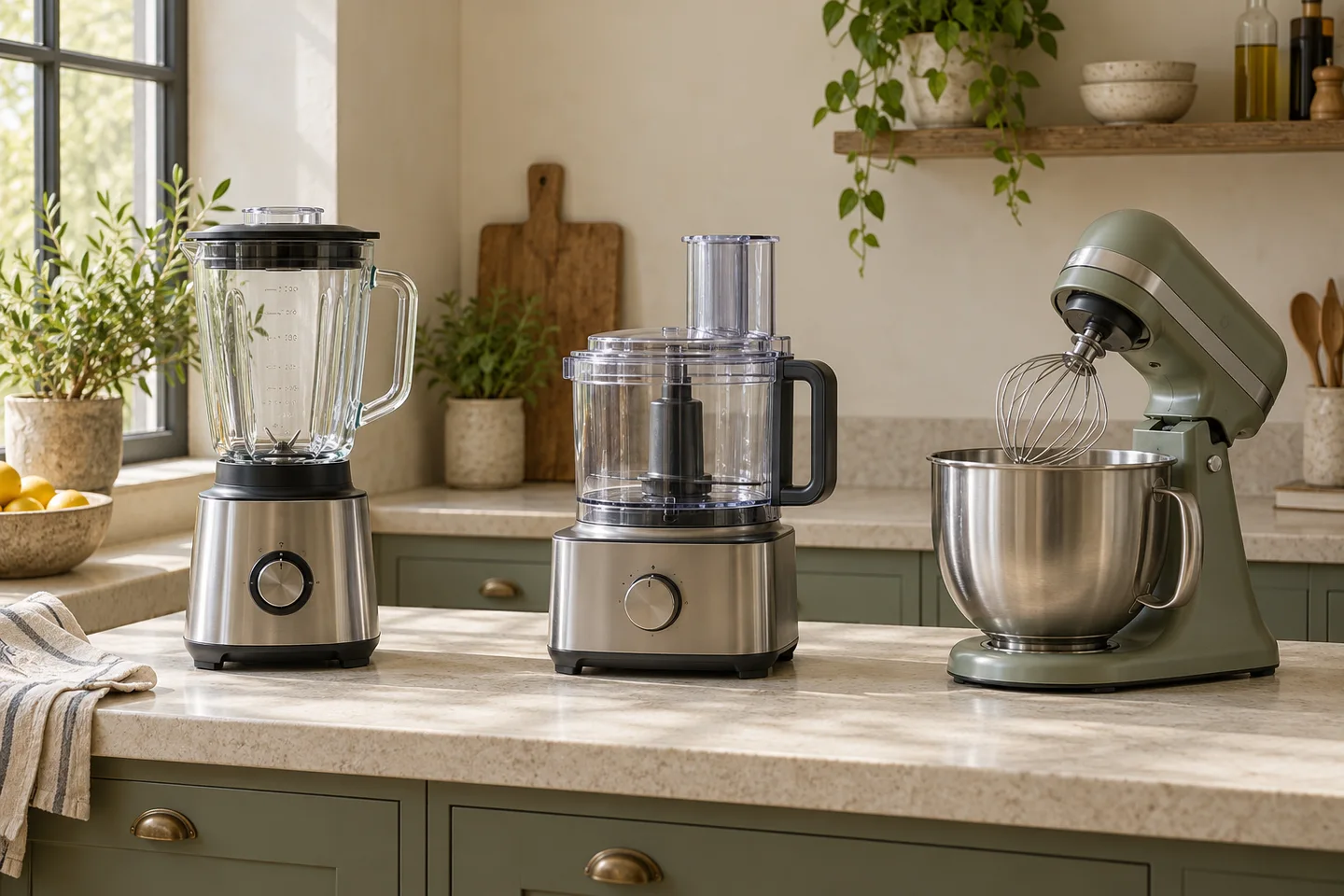
Blenders use blades near the bottom of a relatively tall jar to move and break down ingredients. Their shape helps circulate liquid mixtures toward the blades.
- Useful for: Smoothies, smooth soups, pourable sauces, and finely pureed mixtures.
- Check: Minimum liquid or loading requirements, usable jar capacity, and whether the appliance is intended for hot ingredients.
- Tradeoff: A blender can puree foods that need to stay in distinct pieces; it does not replace slicing or shredding discs.
Food processors
A food processor works in a wide bowl with a chopping blade or interchangeable discs. Discs near the feed tube can slice or shred ingredients as they enter the bowl, while a blade handles chopping and some mixing tasks.
- Useful for: Vegetable preparation, grated foods, crumbs, chunky dips, and repeated chopping.
- Check: Which blades and discs are actually included, the feed opening, work-bowl capacity, and ease of cleaning the lid and attachments.
- Tradeoff: Some designs can mix or knead dough, but the blade and bowl are not equivalent to a stand mixer's beater and dough hook.
Stand mixers
A stand mixer works ingredients in a bowl using attachments such as a flat beater, whisk, or dough hook. It can mix without chopping and can knead dough while the cook controls the recipe and later baking steps.
- Useful for: Cookie dough, cake batter, whipped mixtures, bread dough, and other repeated mixing tasks.
- Check: Dough and bowl capacity, compatible tools, allowable mixing speeds, and any operating limits for dense dough.
- Tradeoff: A standard stand mixer does not bake bread. Cutting and grinding tasks generally require separate attachments or appliances.
Bread machines
A bread machine combines a mixing and kneading mechanism with a heated baking chamber. A full bread program can manage kneading, rising, and baking in sequence, while some machines offer a dough-only cycle for shaping and baking elsewhere.
- Useful for: Repeatable bread-making routines with minimal hands-on work after loading ingredients.
- Check: Loaf-pan shape and capacity, available dough and bread programs, and which steps the selected cycle completes.
- Tradeoff: A programmed loaf shape and sequence offer less hands-on shaping flexibility than preparing dough in a stand mixer and baking it separately.
Juicers
A juicer extracts liquid from produce and separates much of the solid pulp. Centrifugal designs use a spinning cutting and straining assembly; auger-style designs crush or press produce through a screen. Both differ from blending all edible portions together.
- Useful for: A thinner juice where separating liquid from pulp is the intended result.
- Check: Produce preparation requirements, screen or auger cleanup, and how much pulp the mechanism retains or expels.
- Tradeoff: Juicing leaves separated pulp and generally removes more fiber than blending the edible parts of the same produce.
Choose by the finished texture and remaining work
| Desired result | Start with | What distinguishes the workflow |
|---|---|---|
| Smooth, pourable fruit or vegetable mixture | Blender | Ingredients are blended together rather than separated into juice and pulp |
| Distinct slices, shreds, or evenly chopped pieces | Food processor | A suitable cutting disc or blade preserves the intended piece size |
| Thick dip with some texture | Food processor or blender | Pulsing and blade geometry affect how quickly pieces become a puree |
| Whipped mixture, batter, or kneaded bread dough | Stand mixer | The beater, whisk, or dough hook works the ingredients without a cutting blade |
| A loaf mixed, risen, and baked automatically | Bread machine | The selected program completes the stages in one appliance |
| Dough to shape and bake in a separate oven | Stand mixer or a bread machine's dough cycle | The appliance handles dough preparation but not the final shaping and baking |
| Juice with most solid pulp removed | Juicer | Liquid extraction and pulp separation replace whole-ingredient blending |
Safety: Keep hands away from moving blades and attachments. Switch off and unplug the appliance before handling blades or changing tools, and follow its instructions for hot liquids and cleaning sharp components.
Coffee brewers, espresso machines, and grinders
Choose a coffee appliance by the drink you make regularly and how much of the preparation you want to handle. Drip brewers make filtered coffee, often a batch at a time. Pod and capsule systems simplify individual servings. Espresso machines push pressurized water through a prepared bed of finely ground coffee, with very different levels of manual control. A suitable grinder matters when you use whole beans, but it does not have to be built into the brewer.
Drip coffee brewers
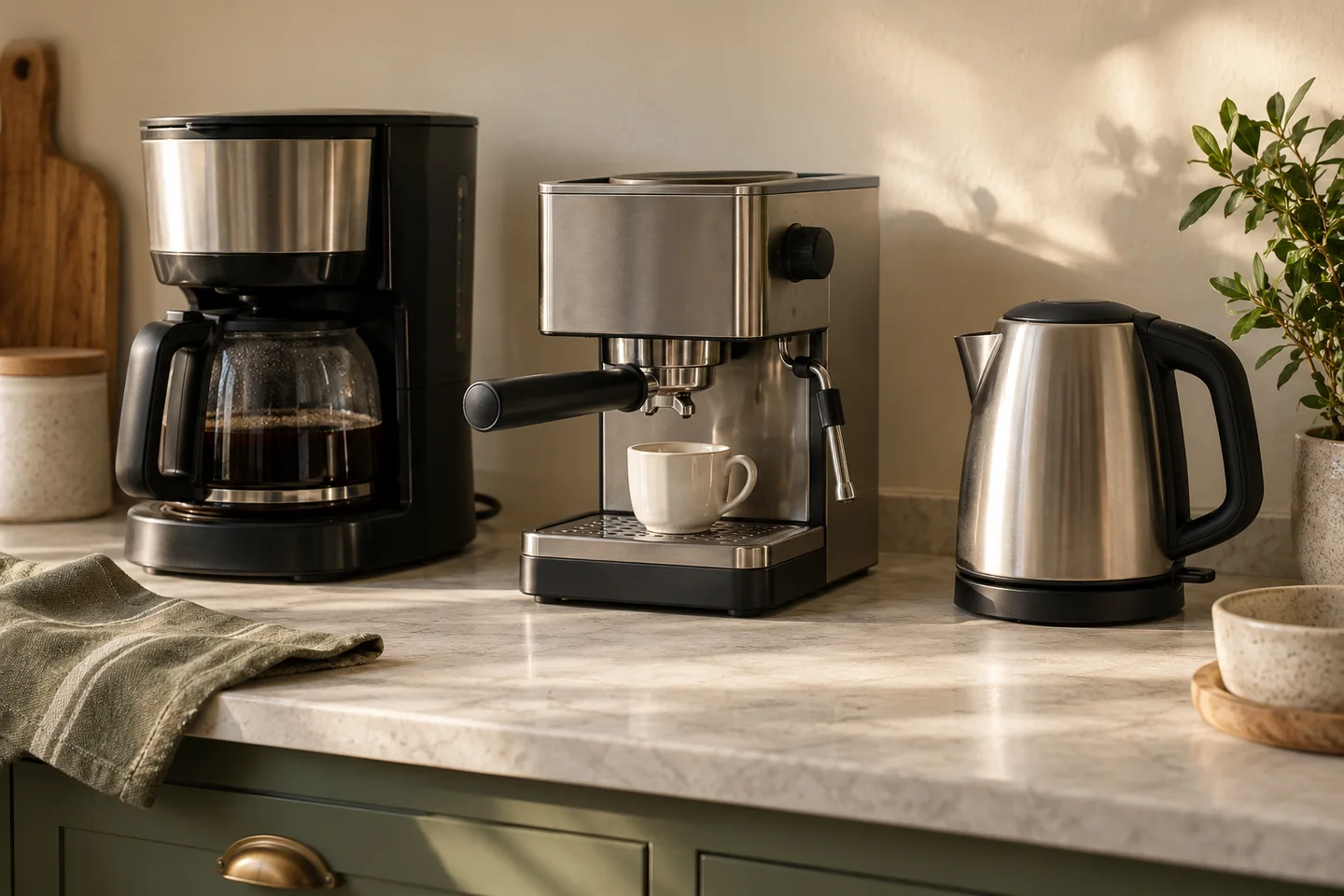
An automatic drip brewer heats water and passes it through ground coffee held in a filter basket. The brewed coffee collects in a carafe or other container. Batch volume and the way finished coffee is held are important differences among designs.
- Useful for: Several cups of filtered coffee in one brewing routine.
- Check: Minimum and maximum brew volumes, filter type, carafe size, and whether a warming plate or insulated carafe holds the finished coffee.
- Tradeoff: Making a batch can be convenient for several drinkers, but the basket, carafe, and water-contact parts still need cleaning.
Pod and capsule brewers
These machines brew from a preportioned coffee pod or capsule rather than requiring the user to measure loose grounds for every cup. The format, extraction method, and available drink sizes depend on the system; a pod brewer is not necessarily an espresso machine.
- Useful for: One drink at a time with little measuring and limited loose-ground handling.
- Check: Pod or capsule compatibility, available beverage sizes, water-tank access, and how spent portions are collected or discarded.
- Tradeoff: The portion format reduces control over coffee dose and grind, and creates a recurring spent-pod or capsule handling task.
Manual and semi-automatic espresso machines
These machines give the user a direct role in preparing the coffee bed and managing extraction. A semi-automatic machine typically uses a pump for brewing, while some manual machines use a hand-operated mechanism. The exact controls vary.
- Useful for: Espresso drinkers who want to adjust coffee dose, grind, tamping, and brewing technique.
- Check: Whether a grinder is included, the control available over brewing, the portafilter and basket arrangement, and how milk is heated or textured if needed.
- Tradeoff: Preparing each coffee bed, removing spent grounds, and cleaning the brewing equipment are part of the routine.
Superautomatic espresso machines
A superautomatic, or bean-to-cup, machine generally grinds beans, prepares the coffee bed, and brews espresso through an internal mechanism after the user selects a drink. Some also dispense or texture milk automatically; others require manual milk preparation.
- Useful for: Repeated espresso-based drinks with fewer hands-on preparation steps.
- Check: Drink adjustments, access to the brew unit if applicable, grounds-bin and drip-tray capacity, and the cleaning process for any milk system.
- Tradeoff: Automation reduces daily dosing and tamping, but it adds internal components that require rinsing, cleaning, and sometimes descaling.
Built-in versus separate coffee grinders
Grind size affects how water moves through coffee and how the drink extracts. Espresso preparation generally needs finer, more adjustable grinding than many filtered brewing methods. Confirm that a grinder's adjustment range suits the method; the word "grinder" alone does not establish espresso suitability.
- Built-in grinder: Keeps grinding and brewing in one appliance, with less equipment to place separately. Adjustment range and cleaning access depend on the machine.
- Separate grinder: Uses extra counter space but can serve different brewers when its grind range is appropriate, and can be maintained or replaced independently.
- No grinder: Pre-ground coffee or a compatible pod system reduces equipment, but offers less control over grind freshness and particle size.
Match the brewer to the daily routine
| Regular coffee routine | Start with | Main question to settle |
|---|---|---|
| Several mugs of filtered coffee at breakfast | Automatic drip brewer | Does the useful batch size and carafe fit the number of drinkers? |
| One cup at a time with minimal measuring | Pod or capsule brewer | Is the portion format compatible with the machine and acceptable to handle afterward? |
| Espresso with hands-on control | Manual or semi-automatic espresso machine and a suitable grinder | Are grinding, coffee-bed preparation, and cleanup welcome parts of the routine? |
| Espresso-based drinks with less manual preparation | Superautomatic espresso machine | How will the brew mechanism, drip tray, and milk path be cleaned? |
| Filtered coffee and espresso made with the same beans | Separate adjustable grinder, if its range supports both | Can it switch between the needed grind settings without excessive adjustment and cleanup? |
Maintenance: Follow the machine's instructions for cleaning coffee-contact parts, descaling when required, and cleaning milk-contact components promptly. An automatic rinse is not a substitute for every required cleaning step.
Refrigerators, freezers, and beverage coolers
The deciding question is what must be stored, not simply how cold the cabinet feels. A refrigerator holds perishable food at 40°F (4°C) or below; a freezer is intended to maintain 0°F (-18°C) or below for frozen storage. Beverage and wine coolers are designed around drinks and may operate at warmer temperatures. Before using any cooler for milk, leftovers, or other perishables, confirm that its intended use and measured temperature meet food-storage needs.
Refrigerators and refrigerator-freezers
A refrigerator keeps fresh food chilled for near-term use. A refrigerator-freezer combines a fresh-food compartment with a separate frozen-food compartment, while an all-refrigerator devotes its storage space to chilling rather than freezing.
- Useful for: Produce, dairy products, raw ingredients, cooked leftovers, and other foods that require refrigeration.
- Check: Usable shelf and drawer space, the actual fresh-food temperature, door clearance, and whether a true freezer compartment is included.
- Tradeoff: A compact refrigerator saves floor space, but small shelves or an internal ice compartment may not accommodate the food containers or frozen-food load you expect.
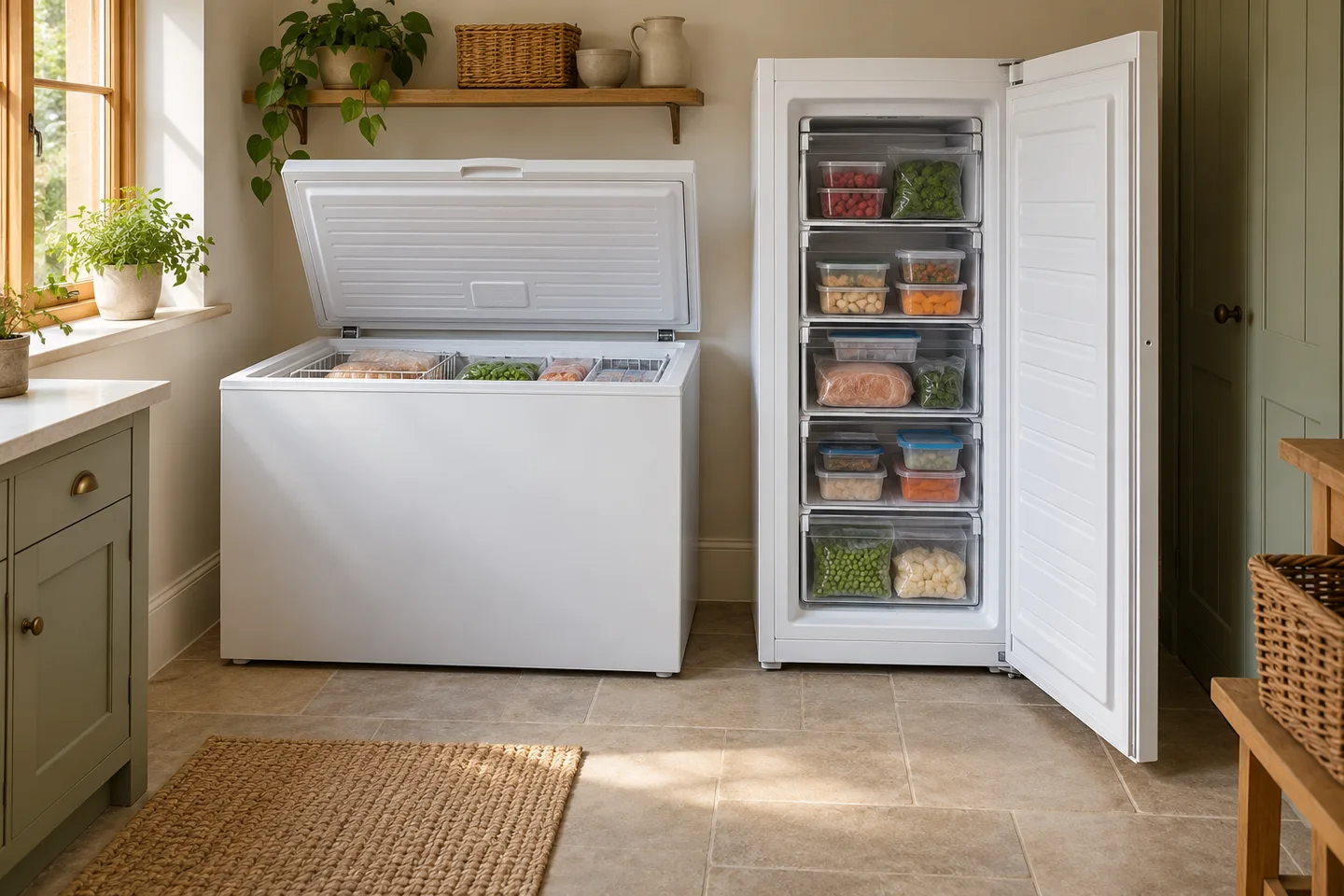
Dedicated freezers: chest and upright
A dedicated freezer is the relevant category when the main need is additional frozen-food storage. Chest freezers open from above and usually use open bins or baskets. Upright freezers have front-opening doors with shelves or drawers that make individual packages easier to reach.
- Chest freezer: Useful for bulky packages and larger quantities of frozen food when there is enough floor space and overhead room to open the lid. Check how baskets divide the usable interior.
- Upright freezer: Useful when visible shelves and front access matter more than a broad bin. Check the depth required for the open door and the usable shelf dimensions.
- Defrost method: Manual-defrost designs require periodic frost removal; automatic-defrost designs manage frost buildup with less manual work. Verify the actual method and follow the care instructions.
Beverage and wine coolers
Beverage coolers and wine chillers typically prioritize bottle or can storage, access, and serving temperature. Some have glass doors or separate temperature zones. Their temperature range and intended contents can differ from those of a food refrigerator.
- Useful for: Keeping a separate supply of sealed drinks or wine at an appropriate serving or storage temperature.
- Check: Temperature range, shelf arrangement for actual container sizes, door-swing space, and whether the manufacturer permits perishable-food storage.
- Tradeoff: A cooler optimized for drinks can free space in the main refrigerator, but it should not be assumed safe for meat, milk, or prepared food merely because the contents feel cold.
Choose by the storage problem
| What needs more space? | Start with | Decisive check |
|---|---|---|
| Fresh groceries and refrigerated leftovers | Refrigerator or all-refrigerator | Can it maintain 40°F (4°C) or below with the intended load? |
| Both fresh and frozen foods in one location | Refrigerator-freezer | Are the fresh-food and freezer compartments each suited to their intended temperatures and loads? |
| Frozen meals, ingredients, or bulk packages | Dedicated chest or upright freezer | Can it maintain 0°F (-18°C) or below, with enough usable space for the package shapes? |
| Cans, bottles, or wine kept separately from groceries | Beverage or wine cooler | Does its temperature range fit the drinks, and is it intended for those contents? |
| Perishable snacks or ingredients in a small room | Compact refrigerator | Verify the actual holding temperature, storage dimensions, and installation requirements. |
Three checks that prevent a poor fit
- Measure the contents and the opening. Compare shelf width, drawer depth, bottle height, door swing, and lid-opening clearance. Total capacity alone does not describe the shapes that fit.
- Check the installation conditions. Confirm ventilation clearances, power requirements, and the room-temperature range permitted by the appliance instructions, especially for an unheated garage or another variable-temperature space.
- Verify the temperature after setup. Use an appliance thermometer rather than relying only on a numbered control setting. Keep airflow paths clear, clean spills and door seals, and defrost manually when required.
Food safety: Do not use a beverage cooler as a substitute for a food refrigerator unless it is intended for that use and consistently maintains a safe refrigeration temperature. Freezing slows deterioration but does not make contaminated food safe.
Cooktop technologies and dishwashing methods
Choose a cooktop by how it heats the pan, which cookware it accepts, and the kitchen's available utilities. Induction needs compatible magnetic cookware; conventional electric elements heat cookware through a hot element or surface; gas burners use a flame. For cleanup, the central choice is between a permanently installed dishwasher, a portable or countertop unit, and hand washing. Dish volume, water and drain access, and the items being cleaned determine which method fits.
Induction cooktops
An induction element creates an electromagnetic field that heats a compatible pan directly. The glass surface can still become hot from contact with the heated cookware, even though the element does not heat the glass in the same way as a radiant burner.
- Useful for: Cooking with responsive heat adjustments when compatible pots and pans are available.
- Check: Whether a magnet sticks firmly to the flat cookware base, the cooking-zone size, control layout, and electrical connection requirements.
- Tradeoff: Cookware without a suitable magnetic base will not work directly. A smooth glass top is also vulnerable to impacts and abrasive cleaning.
Radiant and exposed-coil electric cooktops
Conventional electric cooktops use resistance heating. A radiant smooth-top design places its heating element beneath a glass-ceramic surface; an exposed-coil design heats cookware on an accessible metal coil. Neither should be confused with induction merely because an appliance has a flat glass top.
- Useful for: Cooking with a broad range of stable, appropriately sized pans without an induction-compatibility requirement.
- Check: Pan-bottom flatness, burner dimensions, hot-surface indicators, and the cleaning access around coils or beneath a smooth surface.
- Tradeoff: Elements and surrounding surfaces retain heat after switching off, so spill cleanup and safe handling must wait for cooling.
Gas cooktops
Gas burners deliver heat from a visible flame beneath the pan. They do not require a magnetic cookware base, but their installation depends on an appropriate gas supply, compatible connections, and safe ventilation.
- Useful for: Kitchens already equipped for gas and cooks accustomed to adjusting a visible flame.
- Check: Burner and grate stability for the intended cookware, ignition arrangement, gas installation requirements, and exhaust ventilation to the outdoors.
- Tradeoff: Grates and burner parts require cleaning, and burning gas creates indoor combustion pollutants. Proper ventilation and maintenance are important.
Which cooktop constraint matters most?
| Kitchen constraint | Start by comparing | Verify before deciding |
|---|---|---|
| You want to retain nonmagnetic cookware | Gas or conventional electric | Pan stability and fit, plus the available fuel or electrical connection |
| You want a smooth surface and already own magnetic-base pans | Induction and radiant smooth-top | Heating mechanism, cookware compatibility, hot-surface behavior, and electrical requirements |
| You need one supplemental burner without changing the main range | Portable electric or induction cooktop | Outlet and circuit suitability, counter clearance, and cookware fit |
| You are replacing an installed gas cooktop | Gas and electric alternatives | Existing connections, ventilation, cutout dimensions, and any required professional work |
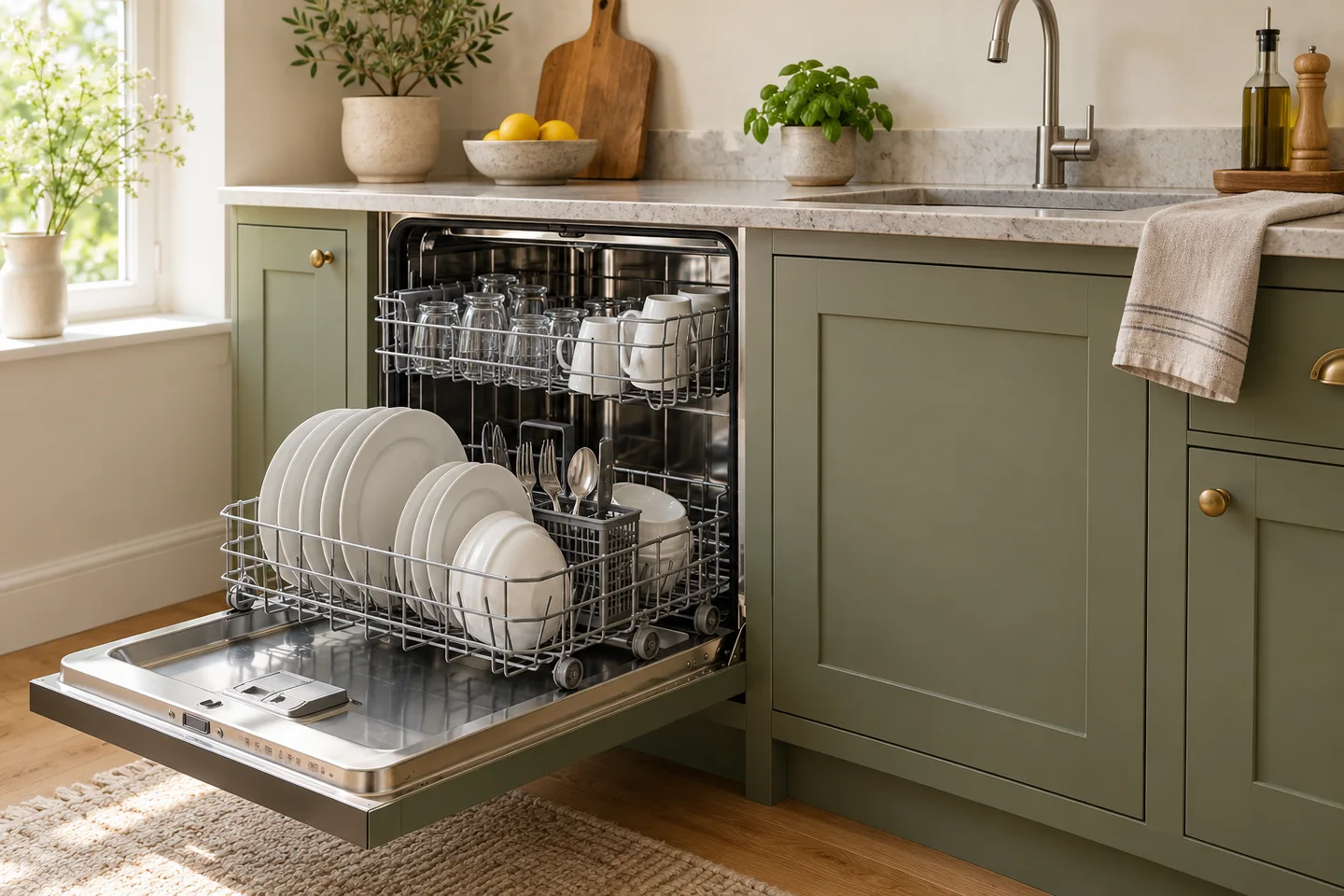
Built-in dishwashers
A built-in dishwasher sits in a dedicated cabinet opening and connects to the home's water supply, drain, and power. It washes with detergent and circulating spray water, then drains and rinses the load. Drying methods and rack layouts vary.
- Useful for: Recurring loads of everyday dishwasher-safe dishes, glasses, utensils, and cookware.
- Check: Cabinet opening, plumbing and electrical connections, rack clearance for tall items, and available wash and drying cycles.
- Tradeoff: Installation commits cabinet space and requires suitable utility connections. Oversized or dishwasher-unsafe items still need another cleaning method.
Portable and countertop dishwashers
Portable dishwashers offer mechanical dishwashing without the same permanent under-counter installation. Some wheeled units connect temporarily to a compatible sink faucet; countertop designs use a smaller footprint but have their own water, drainage, and placement requirements.
- Useful for: Kitchens without a conventional built-in dishwasher opening or households with smaller dish loads.
- Check: Faucet or supply compatibility, drain arrangement, where the appliance sits during use, and whether plates, pans, and glasses fit the racks.
- Tradeoff: Smaller racks may require additional cycles, and temporary hose connections or counter placement can interfere with normal sink use.
Hand washing
Hand washing leaves cleaning, rinsing, and drying under the user's direct control. It remains useful when an item is not labeled dishwasher-safe or is too large or unusually shaped for the available racks.
- Useful for: Delicate or restricted-care items, irregularly shaped utensils, and occasional small loads.
- Check: The item's cleaning instructions, access to clean water and a suitable drying area, and whether a basin can be used instead of continuous running water.
- Tradeoff: Cleaning effort scales with the number and condition of the items. A dishwasher may better suit frequent full loads if installation and dishware allow it.
Match the dishwashing method to the load
| Routine | Start with | Main limitation to resolve |
|---|---|---|
| Everyday plates and utensils build up across meals | Built-in dishwasher | Rack capacity, plumbing, cabinet fit, and which items are dishwasher-safe |
| Small recurring loads in a kitchen without a dishwasher opening | Portable or countertop dishwasher | Faucet, water-fill, drain, and placement requirements vary by design |
| Only a few pieces need cleaning, or they require special care | Hand washing | Follow the material's care instructions and manage water use |
| A mix of dishwasher-safe dishes and delicate tools | Dishwasher plus hand washing for exceptions | Separate items by their care restrictions instead of forcing everything into one cycle |
Practical safety: Use an outdoor-venting range hood when available, including during electric cooking, which also produces cooking fumes. For automatic dishwashers, use detergent intended for dishwashers rather than ordinary liquid dish soap.
Appliance combinations for small kitchens, new homes, and batch cooking
A useful appliance combination handles different parts of a routine without competing for the same counter space and storage. In a small kitchen, one adaptable cooking appliance may be more useful than several devices with overlapping presets. In a newly equipped kitchen, reliable food storage, a practical heat source, and a workable cleanup method come before specialized tasks. For batch cooking, the limiting factor may be pan area, cooking-vessel capacity, or safe space for cooling and storing finished food.
Small kitchens: cover distinct cooking tasks
First identify the cooking method already available. A toaster oven or countertop convection oven can handle toast, small pans, and some crisping tasks; a separate basket air fryer makes more sense if its basket shape and airflow serve a frequent, different routine. Neither automatically replaces a cooktop for pan-based cooking.
- If counter space is tight: Compare one appliance's real pan or vessel dimensions with the foods you make before adding a second appliance with similar modes.
- If one-pot meals dominate: A multi-cooker may consolidate rice, simmering, sauteing, and possibly pressure cooking, but confirm each function rather than assuming it from the name.
- If preparation takes most of the time: Choose a blender for smooth liquids or a food processor for repeated chopping and slicing. Their overlap on dips does not make their main jobs identical.
- If there is no dishwasher opening: Compare portable or countertop dishwashing with hand washing based on sink connections, actual rack fit, and where the unit will be stored.
New homes: establish the complete routine first
Think in a sequence: store ingredients safely, prepare them, cook, then clean up. A specialized appliance cannot fix a missing step elsewhere in that sequence. The basic combination depends on what is already installed and how often meals are prepared at home.
- Food storage: Confirm a refrigerator that can safely hold perishables and a freezer compartment or separate freezer if frozen food is part of the routine.
- Primary cooking: Match a cooktop and oven, or the available cooking setup, to everyday pans, dishes, and the home's utility connections.
- Preparation and cleanup: Use ordinary knives and cookware for tasks they already handle; add a powered preparation appliance or dishwasher only when the repeated workload and space justify it.
A dedicated bread machine, juicer, espresso system, or additional fryer becomes easier to evaluate after the household's actual habits are clear. Each solves a narrower job than food storage or primary cooking.
Batch cooking: match the batch to the storage plan
Batch cooking needs enough cooking capacity and a safe way to handle finished portions. For tray meals and casseroles, usable oven racks and pan area matter. For beans, soups, and stews, a pressure cooker or slow cooker may suit the recipe and schedule; its stated vessel volume is not necessarily its allowable working fill level.
- Dry-heat batches: Compare the number and dimensions of pans that fit in the oven. Several crowded small batches can defeat the purpose of preparing food ahead.
- Moist one-pot batches: Compare usable vessel fill, required liquid, and the total heating, cooking, and release or cooling time for the chosen method.
- Freezer-bound meals: Make sure the refrigerator and freezer have room for portioned containers rather than relying only on total advertised capacity.
- Repeated ingredient prep: A food processor can complement a cooker when chopping and slicing are the recurring bottleneck, but it does not increase the cooker's capacity.
Divide cooked food into shallow containers and refrigerate or freeze it promptly. Reheat leftovers to 165°F (74°C) as measured with a food thermometer; do not rely on a slow cooker to reheat refrigerated leftovers safely.
When two appliances genuinely complement each other
| Tasks repeated in the same household | Combination that can make sense | When the second appliance adds little |
|---|---|---|
| Crisp individual portions and bake food in flat pans | Basket air fryer plus an oven or toaster oven | The existing convection oven already handles the usual portions and shapes well |
| Cook rice while preparing a separate pressure-cooked main dish | Dedicated rice cooker plus pressure cooker or pressure multi-cooker | Only one moist dish is normally cooked at a time and the multi-cooker handles the rice adequately |
| Make smooth drinks and prepare sliced or shredded vegetables | Blender plus food processor | Nearly all preparation is pureeing rather than cutting distinct pieces |
| Knead dough and sometimes run a complete bread-making program | Stand mixer plus bread machine | The household needs only one of those two dough workflows |
| Serve batch filtered coffee and make espresso drinks | Drip brewer plus espresso machine | One drink style meets nearly every daily need |
| Prepare large quantities of frozen meals | Appropriate cooking equipment plus added freezer capacity | The current freezer already fits the portioned meals and maintains the required temperature |
Find the real bottleneck before adding another device
- Walk through a common meal. Identify whether the delay is chopping, cooking space, active attention, cooling, storage, or washing up.
- Check for simultaneous tasks. Two appliances may be justified when they handle different foods at the same time, even if their functions overlap on paper.
- Account for the reset. Extra bowls, baskets, lids, filters, and attachments need cleaning and storage between uses. A second machine is helpful only if its distinct output or parallel workflow earns that work.
What to verify before choosing between appliance families
Use the food, drink, or cleanup task as the common reference, then compare specifications within their stated conditions. A cooker's vessel volume, an oven's chamber capacity, and a dishwasher's place settings describe different kinds of space. Electrical wattage alone does not establish cooking speed or food quality. An energy label can help compare similar eligible appliances, but it does not establish which unrelated appliance completes a particular kitchen task with less energy.
The final six checks
- Confirm the result and mechanism. Decide whether the task needs crisping, baking, simmering, pressure cooking, chopping, pureeing, brewing, chilling, or washing. A shared program name does not ensure the same method or result.
- Measure the working fit. Compare the largest pan, portion, bottle, loaf, or dish you actually use with the appliance's usable interior dimensions. Also measure installation space, ventilation clearance, doors, lids, and access to removable parts.
- Translate capacity into real loads. Check whether the listed volume refers to an empty chamber, a basket, a maximum vessel fill, uncooked rice, or a number of place settings. Confirm minimum and maximum loads for the intended operation.
- Match connections and compatibility. Check electrical voltage and circuit needs, gas and ventilation requirements, water supply and drain access, and any necessary magnetic cookware, filters, accessories, or compatible capsules.
- Count the whole cycle. Include preparation, preheating or pressurizing, cooking or washing, resting or pressure release, unloading, and cleanup. An automated step may still require substantial work before or afterward.
- Check safety and maintenance limits. Verify the appliance's intended use, food-safe storage or cooking temperatures where relevant, cleaning instructions, replacement parts, and any restrictions on continuous operation or particular ingredients.
What common specifications and labels establish
| Specification or label | What it can tell you | What it cannot establish by itself |
|---|---|---|
| External width, depth, and height | Whether the appliance can enter and occupy a space | Usable pan fit, open-door clearance, or ventilation needs |
| Basket, bowl, chamber, or storage volume | A defined physical capacity | How much food can be cooked evenly or safely loaded in one batch |
| Number of place settings | A dishwasher's nominal dish-capacity class | Whether your largest plates, pans, and glasses fit its particular racks |
| Electrical watts, volts, and amps | Rated electrical input or installation requirements, depending on the label | Real meal time, finished texture, or suitability of every household circuit |
| EnergyGuide label, where required | Estimated annual energy use and an operating-cost comparison with similar appliances | Your exact electricity bill or a fair energy-per-meal ranking across different appliance families |
| ENERGY STAR certification, where available | Compliance with the program's applicable efficiency criteria for that product category | A universal performance ranking or proof that the appliance suits a different task |
Short answers to close decisions
If two appliances list the same mode, will they produce the same result?
Not necessarily. Compare the actual heating, cutting, or extraction mechanism and the shape of the working area. An oven's air-fry setting and a basket air fryer may overlap, but airflow and usable food area still affect what fits and how a batch cooks.
Can a compact appliance replace a full-size one?
Only when it accommodates the foods, cookware, and frequency of use that matter to you. A compact oven may cover daily toast and small baking, but cannot be assumed to fit large pans. A compact refrigerator or dishwasher must also meet the relevant temperature or dish-load requirements.
Does more automation always mean less work?
No. A bread machine can complete a loaf program, and a superautomatic espresso machine can simplify drink preparation, but both still need loading, cleaning, and upkeep. Compare the full routine, not just the number of buttons pressed.