Cooking Appliances: Types, Heating Methods, and Practical Selection
Cooking appliances differ in how they deliver heat, what they can hold, and how much control they give the cook. This guide explains the major household and countertop types, the properties that matter for different cooking tasks, and the practical limits of each approach.
What Counts as a Cooking Appliance?
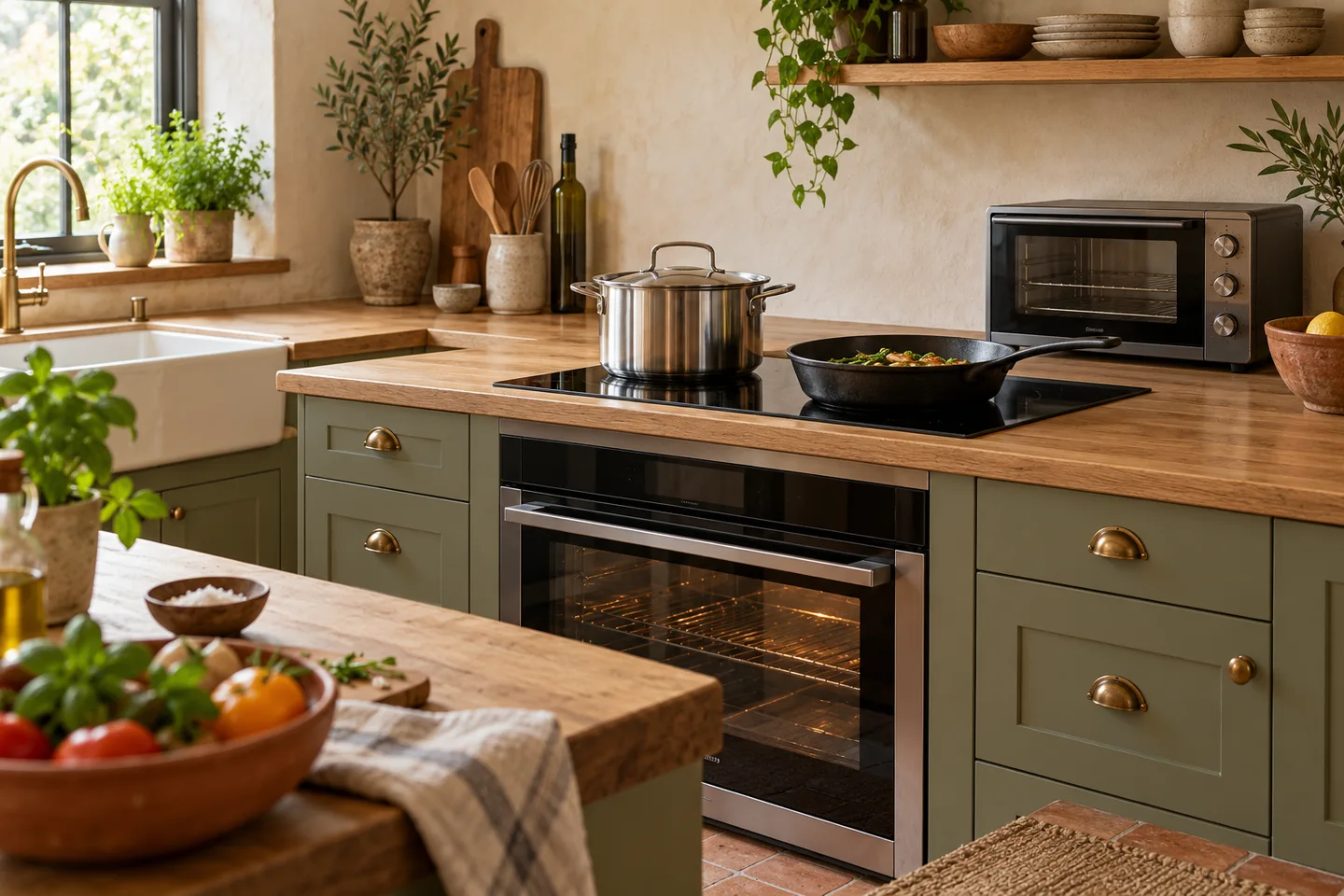
A cooking appliance is a purpose-built piece of equipment that supplies heat to food or cookware as part of cooking. The category includes cooktops, ovens, grills, microwaves, and countertop cookers. The most useful starting distinction is the cooking environment: an open heated surface, an enclosed hot chamber, a pot containing liquid or steam, or microwave energy absorbed by food. These approaches produce different results and cannot always replace one another.
| Cooking approach | How food is heated | Common appliance types | Typical tasks |
|---|---|---|---|
| Heated cookware or cooking surface | A flame, electric element, or induction-heated pan transfers heat to food | Cooktops, electric skillets, griddles | Boiling, simmering, sauteing, pan-searing |
| Enclosed dry heat | Hot air, heated surfaces, and sometimes a fan surround the food | Full-size ovens, countertop ovens, air fryers | Baking, roasting, crisping |
| Contained moist heat | Hot liquid or steam transfers heat inside a vessel; some appliances also use pressure | Slow cookers, pressure cookers, rice cookers, steamers | Stewing, braising, steaming, cooking grains |
| Microwave heating | Microwave energy is absorbed by food and converted to heat | Microwave ovens | Reheating, defrosting, cooking moisture-rich foods |
| Direct grilling or broiling heat | Intense radiant heat reaches the food, sometimes with added heat from a grate | Grills, oven broilers | Browning, grilling, broiling |
One appliance can perform several jobs
A range combines a cooktop and an oven. An electric multicooker may saute food before pressure cooking it, while a countertop oven may offer convection baking and an air-fry setting. These combinations save space, but a shared name or program does not mean two devices have the same capacity, airflow, heat distribution, or controls.
Cooking equipment versus food-prep tools
Pots, pans, and baking sheets hold or transfer heat but do not generate it on their own. Kitchen appliances such as blenders, mixers, and food processors mainly prepare ingredients rather than cook them, unless they have an active heating function. Cookware still matters because its material, shape, and compatibility can determine whether a heating appliance works as intended.
How Cooking Appliances Transfer Heat
Heat reaches food through conduction (direct contact), convection (moving air or liquid), and thermal radiation from hot surfaces or flames. Most cooking appliances use more than one of these pathways. Induction first generates heat in compatible cookware, while microwaves deposit energy within the food. Pressure cooking is different again: it raises the boiling temperature of water rather than creating a separate kind of heat.
Conduction: heat through contact
Conduction moves heat between touching materials and through the food itself. In a skillet, heat travels through the metal and into the food where it contacts the pan. The center of a thick piece of food also warms partly by conduction from its hotter outer layers.
- Where it matters: Pan-searing, griddling, and heat spreading through cookware.
- Practical limit: Uneven pan contact can create uneven surface browning, even when the burner setting stays constant.
Convection: heat carried by moving air or liquid
Convection transfers heat through moving fluids, including air, water, and steam. An oven fan circulates hot air around food; simmering water and steam carry heat through a covered cooker. An air fryer's concentrated airflow is a form of forced convection, not immersion in frying oil.
- Where it matters: Convection baking, air frying, boiling, steaming, and moist-heat cooking.
- Practical limit: Crowding a cooking chamber or basket can obstruct airflow and make heating less even.
Thermal radiation: heat from hot surfaces
Thermal radiation carries energy from a hot element, flame, or oven wall toward food without requiring contact. Broiling and direct grilling make strong use of this pathway, while ordinary ovens also expose food to radiant heat from their hot interiors. Once the surface heats, energy continues moving toward the center of the food.
- Where it matters: Broiling, grilling, roasting, and surface browning.
- Practical limit: A browned exterior does not establish that the center has reached the required cooking temperature.
Induction: heat generated in the cookware
An induction cooktop produces a changing magnetic field that generates heat in a compatible pan. The pan then cooks food by the familiar contact and liquid-heating pathways. Induction is therefore a way of heating cookware, not a microwave method of heating food directly.
- Where it matters: Responsive pan-based cooking with a suitable magnetic cookware base.
- Practical limit: Not every metal pan is compatible, and the cooking surface can remain hot after use because of heat transferred back from the pan.
Microwaves: energy absorbed by food
Microwave ovens use electromagnetic energy absorbed by food, producing heat without first warming an entire oven chamber in the same way as a conventional oven. They do not cook food from the inside out. In thick portions, heat still travels inward from warmer regions, and uneven heating is possible.
- Where it matters: Reheating, defrosting, and cooking foods that heat well by microwave absorption.
- Practical limit: Stirring or rotating food and allowing standing time help redistribute heat; a food thermometer is still needed when a safe internal temperature matters.
Pressure: a change in cooking conditions
A sealed pressure cooker traps steam and raises the pressure inside the vessel. Water can then boil at a higher temperature than it does in an open pot, allowing many moist-heat dishes to cook faster. Heat still moves through hot liquid, steam, and contact with the vessel.
Key distinction: Gas combustion and electric resistance describe how an appliance produces heat. Conduction, convection, and radiation describe how heat travels. Pressure describes the conditions in which cooking takes place. These terms are related, but they are not interchangeable.
Cooktops, Griddles, and Grills
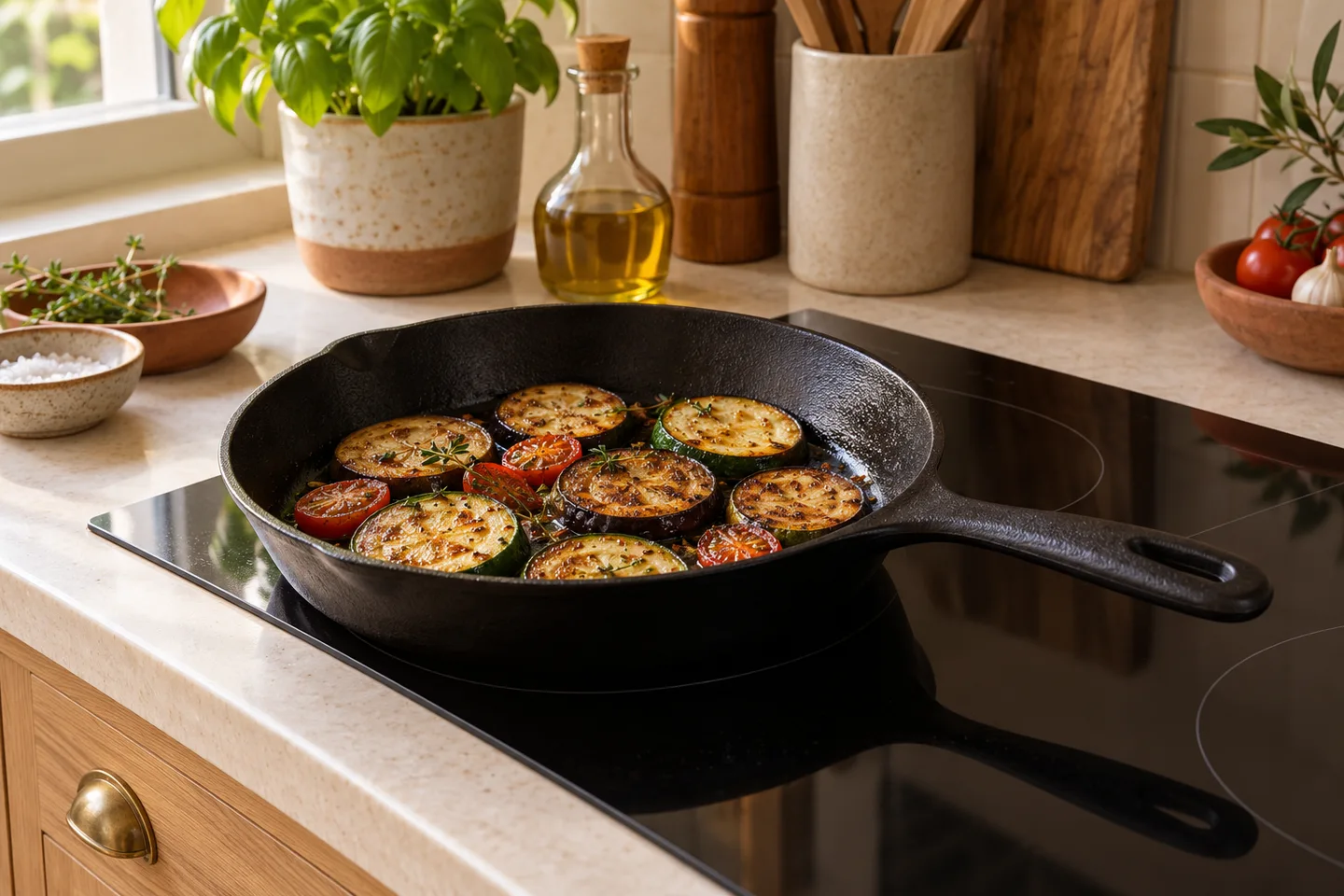
Cooktops heat separate pots and pans, making them flexible for boiling, simmering, sauteing, and pan-searing. A griddle provides a broad, flat surface for cooking food directly; an electric skillet adds raised sides and often a lid. Grills expose food to direct heat or heated plates, making them useful for surface browning. The best fit depends on whether the task needs a vessel, a flat contact area, or an open grilling surface.
Four common cooktop technologies
The cooktop's heat source affects cookware compatibility, how quickly heat changes reach the pan, and how much heat remains at the surface after cooking.
| Cooktop type | Where heat is produced | Cookware requirement | Main tradeoff |
|---|---|---|---|
| Gas burner | At an open flame beneath the pan | A stable, flame-safe pot or pan that fits the grate | Flame responds to control changes, but fuel combustion adds indoor air pollutants and calls for effective ventilation |
| Exposed electric coil | In a resistance-heated metal element | A stable pan with good contact over the coil | The element remains hot after power is reduced or switched off |
| Smooth-top radiant electric | In a resistance element beneath a glass-ceramic surface | A suitable flat-bottomed pan and surface-safe material | The smooth surface is easy to wipe, but retained heat delays cooling and can bake on spills |
| Induction | In compatible cookware energized by a magnetic field | A sufficiently flat, induction-compatible magnetic base | Heating can respond quickly, but unsuitable pans will not heat as intended |
Flat electric griddles
An electric griddle contains a heated plate that food touches directly. Its broad, usually low-sided surface works for pancakes, eggs, toasted sandwiches, and batches of small portions without separate pans.
- Useful feature: Cooking space is measured by usable plate area, not pot capacity.
- Check: Heating may vary across the plate, and adding cold food can temporarily lower its surface temperature.
Electric skillets
An electric skillet combines a heated pan with its own temperature control. Raised sides make it more suitable than a flat griddle for shallow liquids, covered cooking, and dishes that begin with browning and finish with simmering.
- Useful feature: A lid, when supplied, helps retain heat and moisture.
- Check: The pan's usable depth and the manufacturer's permitted liquid or oil level matter as much as its surface diameter.
Contact grills
Electric contact grills cook food against one or two heated plates, often with ridges and a hinged upper plate. Double-sided contact can be convenient for pressed sandwiches and appropriately sized portions of meat or vegetables.
- Useful feature: Direct plate contact creates localized browning without requiring an open flame.
- Check: Food thickness and plate contact affect results; grill marks alone do not establish safe internal doneness.
Outdoor gas and charcoal grills
Outdoor grills cook over a gas flame or hot charcoal, using radiant heat and often a heated grate. Food may sit directly above the heat source for browning or away from it for slower indirect cooking. A lid can turn the grill into a partly enclosed cooking environment.
- Useful feature: Direct and indirect heat zones support different cooking stages.
- Check: Fuel handling, clearance from combustible materials, and outdoor placement are fundamental operating requirements.
Important: Never operate a charcoal or outdoor gas grill inside a home, garage, tent, or other enclosed space. Burning fuel can produce deadly carbon monoxide.
Ovens, Air Fryers, and Microwaves
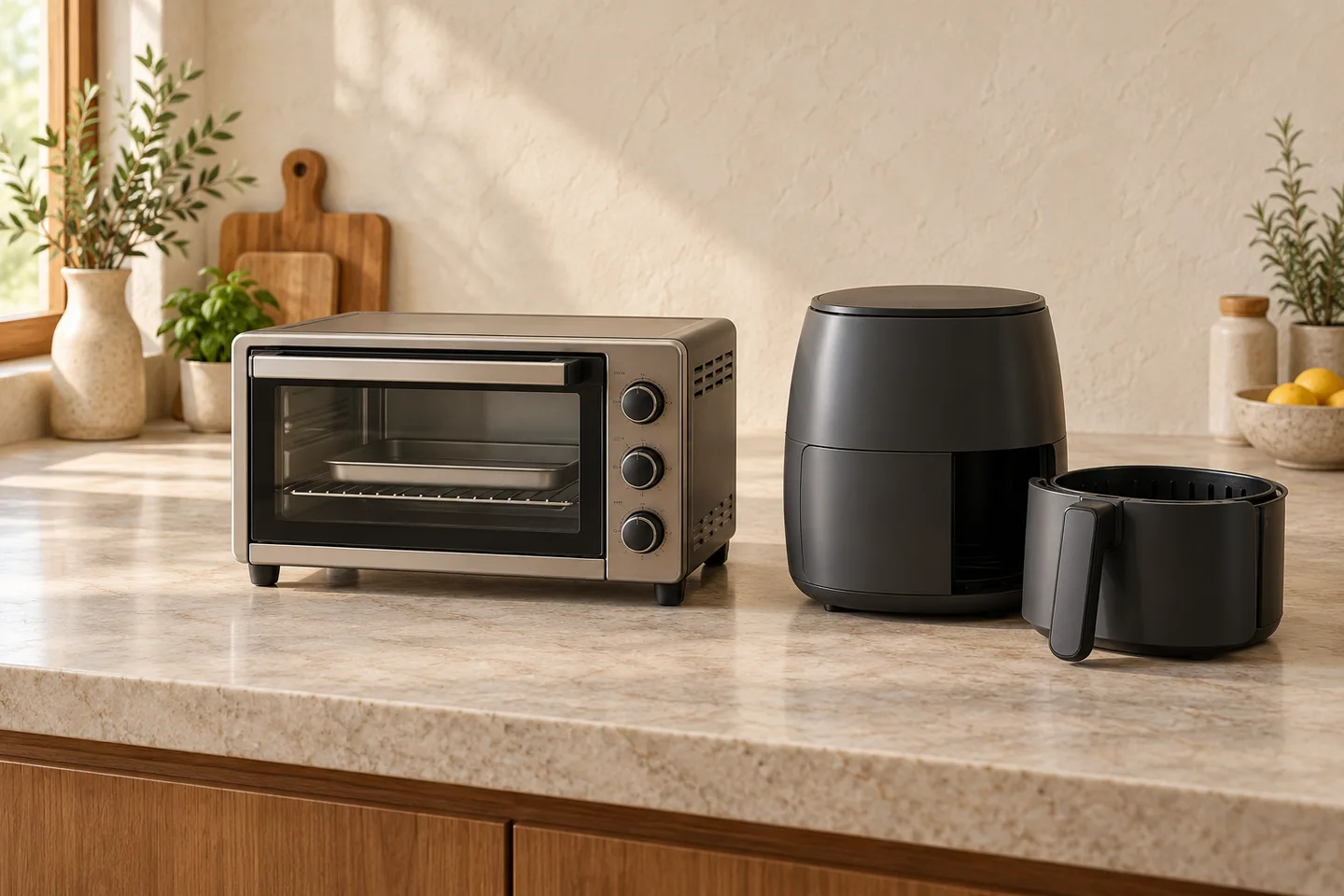
Conventional ovens and air fryers cook food in heated chambers, while microwave ovens heat food through absorbed electromagnetic energy. Dry-heat ovens are suited to baking, roasting, and browning; microwaves are particularly useful for reheating and defrosting. The main differences are how heat reaches the food, how much can fit without obstructing circulation, and which containers are safe for the selected cooking mode.
| Appliance type | Main heating method | Well-suited tasks | Important limitation |
|---|---|---|---|
| Conventional full-size oven | Hot surfaces, radiant heat, and air circulation from gas or electric heating | Baking, roasting, large pans and multiple dishes | Preheating, rack position, and chamber temperature affect results |
| Fan convection oven | Oven heat combined with forced air circulation | Baking or roasting where airflow around food is useful | Recipes and pan placement may need adjustment for the moving air |
| Countertop or toaster oven | Electric elements heat a smaller chamber; some also have a fan | Toasting, small bakes, reheating, compact roasting | Tray width, cavity height, and required exterior clearances restrict use |
| Air fryer | Heating element and concentrated forced hot air in a compact chamber | Crisping and roasting exposed small portions | Crowded baskets or trays can interfere with airflow and even cooking |
| Microwave oven | Microwave energy absorbed by food | Reheating, defrosting, cooking moisture-rich dishes | Heating can be uneven, and dry surface browning is generally limited |
| Microwave-convection combination | Microwave heating, convection heating, or both, depending on the setting | Reheating and oven-style cooking in one appliance | Permitted cookware and accessories change with the active mode |
Conventional versus fan convection ovens
A conventional oven cooks through a combination of radiant heat, hot surfaces, and natural air movement. A convection setting adds a fan to move hot air around the food. That can change browning, moisture loss, and cooking time, but it does not make every recipe automatically faster or more even. Pan spacing, rack position, and the oven's actual temperature still matter.
Countertop ovens and usable space
Countertop ovens use a smaller heated compartment for tasks that do not require a full-size oven. Some operate mainly as toaster ovens, while others add convection or broiling modes. A stated cavity volume does not guarantee that a particular baking dish will fit: interior width, depth, rack spacing, door clearance, and the required gap around food all matter. The appliance also needs the exterior ventilation clearance specified in its instructions.
Air fryers are compact convection ovens
Air frying circulates hot air around food instead of submerging it in frying oil. Its main distinction from a larger convection oven is the compact cooking space and how the basket or trays expose food to moving air. Small, separated portions can brown and crisp well; tightly packed food may cook unevenly. Some devices offer an air-fry program inside an oven-style chamber, so the label alone does not establish a particular airflow or batch capacity.
Microwaves heat differently from dry-heat ovens
Microwave energy is absorbed by food and converted to heat. This is useful for many moist foods, but a microwave-only setting generally does not create the same dry, browned exterior as roasting or broiling. Hot and cold spots can occur, especially in thick or irregular portions. Arrange food evenly, stir or turn it when possible, allow the instructed standing time, and check the internal temperature when food safety requires it.
Combination modes require different cookware rules
A microwave-convection appliance may provide microwave-only, convection-only, and combined cooking programs. A metal baking pan that is suitable in a convection-only setting may be unsafe in a mode that uses microwaves. Use only the cookware, racks, and trays permitted for the active program; do not assume that an accessory approved for one mode is approved for all of them.
Slow Cookers, Pressure Cookers, Rice Cookers, and Steamers
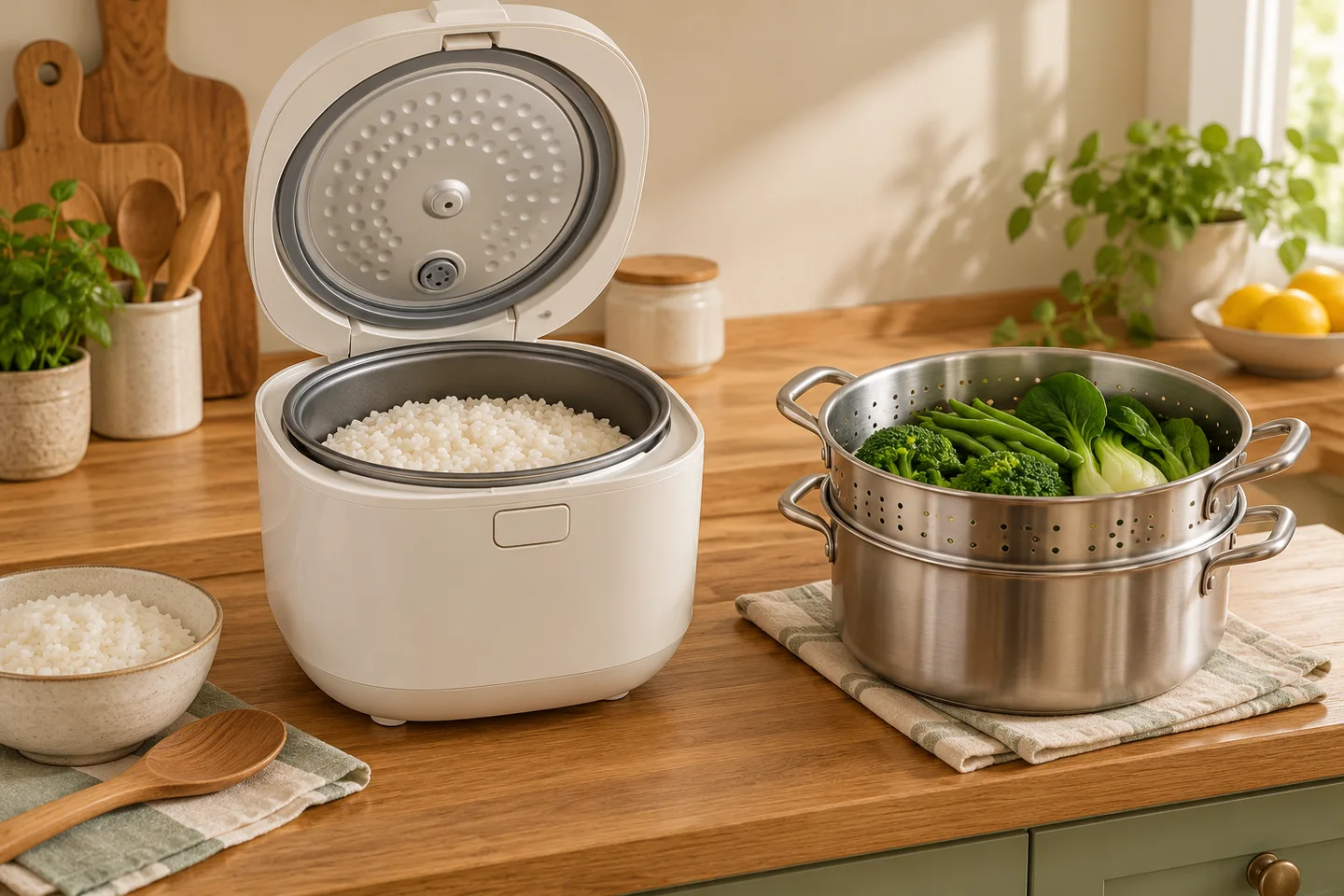
These appliances all make use of water or steam, but they control cooking in different ways. Slow cookers apply gentle heat over a long period; pressure cookers raise the boiling temperature inside a sealed vessel; rice cookers regulate a grain-and-water cooking cycle; and steamers surround food with vapor rather than submerging it. The distinctions matter for texture, timing, liquid requirements, and safe operation.
Slow cookers: covered cooking over time
A slow cooker heats a covered inner vessel and retains moisture during a long cooking cycle. It suits soups, stews, braised dishes, and other foods that benefit from gradual cooking without constant stirring. Low and high settings affect the cooking time, but both are cooking settings when used according to the recipe and appliance instructions.
- Use: Moist dishes with a suitable amount of liquid and ingredients sized for the cooker.
- Check: Thaw raw meat and poultry before slow cooking. A "keep warm" setting is for holding already cooked food hot, not cooking raw ingredients or reheating chilled leftovers.
Pressure cookers: sealed steam at higher temperature
Stovetop and electric pressure cookers trap steam under a secured lid. The increased pressure lets water and steam reach higher cooking temperatures than in an open pot, shortening many moist-heat recipes. This is useful for beans, stocks, tough cuts of meat, and some grains, subject to the recipe.
- Use: Cooking that needs moist heat and can tolerate the appliance's required liquid and sealed environment.
- Check: Follow the fill limit, minimum-liquid instructions, valve position, and prescribed pressure-release method. Never force a pressurized lid open; heat-up and pressure-release time also count toward the total meal time.
Rice cookers: a controlled grain-and-water cycle
A rice cooker heats a removable cooking vessel, usually with a heating plate or induction system. In a basic design, a thermostat detects the temperature rise that follows absorption or evaporation of the cooking water and ends the cooking cycle. More advanced controls adjust heating stages for different grain programs.
- Use: Rice and other grains for which the cooker provides suitable cooking directions.
- Check: Match the grain, water quantity, and program to the instructions. A setting labeled "rice" on a general multicooker does not establish the same cooking sequence as a dedicated rice cooker.
Steamers: food above boiling water
A steamer places food in a basket, tray, or perforated tier above a water reservoir. Steam reaches the food without requiring it to sit in boiling water. A steamer may be a stovetop insert or an electrically heated appliance with its own chamber. Steaming suits vegetables, fish, dumplings, and other foods that do not need a browned crust.
- Use: Portions arranged so steam can circulate around them.
- Check: Keep enough water to avoid running dry, avoid packing the trays tightly, and open the lid away from your face and hands to avoid escaping steam.
Multicookers: shared hardware, different programs
An electric multicooker may combine sauteing, pressure cooking, slow cooking, steaming, and grain programs. These functions use the same vessel but can require different lid positions, heating controls, liquid amounts, and food loads. A list of program names is not proof that each mode reproduces the behavior or capacity of a dedicated appliance.
Important: An electric pressure multicooker is not a substitute for a tested pressure canner for preserving low-acid foods. Pressure-cooking settings do not establish that a canning process will safely heat every jar.
Power, Capacity, and Physical Fit
Power, capacity, and dimensions describe different limits of a cooking appliance. Power ratings identify a rate of energy input or, in some cases, cooking output. Capacity describes a nominal chamber, vessel, or surface. Dimensions determine what fits in the kitchen and inside the cooking area. None of these numbers alone establishes cooking speed, efficiency, or the size of a practical batch.
Decode the specification label
| Specification | Common unit | What it tells you | What it does not tell you |
|---|---|---|---|
| Electrical input or element rating | W or kW | Rated electrical power for the appliance or a specified heating zone | How much heat reaches the food, or whether the element draws that power continuously |
| Gas burner input | Btu/h | Rate of fuel energy supplied to a burner | How much of that heat reaches a pan |
| Microwave cooking output | W | Rated microwave heating output under specified test conditions | The same thing as electrical power drawn from the outlet |
| Electrical energy use | kWh | Total electricity consumed over a period of operation | Instantaneous heating power |
| Oven or microwave cavity volume | cu ft or L | Nominal internal volume | Whether a particular pan, rack arrangement, or tall dish will fit |
| Pot or basket capacity | qt or L | Stated vessel or basket volume | The permitted fill level or a useful single-layer food load |
| Cooking-surface dimensions | in or cm | Width and depth of a plate, grate, or available area | Whether all of that area heats equally or accommodates every pan shape |
| Temperature setting | °F or °C | The selected control target | Exact chamber temperature at every moment or the food's internal temperature |
One kilowatt equals 1,000 watts. A kilowatt-hour measures energy used over time, not a higher level of power. Even when two appliances list the same input wattage, their heating methods, cookware, preheating requirements, and food loads can produce different results. A gas burner rated in Btu/h and an electric element rated in watts cannot be meaningfully compared for cooking performance by converting their input units alone.
Usable capacity depends on the food and vessel
- Ovens and microwaves: Check the usable interior width, depth, and height, not only cubic feet. Allow for rack supports, the door, a microwave turntable, and the space needed around cookware.
- Air fryers and convection baskets: Basket volume does not mean the entire space can be packed with food. Exposed surfaces and airflow often determine an effective batch size.
- Pressure cookers: The cooking vessel's stated volume is not the safe pressure-cooking fill volume. Food type, expansion, foaming, and the required liquid affect permitted loading; follow the appliance's marked limits and instructions.
- Rice cookers: A capacity expressed as rice-cooker cups may refer to the supplied rice measure rather than a standard kitchen measuring cup. Check whether the rating means uncooked rice, cooked rice, or vessel volume.
- Cooktops and griddles: Count usable cooking zones and verify pan diameters and spacing. A wide surface does not necessarily accommodate several large pans at once.
Check the fit before installation or use
- Start with the actual meal. Identify the largest pan, casserole dish, pot, or typical food batch you intend to use. Note handles, lids, and the room needed to turn or stir food.
- Measure the cooking space. Compare that vessel with the appliance's usable interior dimensions, rack positions, door opening, basket geometry, or burner layout. Confirm that it can be inserted and removed safely.
- Measure the appliance in operation. Include external handles, open doors, raised lids, removable pots, and the counter space needed to handle hot contents. The closed appliance's footprint is only a starting point.
- Check clearance and airflow. Follow the appliance's installation instructions for spacing around hot surfaces and vents. Do not assume a countertop cooker can operate in a closed cabinet. For indoor cooking, plan for appropriate kitchen ventilation; an exhaust hood vented outdoors helps remove cooking pollutants.
- Verify the supply connection. Match the nameplate voltage, current or power requirements, plug, and fuel type to the intended location. Check the manufacturer's outlet and circuit instructions; an adapter or extension cord does not correct an unsuitable supply. Gas connections and changes to fixed wiring require appropriately qualified installation.
- Confirm the working load. Compare the intended portions with food-specific fill limits, airflow needs, and any minimum liquid requirement. Where a capacity label is unclear, use the appliance instructions rather than assuming the full volume is usable.
The most useful size is the one that fits the food, the cooking method, and the installation space at the same time.
Cookware, Controls, and Useful Features
Cookware must match both the appliance's heating method and the specific cooking program. A pan that works on a gas burner may not work on induction; a dish approved for microwaving may not withstand broiling. Controls also differ: a temperature setting, food probe, humidity sensor, and timer do not measure or regulate the same thing. Check these functions separately before relying on an appliance's feature list.
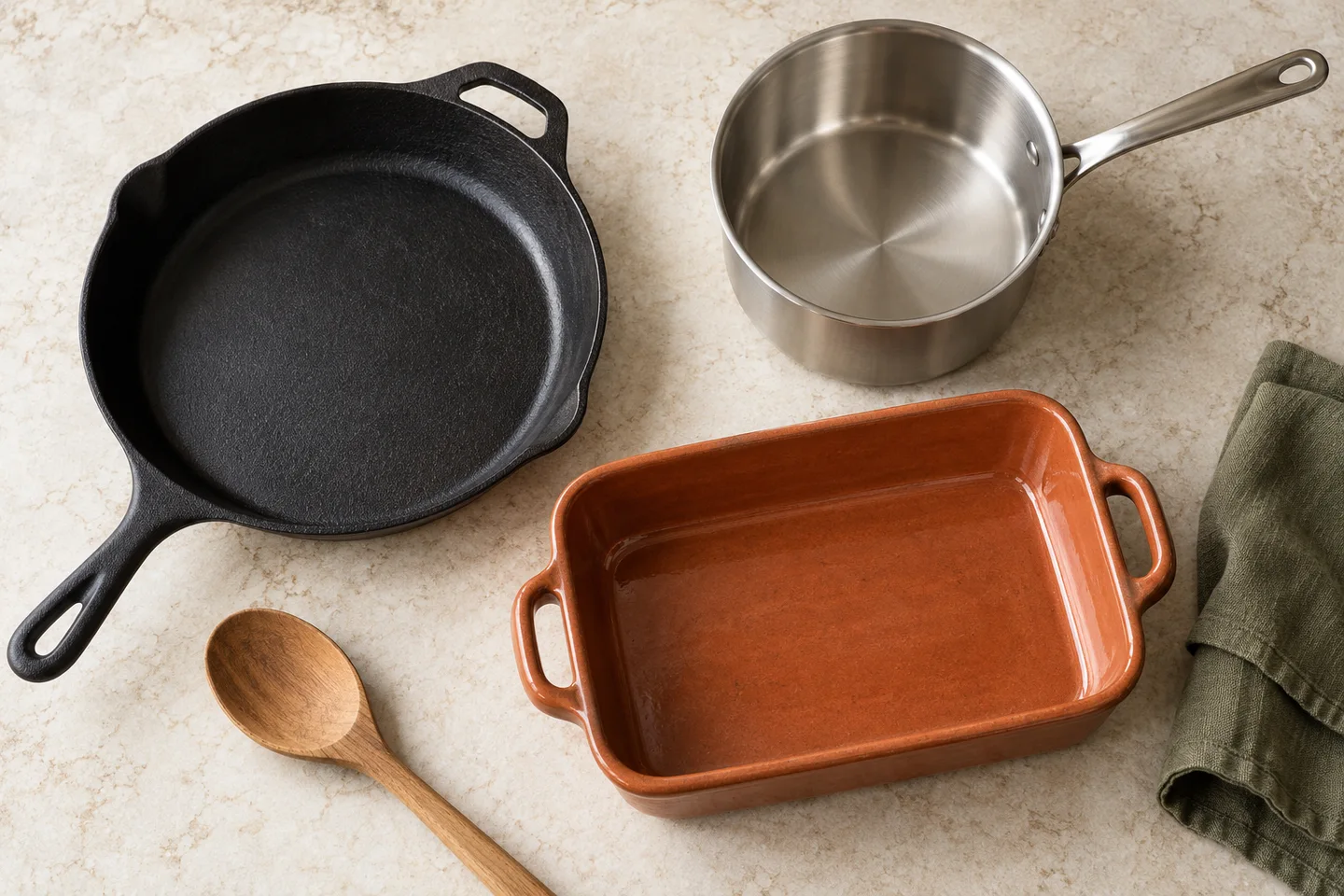
Cookware compatibility at a glance
| Cooking environment | What to use | Main compatibility check |
|---|---|---|
| Gas burner or electric coil | Stable, stovetop-safe pots and pans | Base sits securely on the grate or element; handles and coatings tolerate the heat source |
| Smooth radiant cooktop | Flat-bottom cookware approved for the glass surface | Warped bases lose contact; rough or damaged bottoms can harm the surface |
| Induction cooktop | Cookware with a magnetic base | A magnet holds to the bottom, and the base size and shape suit the cooking zone |
| Conventional, convection, or countertop oven | Bakeware and handles rated for the selected oven temperature and mode | Lids, coatings, and accessories must also be oven-safe; allow the required clearance |
| Microwave-only setting | Containers and accessories specifically approved for microwave use | Metal is generally unsuitable unless the oven instructions expressly permit it; the container must also tolerate heat from the food |
| Air fryer | The supplied basket or compatible heat-safe cookware and accessories | Nothing blocks necessary airflow, and the accessory is approved for that appliance |
| Pressure or rice cooker | The designated inner pot and approved inserts or trivets | Parts fit the heating, lid, steam, and sensing arrangement; fill limits still apply |
Induction compatibility depends on the base
Induction needs a cookware base that responds to a magnetic field. Cast iron, carbon steel, and some stainless steels work; plain aluminum, copper, and glass do not heat directly on induction unless the cookware includes a suitable magnetic base. An enamel or nonstick coating alone does not establish compatibility.
Hold a household magnet against the underside of the pan. If it grips the cooking base, the pan is a potential match. Then check that the base is reasonably flat, the size falls within the cooktop's supported range, and the manufacturer permits that cookware. A magnetic pan that is badly warped or too small for the detection zone may still perform poorly or fail to activate heating.
What cooking controls actually do
| Control or feature | What it manages or senses | What not to assume |
|---|---|---|
| Power-level knob or touch setting | Adjusts energy delivered to a heater or cooking zone | A numbered level represents the same temperature across appliances |
| Oven thermostat | Cycles heating to maintain a selected chamber temperature | The air remains at that exact temperature, or the food has reached it |
| Cooking timer | Counts a programmed interval; some modes also stop heating | Every timer automatically turns the appliance off or confirms food is done |
| Food-temperature probe | Measures temperature where its sensing portion is placed; some ovens can stop at a target | A reading at one location proves an irregular or thick dish is uniformly cooked |
| Microwave humidity sensor | Detects moisture or steam released during heating and adjusts a program | It directly measures the food's coldest internal point |
| Pressure-cooking control | Regulates a sealed heating cycle using temperature and pressure-related sensing | A pressure setting replaces the required liquid, fill, valve, or release instructions |
| Preset program | Selects a defined sequence of heating, timing, fan operation, or pressure steps | The same program name means the same process on every appliance |
| Keep-warm mode | Holds already cooked food after a cooking cycle, where supported | It is suitable for cooking raw food or reheating chilled leftovers |
Features worth matching to the task
- Adjustable heat and separate cooking zones: Useful when different pans need different heating levels. Check the number of independently controlled zones, not just the size of the top surface.
- Convection fan or air-fry program: Useful when exposed food surfaces benefit from moving hot air. Fan presence does not remove the need for spacing or suitable trays.
- Probe-controlled cooking: Useful for roasts or other thick foods when a compatible leave-in probe monitors internal temperature. An instant-read thermometer is a different tool and should not be left in a hot appliance unless its instructions allow it.
- Delayed start or automatic holding: Can reduce attention for suitable dishes. Do not leave perishable ingredients unrefrigerated while a delayed-start program waits to begin; holding is for safely cooked food at an appropriate temperature.
An unfamiliar control label is a prompt to check its operating instructions, especially on appliances that combine microwave, convection, pressure, and nonpressure modes.
Which Appliance Fits Each Cooking Task?
Start with what the food needs: direct contact for browning, a heated chamber for baking or roasting, moving hot air for crisping, water or steam for gentle cooking, or a sealed pressure environment for faster moist-heat cooking. Then check portion size, cookware fit, and how much attention the process needs. A multifunction program is suitable only if its actual cooking method meets those requirements.
Match the task to the cooking method
| Cooking task | Useful appliance types | Why the method fits | Main practical check |
|---|---|---|---|
| Boiling pasta or simmering sauce | Gas, electric resistance, or induction cooktop with a pot | Direct control of heat applied to the liquid | Pot volume, boil-over space, and the ability to stir or adjust the simmer |
| Searing cutlets or browning vegetables | Cooktop and skillet, or electric griddle | Contact with a hot cooking surface develops a browned exterior | Enough surface area to avoid crowding; heat can drop when cold food is added |
| Baking bread, cookies, or casseroles | Conventional or convection oven; countertop oven for suitably sized dishes | A heated chamber exposes the food and pan to sustained dry heat | Pan dimensions, rack position, and recipe adjustments for fan convection |
| Roasting large cuts or whole poultry | Full-size oven or an oven with enough usable space | Enclosed dry heat cooks the interior while exposing the surface to browning | Clearance around the food and safe internal temperature checked with a thermometer |
| Crisping small portions | Air fryer or convection oven | Forced hot air reaches exposed food surfaces | Basket or tray spacing; several batches may be necessary |
| Steaming vegetables, fish, or dumplings | Stovetop steamer basket, electric steamer, or a cooker with an approved steam mode | Steam cooks without immersing food in boiling water or creating a browned crust | Water supply, room for steam circulation, and safe handling of the lid |
| Cooking rice or suitable grains | Rice cooker or a covered pot on a cooktop | A controlled grain-and-water cycle or monitored simmer absorbs cooking water | Correct grain-to-water directions, amount of dry grain, and compatible program |
| Making moist stews or braised dishes | Slow cooker, pressure cooker, or covered pot | Sustained moist heat softens ingredients; pressure cooking raises the cooking temperature | Slow-cooker timing and thawed ingredients, or pressure-cooker liquid and release requirements |
| Cooking dried beans | Stovetop pot or pressure cooker with bean-specific instructions | Sufficient boiling or pressure cooking softens properly prepared beans | Follow bean-specific preparation; raw red kidney beans must not be cooked solely on a low-temperature slow-cooker cycle |
| Reheating chilled leftovers | Microwave, cooktop, or oven | Microwave heating suits many moist portions; stovetop or oven heat can better preserve some surface textures | Reheat leftovers to 165°F throughout; stir and allow standing time when microwaving; do not use a slow cooker for reheating |
| Outdoor direct or indirect grilling | Outdoor gas or charcoal grill | Direct heat browns the surface; an indirect zone supports longer cooking away from the flame or coals | Grill placement outdoors, fuel handling, and a thermometer for meat and poultry |
When one dish needs more than one method
Some meals benefit from a sequence rather than one all-purpose setting:
- Brown, then braise: Sear meat or vegetables in a skillet or saute-capable vessel, then cook with liquid in a covered pot, slow cooker, or pressure cooker as the recipe directs. Browning and moist-heat tenderness are separate stages.
- Heat through, then crisp: For already cooked food, a microwave can heat a moist center while a suitable oven or air-fry setting can finish an exposed surface. The food must still reach its safe reheating temperature, and each stage needs compatible cookware.
- Scale up without crowding: A compact air fryer may suit a small crisp batch, while a larger convection oven can spread more food over appropriately spaced trays. Compare usable cooking area and required airflow, not only stated chamber volume.
Three constraints that settle close choices
- Texture: Use contact or dry heat when a browned or crisp surface matters; use simmering, steaming, or pressure for a moist result.
- Batch size: Match the real quantity of food to available surface area, pan space, and safe fill limits. A small appliance may need several cycles.
- Cooking schedule: Slow cooking suits appropriately prepared dishes that can cook for an extended period. Pressure cooking can shorten many moist-heat recipes, but the total time still includes heating up and releasing pressure.
The best match is the appliance that can carry out the required heating method at the needed batch size while staying within its operating instructions.
Food Safety, Ventilation, and Everyday Hazards
Safe cooking requires more than choosing the right heat setting. Check the food's internal temperature, use the appliance within its operating limits, and control fire, steam, and indoor-air hazards. A timer, browned surface, grill mark, or automatic program cannot prove that a thick or unevenly heated portion is safe to eat.
Check the food, not just the appliance setting
Use a food thermometer in the thickest part of the food, away from bone and large pockets of fat. Check more than one location in irregular portions or dishes that may heat unevenly. These are safe minimum internal temperatures for common foods:
| Food | Minimum internal temperature | Additional condition |
|---|---|---|
| Whole cuts of beef, pork, veal, and lamb | 145°F | Rest for at least 3 minutes before carving or eating |
| Ground beef, pork, veal, and lamb | 160°F | Check the center or thickest portion |
| All poultry, including ground poultry and stuffing cooked inside poultry | 165°F | Check the thickest areas; do not rely on color |
| Fish | 145°F | Measure in the thickest part |
| Egg dishes, including quiche and frittata | 160°F | Check the center of the dish |
| Casseroles and reheated leftovers | 165°F | Heat throughout, not only at the edges |
An oven thermostat measures the cooking environment, not the center of the food. A leave-in probe must be designed for that appliance and mode; an instant-read thermometer is generally used after removing or safely accessing the food. Clean the probe between uses to prevent cross-contamination.
Keep food safe before and after heating
- Separate raw and cooked food. Use clean plates, utensils, and cutting surfaces for ready-to-eat food. Wash hands and surfaces after handling raw meat, poultry, seafood, or eggs. Do not wash raw poultry, which can spread contaminated droplets.
- Handle slow-cooker ingredients correctly. Refrigerate perishables until preparation and thaw raw meat and poultry before slow cooking. Use a true cooking setting for raw food; a keep-warm mode is not a substitute.
- Prevent microwave cold spots. Arrange food evenly, cover with a vented microwave-safe lid where appropriate, and stir or turn it when possible. Allow the specified standing time, then check the temperature in several places.
- Hold or cool cooked food promptly. Keep hot food at 140°F or above if it will not be served immediately. Refrigerate perishables and leftovers within 2 hours, or within 1 hour when exposed to temperatures above 90°F. Divide large batches into shallow containers so they cool faster.
- Reheat with an actual cooking method. Use a microwave, cooktop, or oven to bring leftovers to 165°F. A slow cooker or warming tray is for suitable hot holding, not reheating chilled food from a cold start.
Ventilate while cooking
Frying, searing, roasting, and even ordinary stovetop cooking can release airborne particles. Gas combustion can also add pollutants such as nitrogen dioxide and carbon monoxide. Ventilation matters for both gas and electric cooking, although the combustion-related risks differ.
- Run a kitchen exhaust hood during cooking; a hood that vents outdoors removes cooking pollutants more directly than one that only recirculates air.
- If there is no effective hood, use other safe outdoor ventilation when weather and outdoor air quality allow. Do not block appliance vents or manufacturer-required clearances.
- Have gas equipment with abnormal flames or suspected malfunction checked by a qualified service professional. Never use a gas oven or range to heat a room.
- Keep working carbon monoxide alarms in the home according to their installation instructions. An alarm does not replace proper combustion-appliance use or ventilation.
Important: Charcoal grills, outdoor gas grills, and portable outdoor fuel-burning cookers do not belong in homes, garages, tents, or other enclosed spaces. Carbon monoxide can build up even when doors or windows are open.
Prevent burns, pressure injuries, and cooking fires
- Stay with high-heat cooking. Remain in the kitchen when frying, grilling, or broiling. Keep towels, packaging, loose clothing, and other combustibles away from burners and heating elements; turn pot handles away from edges.
- Protect against steam. Open steamer lids and covered pots away from your face and hands. Use dry heat-resistant protection when handling hot baskets, trays, and cookware.
- Treat pressure as a locked operating condition. Follow the prescribed fill, liquid, valve, and release instructions. Keep hands clear of escaping steam, and never force a pressure-cooker lid open. If it resists, do not assume pressure has been released.
- Use a suitable electrical connection. Plug portable cooking appliances directly into an appropriate wall outlet, not an extension cord. Keep cords away from water and hot surfaces; stop using equipment with damaged plugs or cords.
- Respond to a small pan grease fire without water. If it is safe to do so, slide a fitting metal lid over the pan and turn off the burner. Do not move the pan or lift the lid until it cools. Never pour water on burning oil. If the fire is spreading or cannot be safely controlled, leave the area and call emergency services from outside.
- Keep an oven or microwave fire enclosed. Turn off the appliance and keep the door shut. If flames escape or conditions are unsafe, evacuate rather than attempting to remove burning contents.
The central rule is to verify food temperature independently, respect each appliance's heat and pressure boundaries, and keep cooking fumes and flames under control.
Cleaning and Maintenance by Appliance Type
Cleaning protects more than appearance. Grease and crumbs can become fire hazards, dried food can obstruct steam or gas passages, and rough cleaning can damage cooking surfaces. The right routine depends on which parts touch food, carry heat, control pressure, or contain electrical components.
Start with a safe shutdown
- Turn the appliance off and let hot surfaces, removable vessels, and any collected grease cool. Unplug portable electric appliances before cleaning them. For a pressure cooker, confirm that pressure is completely released before opening or removing lid components.
- Remove only the trays, pots, caps, shields, or other parts the instructions identify as removable. Wash food-contact parts according to their materials and stated hand-wash or dishwasher requirements.
- Keep the electrical base, controls, cord connection, and enclosed heating components out of water. Use a lightly damp cloth where permitted, then dry parts before reassembly.
- Check that air vents, steam passages, seals, and burner openings are clear and that every removable component is correctly seated before the next use.
What to clean on each appliance
| Appliance type | Routine cleaning | Maintenance detail that matters |
|---|---|---|
| Gas cooktop | Wash grates and removable burner caps as their finish permits; wipe away spills after the burners cool. | Inspect burner-head openings for deposits. Follow the manual for cleaning ports, then dry and reseat caps fully; wet or misaligned parts can interfere with ignition. |
| Radiant or induction glass cooktop | Clean the cooled surface with a cleaner and pad approved for glass-ceramic cooking surfaces. | Remove baked-on residue using the specified method. Abrasive powders, rough pads, and dragging damaged cookware bottoms can scratch the glass. |
| Electric griddle or contact grill | Remove grease and food residue from the cooking plates and drip collector after cooling. | Detachable plates may have different washing rules from fixed, electrically heated plates. Protect any nonstick coating from metal scrapers and abrasive pads. |
| Oven or countertop oven | Clean accessible food spills, baking trays, racks, and crumb trays as directed. | Keep vents unobstructed. Use self-clean or steam-clean cycles only as instructed; do not scrub a delicate oven door gasket or assume every rack can remain inside during self-cleaning. |
| Air fryer | Wash the basket, pan, or tray after cooling; remove grease from the bottom of the cooking vessel. | Check accessible food residue near the heater and air passages. Clean with approved nonabrasive tools; never immerse the powered housing. |
| Microwave | Wipe the cavity, door interior, and the surfaces where the door meets the oven with mild detergent and water. | Avoid abrasive pads or cleaners that damage these surfaces. The door and its sealing areas must stay intact and close correctly. |
| Slow cooker or electric pressure cooker | Wash the removable cooking pot and permitted lid components; wipe the appliance base. | On a pressure cooker, inspect the sealing ring, float valve, steam-release path, and any protective shield for food deposits or damage. Refit correctly before pressure cooking. |
| Rice cooker or electric steamer | Wash the inner pot, food trays, removable inner lid, and steam vent parts as permitted. | Remove stuck starch from steam outlets and keep the heating plate or sensor contact area clean and dry. Treat nonstick pots gently; descale water reservoirs only by the appliance's instructions. |
| Outdoor gas or charcoal grill | Clean grates and remove accumulated grease from accessible grease trays or collectors. | Inspect gas-grill burner passages and fuel connections using the grill's instructions. For charcoal units, clear ashes only after every coal is extinguished and the grill is completely cool. |
Signs that cleaning is not enough
- Damaged door or glass: Stop using a microwave with a bent, damaged, or poorly closing door. Do not operate a cooktop with cracked cooking glass. A torn oven door gasket needs an appropriate replacement, not aggressive scrubbing.
- Defective pressure seal or release parts: Replace a stretched, torn, or damaged pressure-cooker ring or valve component with an approved part before using pressure mode again. Do not attempt to clear a valve while the cooker is pressurized.
- Persistent ignition or gas trouble: If a gas burner continues to misfire after its removable parts are correctly cleaned, dried, and seated, stop using that burner and seek qualified service. A suspected gas leak requires the fuel supplier's or emergency service's safety procedure, not another ignition attempt.
- Electrical or heating damage: Stop using an appliance with a damaged cord, plug, control housing, or exposed internal wiring. Do not dismantle enclosed heaters, microwave shielding, or safety interlocks to clean them.
Cleaning instructions are specific to the appliance's materials and construction. A removable basket being dishwasher-safe does not make its electrical housing washable, and a cleaning method suitable for one nonstick surface may damage another.
Common Questions About Cooking Appliances
Appliance labels describe different things: power ratings, heating methods, combined programs, and food-holding functions. The name of a feature does not establish cooking speed, food texture, practical capacity, or safe doneness by itself.
Does higher wattage always mean faster cooking?
No. Watts may describe an appliance's electrical input or, for a microwave, its rated cooking output. Neither figure alone predicts how quickly a particular food will cook. The heating method, pan contact, air circulation, starting food temperature, portion size, and preheating all affect the result. Compare the relevant rating on the same basis, then follow cooking instructions and verify safe food temperature where needed.
Is air frying the same as deep frying?
No. An air fryer circulates hot air around exposed food, while deep frying submerges food in hot oil. Both can produce a crisp exterior, but the heat transfer, oil exposure, and resulting texture differ. Air-fryer instructions and batch sizes cannot simply be transferred to a deep fryer, and an air-fryer basket is not an oil-filled frying vessel.
Can one multifunction cooker replace several separate appliances?
It can cover several tasks if each program supplies the required heating method and its vessel fits the food. A pressure-and-slow-cooking multicooker can handle many moist dishes, but its saute area may be smaller than a cooktop, and it may not provide an oven's dry-heat browning or batch space. Check each mode's lid, liquid, fill, and accessory rules independently; a pressure program does not make the appliance an approved pressure canner.
Does "keep warm" cook food or reheat leftovers?
No. A keep-warm setting is intended to hold food that is already fully cooked or properly reheated. For safe hot holding, the food must remain at 140°F or above. Do not use the setting to cook raw food or slowly bring refrigerated leftovers up to temperature. Reheat leftovers using an appropriate cooking method until they reach 165°F throughout, then transfer them to a suitable preheated holding appliance if needed.