Refrigerators, Freezers, and Ice Makers: A Buying Guide
Refrigeration equipment serves several different jobs: keeping everyday food cold, preserving frozen supplies, chilling drinks, and producing ice. The right choice starts with what needs to be stored or made, at what temperature, and in what quantity. A compact footprint or a large advertised capacity means little if the appliance cannot do that job safely.
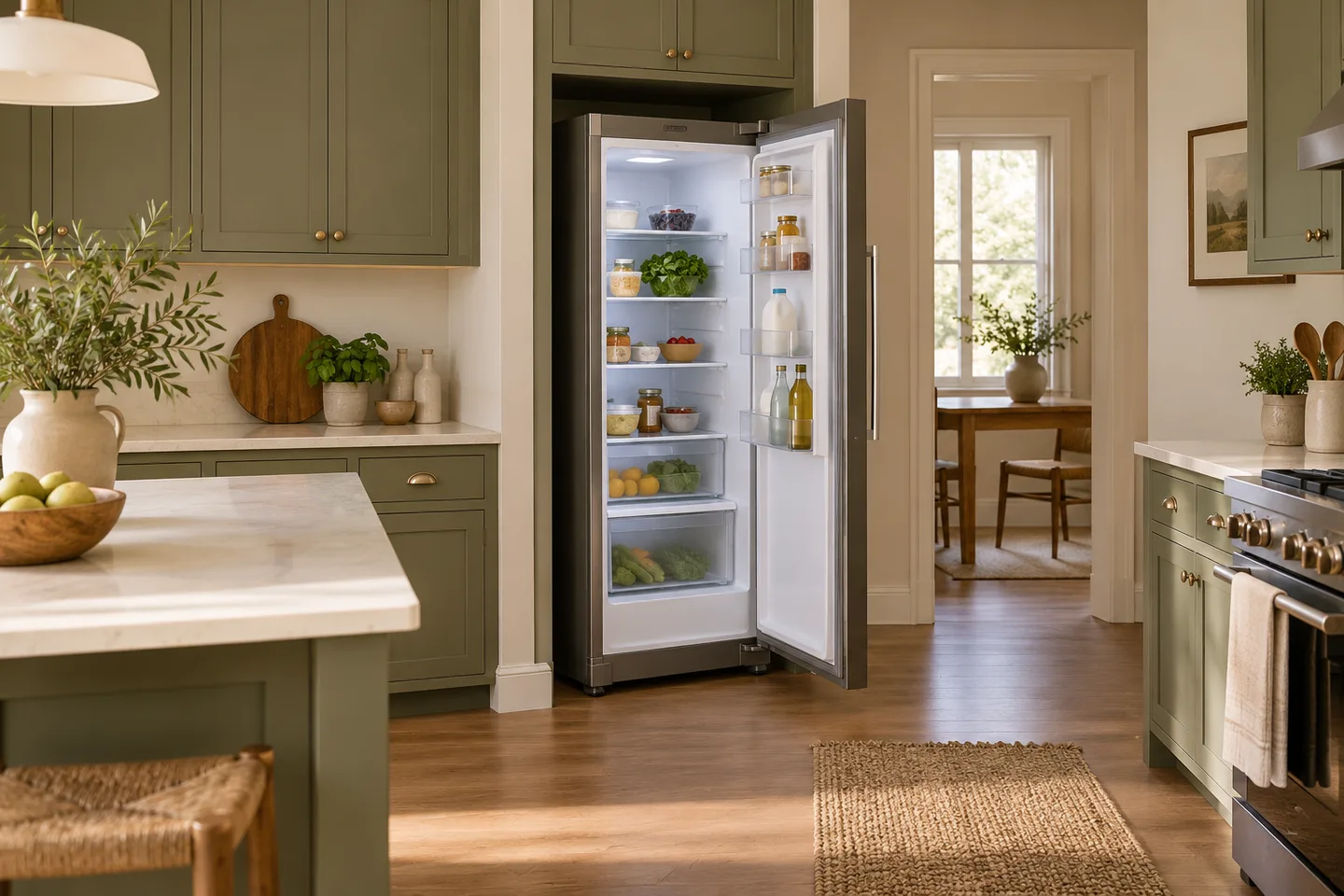
Which appliance should handle your food, drinks, or ice?
Use a refrigerator or refrigerator-freezer for perishable groceries and everyday meals, with a fresh-food compartment maintained at 40°F (4°C) or below. Frozen food needs a freezer capable of maintaining 0°F (-18°C); a separate freezer adds space when the main refrigerator's freezer is not enough. Beverage and wine coolers are specialized for drinks, while dedicated ice makers produce ice. Neither should be assumed to replace food-safe refrigeration or frozen storage.
| Main task | Appliance family to consider | What to verify first |
|---|---|---|
| Keep everyday groceries, leftovers, and some frozen food | Refrigerator-freezer | Fresh-food and freezer temperatures, shelf layout, and door access |
| Store larger quantities of frozen meals or ingredients | Standalone chest or upright freezer | Usable frozen-food space, organization, and placement conditions |
| Refrigerate a smaller amount of perishable food | Compact food refrigerator | Ability to maintain a food-safe temperature and whether any freezer compartment meets the intended need |
| Chill cans, bottles, or wine | Beverage center or wine cooler | Adjustable temperature range, bottle and shelf fit, and whether the unit is designed for perishable food |
| Make additional ice for drinks or gatherings | Dedicated ice maker | Ice production rate, holding capacity, water supply, and how stored ice is handled |
Three checks before comparing features
- Match the temperature to the contents. A cooler that holds wine at a preferred serving temperature may not be suitable for milk, leftovers, or other perishable foods. Verify the actual operating range and use an appliance thermometer for food storage.
- Match capacity to real items. Consider food containers, frozen packages, tall bottles, and ice demand rather than relying on a cubic-foot or daily-production figure alone.
- Match the appliance to its location. Check the physical opening, door swing, ventilation clearance, room-temperature limits, and any water or drain connection the appliance requires.
How do refrigerator layouts change daily access?
Refrigerator layouts mainly change the height of fresh and frozen food, the width of usable shelves, and the space needed to open doors and drawers. Top-freezer designs put frozen food overhead; bottom-freezer and French-door designs place fresh food higher; side-by-side designs provide vertically arranged access to both compartments. The most useful layout depends on what you reach most often and the size of what you store, not just total cubic feet.
| Layout | Where the food goes | Practical strength | Tradeoff to check |
|---|---|---|---|
| Top-freezer | Freezer above a single-door fresh-food compartment | Straightforward arrangement with a broad fresh-food cavity | Lower refrigerator shelves require bending; a full-width door needs swing space |
| Bottom-freezer | Fresh-food compartment above a lower freezer door or drawer | Frequently used refrigerated foods are easier to reach without bending | Frozen items sit low; a pull-out drawer needs clear space in front |
| French-door | Two upper fresh-food doors above a lower freezer | Broad fresh-food shelves can fit wide trays and containers | Freezer contents may be stacked in baskets; both doors may need to open for large items or drawer removal |
| Side-by-side | Tall fresh-food and freezer compartments next to each other | Some fresh and frozen items can both be kept at a convenient height; narrower doors reduce each door's swing reach | Each compartment is relatively narrow, so wide platters or frozen packages may not fit |
Match the layout to your routine
- Mostly fresh groceries: Start with a bottom-freezer or French-door arrangement if you want everyday ingredients near eye level. Check that produce drawers, door bins, and full-width shelves hold your usual containers.
- Frequent frozen-food access: A side-by-side layout can place commonly used frozen items higher than a bottom freezer. A top-freezer layout keeps the freezer overhead but requires reaching down for lower fresh-food shelves.
- A narrow aisle or nearby island: Split doors on French-door and side-by-side refrigerators often project less into the room individually than one wide door. You still need enough clearance to open doors fully and extend any freezer drawer.
Terms that describe something other than the main layout
- All-refrigerator: Provides refrigerated storage without a full freezer compartment. It makes sense when frozen food is stored elsewhere or is not required.
- Multi-door or convertible-zone: Adds separate drawers or compartments, sometimes with adjustable temperature settings. Check each zone's specified range before treating it as fresh-food or freezer storage.
- Counter-depth or built-in: Describes cabinet alignment or installation approach rather than whether the freezer is on top, on the bottom, or beside the refrigerator. Door and hinge clearance still matter.
When does a separate freezer make sense?
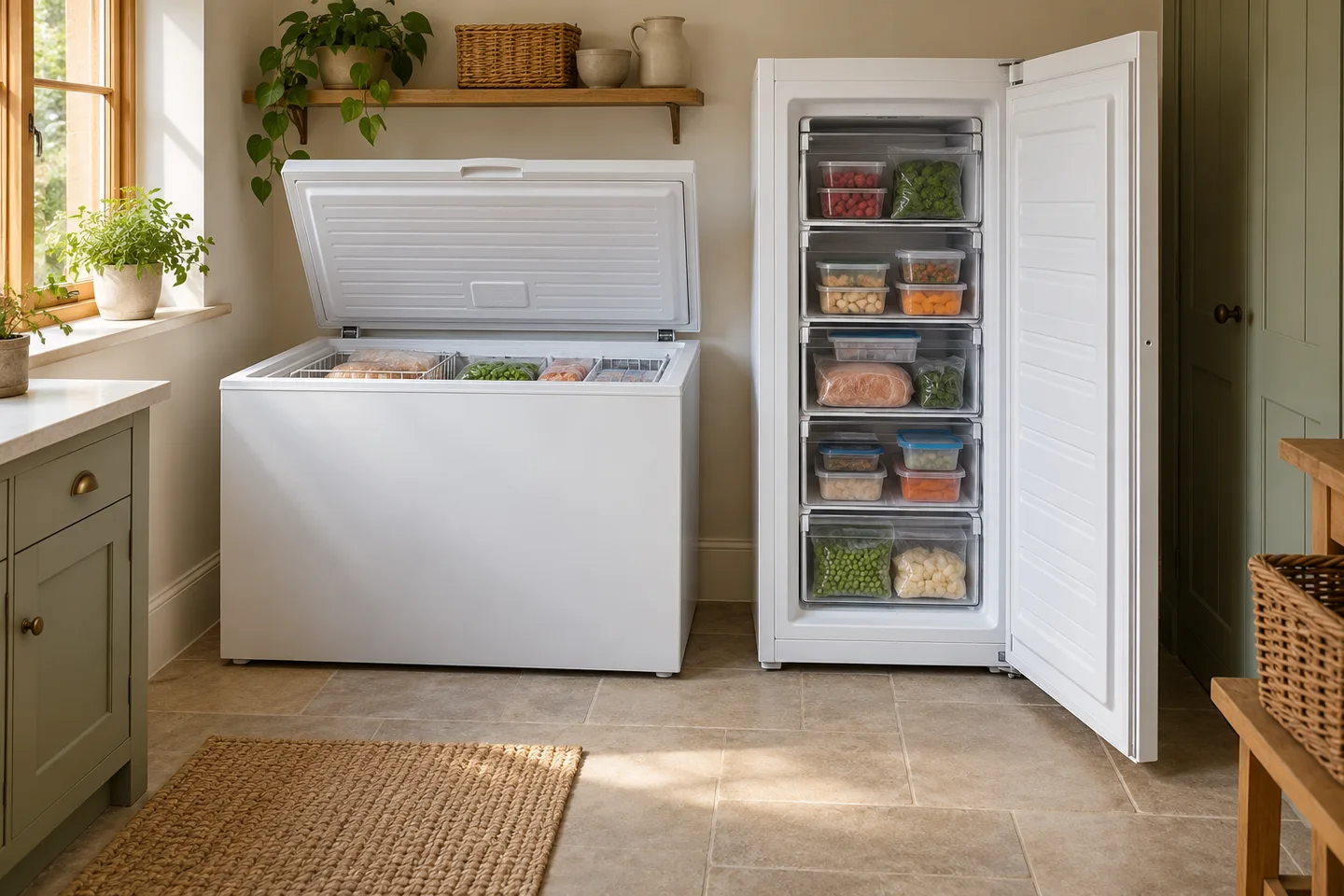
A standalone freezer makes sense when the freezer compartment in your refrigerator cannot comfortably hold the meals, ingredients, or seasonal food you intend to keep frozen. Chest freezers suit bulk storage and usually use less energy than comparable uprights. Upright freezers make individual packages easier to find and typically occupy less floor area. Choose by how often you retrieve food, how you organize it, and where the appliance can operate safely.
| Freezer type | Storage and access | Space requirement | Main tradeoff |
|---|---|---|---|
| Chest freezer | Deep top-opening compartment, often with removable baskets; useful for large or irregular packages | More floor area and enough overhead clearance to raise the lid | Food at the bottom can be difficult to reach; generally lower energy use |
| Upright freezer | Front-opening cabinet with shelves, door bins, or drawers for separating food | Taller footprint with room for the front door to swing open | Easier access and organization, but often higher energy use than a comparable chest freezer |
Manual defrost or frost-free?
Defrost type determines maintenance, not whether the freezer is chest-shaped or upright. Both cabinet styles can have different defrost arrangements, although manual defrost is common in chest designs.
- Manual defrost: Frost must be removed periodically according to the appliance instructions. This adds a maintenance task and requires a safe temporary place for frozen food, but manual-defrost freezers generally consume less electricity than automatic-defrost versions.
- Frost-free or automatic defrost: The appliance periodically removes frost from its cooling system. It reduces routine manual defrosting, but the additional defrost process can increase energy use. Compare the stated annual electricity consumption for freezers of similar size and type.
Check the location before choosing capacity
- Verify the room-temperature rating. A basement, utility room, or garage may have hotter or colder conditions than a kitchen. Check the manufacturer's stated ambient operating range; the term "garage-ready" alone does not provide the exact limits for every freezer.
- Allow access and airflow. A chest lid needs room to lift; an upright door needs swing space. Leave the ventilation clearances specified for the appliance and plan a practical route for carrying frozen packages in and out.
- Plan for monitoring and defrosting. Use a freezer thermometer to confirm a storage temperature of 0°F (-18°C) or below. For a manual-defrost unit, decide where food can remain safely frozen while the appliance is emptied and defrosted.
Can compact, beverage, and wine coolers do the same job?
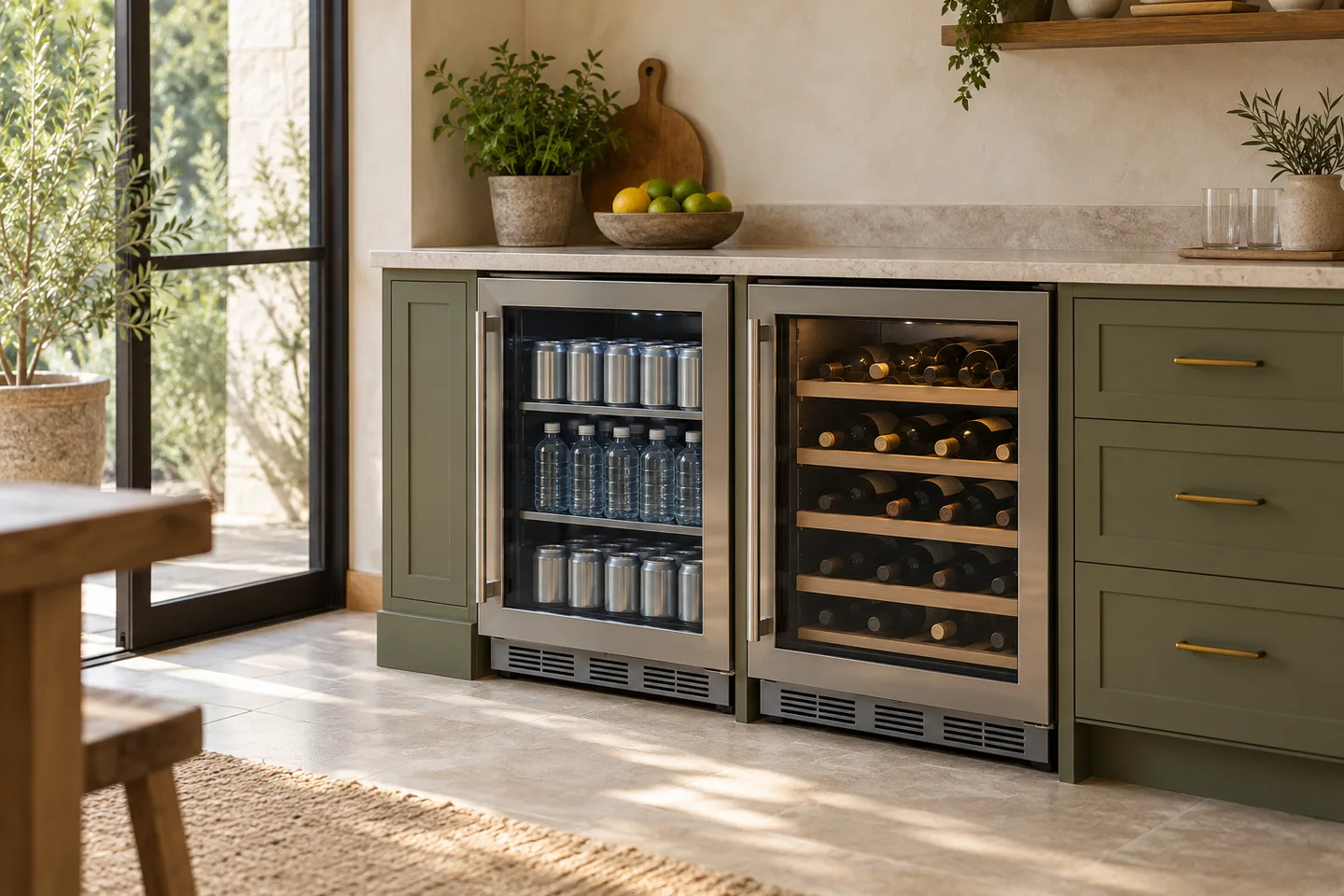
No. A compact food refrigerator is intended for refrigerated groceries and must maintain 40°F (4°C) or below for perishable food. Beverage centers and wine coolers are organized around drinks and may operate at warmer temperatures. Even if a drink cooler offers a cold setting, its display setting alone does not establish that it is intended for perishable-food storage. Check the stated use, achievable temperature range, and actual cabinet temperature before treating these appliances as interchangeable.
| Appliance | Primary purpose | Typical interior arrangement | Limitation to check |
|---|---|---|---|
| Compact food refrigerator | Small-scale storage of milk, leftovers, produce, and other refrigerated foods | Food shelves, door bins, and sometimes a small frozen-food compartment | Consistent food-safe temperature, usable shelf depth, and the capabilities of any freezer compartment |
| Beverage center | Chilling packaged cans and bottles for drinking | Beverage shelves or racks, often with room for upright containers | Intended contents and temperature range; a beverage setting is not proof of suitability for perishable food |
| Wine cooler | Storing or serving wine at selected temperatures | Horizontal bottle racks; some have two independently controlled zones | Bottle shapes and shelf spacing, zone settings, and a temperature range that may be too warm for food storage |
Compressor cooling versus thermoelectric cooling
- Compressor refrigeration: Uses a circulating refrigerant and compressor to move heat out of the cabinet. It is used in many food refrigerators and beverage or wine coolers. The achievable range and placement limits still depend on the appliance's design.
- Thermoelectric cooling: Uses a solid-state module that pumps heat from one side to the other. Its ability to maintain the chosen temperature is particularly sensitive to surrounding temperature and ventilation. It should not be assumed to reach normal food-refrigeration temperatures simply because it is electrically cooled.
Neither technology alone determines whether an appliance is suitable for perishable foods; the specified operating conditions and measured storage temperature do.
Does a mini fridge's small freezer box count as a freezer?
Not automatically. Some compact refrigerators have a small chilling or ice-making compartment that does not provide the same long-term frozen-food conditions as a dedicated freezer. Check whether the compartment is explicitly rated to maintain 0°F (-18°C) and whether its usable space fits the frozen items you plan to store. A compartment labeled only for ice cubes should not be treated as bulk frozen-food storage.
One more installation distinction
A freestanding drink cooler may reject heat through the back or sides, while a unit designed for undercounter installation may use front ventilation. The cabinet opening must suit the appliance's specified airflow path. Bottle or can capacity also depends on the actual mix of container sizes, shelf positions, and door-bin space, not just the advertised count.
How do dedicated ice makers differ?
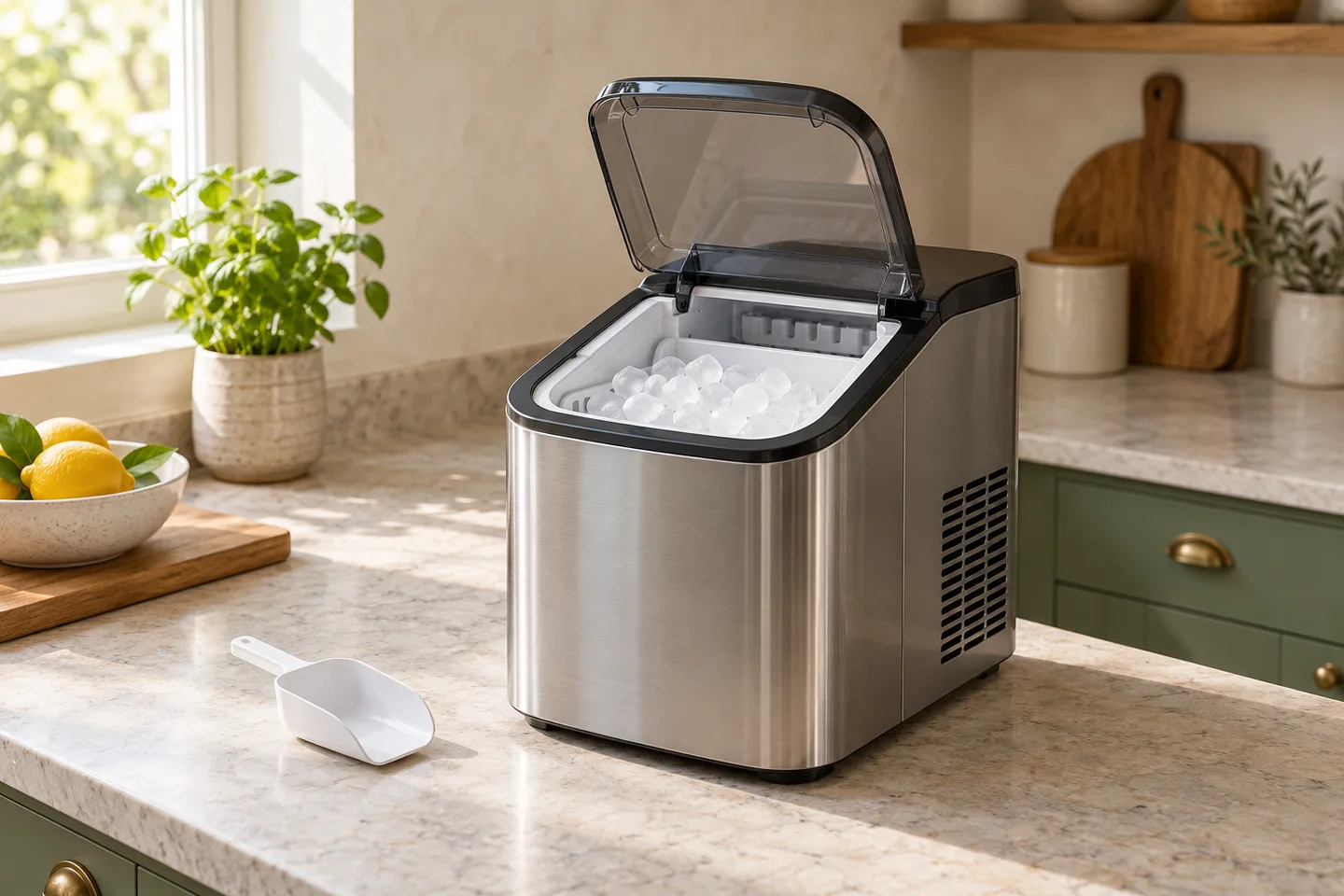
Dedicated ice makers are for producing ice on demand, not for refrigerating food. Countertop units often use a refillable water reservoir and suit occasional or flexible use. Undercounter and freestanding installed units can support more sustained ice demand but may need a water line, drain, and dedicated installation space. Compare how much ice the machine can make in 24 hours with how much its bin holds at once. Those are different capacities, and many ice bins do not keep ice frozen indefinitely.
| Equipment format | How it is used | Main installation consideration |
|---|---|---|
| Ice maker inside a refrigerator-freezer | Makes ice in the appliance's existing freezer or ice compartment | Shares freezer or door space; output depends on the refrigerator's design and conditions |
| Countertop or portable ice maker | Produces ice in a compact unit, often from a manually filled reservoir | Needs counter clearance, an outlet, water refilling, and a way to empty or move ice |
| Undercounter or freestanding dedicated ice maker | Produces ice into an insulated holding bin for repeated household or entertaining use | May need a plumbed water supply, drainage by gravity or pump, and specified ventilation space |
Production rate is not storage capacity
- Ice production rate: The quantity a machine can make over a stated period, often pounds per 24 hours. Air temperature, incoming water temperature, and operating conditions can affect actual output.
- Bin capacity: The amount of ice the holding bin can contain at one time. A high daily production number does not mean that much ice is available immediately or can be stored simultaneously.
- Ice retention: Many countertop and standalone ice-machine bins are insulated rather than refrigerated. Ice can melt and be replaced by newly made ice; transfer it to a freezer when longer-term frozen storage is required.
Ice shapes serve different drink preferences
| Ice form | Distinctive construction | Common use |
|---|---|---|
| Bullet | Rounded or cylindrical pieces, often with a hollow center | Everyday cold drinks and filling smaller containers |
| Nugget or pebble | Small, porous pieces formed from compressed ice flakes | Drinks where a softer, chewable ice texture is preferred |
| Clear, solid cube | Relatively solid pieces with fewer visible air pockets | Drinks where a firm cube and a clear appearance are desired |
Ice shape alone does not establish melt time. Piece size, surface area, drink temperature, and handling all matter.
Water, drainage, and cleaning checks
- Identify the water source. A refillable reservoir needs regular filling and emptying. A connected unit needs a suitable potable-water line and any filtration specified for the equipment.
- Resolve meltwater drainage. Confirm whether water recirculates, collects for manual removal, or needs a gravity drain or pump. Do not assume an undercounter cabinet has a usable drain connection.
- Plan sanitation and scale removal. Ice contacts the reservoir, ice path, and bin. Follow the manufacturer's cleaning, sanitizing, descaling, and filter instructions; a self-cleaning cycle does not eliminate all manual care.
- Check heat and access clearances. The machine must reject heat while allowing access to the bin, reservoir, serviceable parts, and any required drain or water connections.
How do you check usable capacity and installation fit?
A refrigeration appliance fits only if it can be installed with its required airflow and connections, opened far enough to use its compartments, and filled with the food or drink containers you actually store. Advertised cubic feet describe volume, not shelf shape or convenient access. Measure the installation space and delivery route, then compare them with the full dimension drawing and operating instructions for the appliance type.
What capacity figures leave out
| Appliance family | Published figure | What to check inside |
|---|---|---|
| Refrigerator-freezer | Total cubic feet of refrigerated and frozen space | How much volume belongs to each compartment, plus the width and height between shelves, door bins, and drawers |
| Standalone freezer | Cubic feet of frozen storage | Whether large packages fit through the opening and can be retrieved around baskets or shelves |
| Compact, beverage, or wine cooler | Cubic feet or a stated can or bottle count | Actual container diameters and heights, rack positions, and the space lost when shelves must be removed |
| Ice maker | Pounds of ice produced per 24 hours and pounds held in the bin | Whether the ready-to-use bin quantity covers peak demand without confusing it with daily production |
A six-step measurement check
- Record the available opening. Measure width, height, and depth in inches at several points, including the narrowest area near trim, baseboards, countertops, and overhead cabinets. Do not assume the old appliance's dimensions describe the space accurately.
- Compare complete exterior dimensions. Check width, cabinet height, height to top of hinges, and depth with doors and handles closed. A "counter-depth" label does not mean every door or handle will sit flush with the counter edge.
- Check the open position. Use the dimension drawing to confirm door swing, hinge-side clearance, freezer-drawer extension, or chest-lid lift. The appliance may fit when closed but fail to open far enough to remove shelves or storage bins.
- Add the required ventilation space. Use the installation instructions for clearance at the back, sides, top, or front grille. Freestanding and built-in designs can reject heat in different directions, so there is no single clearance measurement for every appliance.
- Walk the delivery path. Check doorways, hallways, stairways, turns, and the route around any island or fixed furniture. Confirm whether any part may be removed for transport only from the appliance's instructions and qualified installer.
- Verify the operating location. Confirm the specified electrical supply, room-temperature range, level supporting surface, and access for cleaning or service. Ice-making or dispensing equipment may also need a suitable water connection and drain.
The most useful final check is physical: identify your largest food tray, frozen package, bottle, or storage container and compare its measurements with the usable opening and interior shelf dimensions. Extra advertised volume does not solve a container that cannot pass through the door or fit between shelves.
What temperatures and food-safety practices matter?
Keep perishable food in a refrigerator at 40°F (4°C) or below and frozen food at 0°F (-18°C) or below. Use a separate appliance thermometer in each compartment because a control setting or digital set point does not always show the actual food-storage temperature. Safe refrigeration also depends on prompt storage, space for cold air to circulate, and preventing raw-food juices from reaching ready-to-eat items. During a power outage, use elapsed time and measured temperatures rather than appearance or smell to decide what to keep.
Everyday cold-storage habits
- Verify the temperature. Check refrigerator and freezer thermometers regularly, especially after an adjustment, heavy loading, or an unusually warm room period.
- Refrigerate promptly. Put perishables and leftovers into safe cold storage within 2 hours, or within 1 hour when the surrounding temperature is above 90°F (32°C). Divide large batches of leftovers into shallow containers for faster cooling.
- Keep air moving. Avoid packing shelves so tightly that vents and the paths for circulating cold air are blocked. Close doors promptly and check that the seals meet the cabinet properly.
- Prevent cross-contamination. Keep food covered, contain raw meat and seafood so their juices cannot drip onto other foods, and clean spills promptly.
- Know what freezing does. Freezing at 0°F stops bacterial growth but does not reliably kill most bacteria already present. Frozen-food quality can decline with time even when safe storage temperatures are maintained.
How long does food stay cold without power?
The following are approximate hold times when the appliance stays closed. They are planning guides, not proof that any particular food remained safe.
| Appliance condition | Approximate cold-holding time without power | Essential condition |
|---|---|---|
| Refrigerator | About 4 hours | Door remains unopened |
| Full freezer | About 48 hours | Door or lid remains closed |
| Half-full freezer | About 24 hours | Door or lid remains closed |
The freezer compartment of a refrigerator-freezer may not hold its temperature as long as a full standalone freezer. If a prolonged outage is expected, arrange an insulated cooler with ice or another way to keep food at a verified safe temperature.
What to do when power returns
- Check, do not taste. Read the appliance thermometers and, when needed, check individual packages with a food thermometer. Smell, texture, and appearance cannot reliably establish food safety.
- Assess refrigerated perishables. Discard meat, poultry, seafood, eggs, milk, and leftovers that have been above 40°F (4°C) for 2 hours or more. After roughly 4 hours in an unopened refrigerator without power or another cold source, do not assume these foods are safe; discard them if safe temperature history cannot be established.
- Assess frozen foods individually. Food that still contains ice crystals or measures 40°F (4°C) or below may generally be cooked or refrozen, although quality may suffer. Discard perishable frozen food that thawed and stayed above 40°F for 2 hours or more.
When temperature history is unknown, the safer choice for questionable perishable food is to discard it.
How should energy use and upkeep affect the choice?
Refrigerators and freezers operate around the clock, so compare annual electricity use as well as storage suitability. The yellow EnergyGuide label on covered refrigerator and freezer types gives estimated yearly electricity consumption and operating cost. ENERGY STAR certification identifies qualifying equipment that meets additional efficiency criteria. These labels answer different questions: one reports estimated use, while the other indicates an efficiency qualification. Neither replaces checks for capacity, temperature, and installation fit.
How to read the energy information
| Information | What it tells you | How to use it |
|---|---|---|
| EnergyGuide electricity use | Estimated annual consumption in kilowatt-hours (kWh/year), based on standardized testing | Compare similar appliances of the same general size, configuration, and feature class; a lower figure indicates less estimated electricity use |
| EnergyGuide operating cost | An annual estimate calculated using an assumed electricity rate | Treat it as a comparison aid, not a prediction of your bill; actual cost depends on local rates and use |
| ENERGY STAR certification | The appliance meets the program's applicable energy-efficiency criteria | Use it to identify qualified equipment, then check the annual kWh figure when choosing between different capacities and layouts |
What can change the energy picture?
- Size and cabinet layout: Larger refrigerated volume generally requires more electricity. Top-freezer refrigerators tend to use less energy than other common full-size layouts, and chest freezers tend to use less than comparable uprights. Check the individual energy figures rather than treating either tendency as a guarantee.
- Defrost and added features: Manual-defrost freezers generally use less energy but require periodic frost removal. Automatic defrost and ice-making equipment affect how a refrigeration product is classified for energy comparisons.
- Placement and daily use: Heat sources, blocked ventilation, damaged door seals, and lengthy door openings can make cooling harder. Follow the appliance's specified clearances and ambient-temperature limits.
- Specialty ice equipment: Daily ice output in pounds is not an electricity-use measurement. Do not compare that figure with a refrigerator's kWh/year rating or assume every dedicated ice maker carries the same consumer energy label.
Maintenance to plan for
- Refrigerators and standalone freezers: Inspect and clean door gaskets, keep vents clear, and clean accessible condenser coils only as instructed in the owner's manual. Check that doors close fully and compartment temperatures remain on target.
- Manual-defrost freezers: Remove frost when required by the manual. Arrange safe frozen-food storage during defrosting and never chip away ice with a sharp tool that could damage the cabinet or cooling system.
- Compact, beverage, and wine coolers: Keep the specified ventilation openings clear, wipe shelves and seals, and confirm that the unit maintains the temperature intended for its contents.
- Dedicated ice makers: Follow the specified schedule for cleaning and sanitizing ice-contact surfaces, descaling the water system, changing filters where fitted, and maintaining the bin, reservoir, and drain.
The practical comparison is energy use for an appliance that can actually do the job, plus a maintenance routine you can realistically keep up with.