Dishwashers, Range Hoods, and Kitchen Cleanup Appliances
Dishwashing, cooking ventilation, food-scrap handling, and drinking-water treatment are different kitchen jobs. The useful starting point is the problem you need to solve, followed by the available space, connections, and routine upkeep.
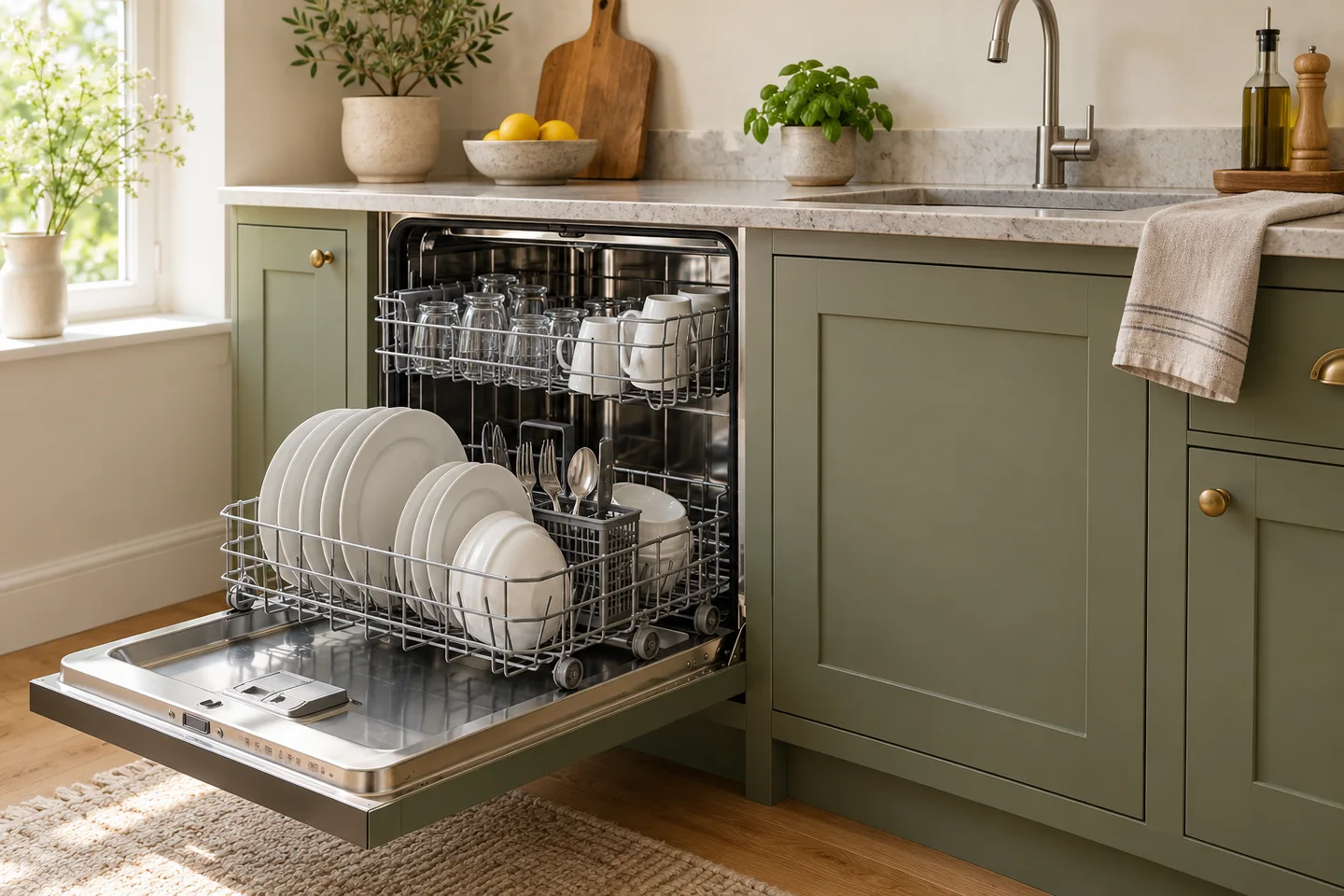
What each kitchen cleanup appliance does
Four appliance families cover the main jobs: dishwashers wash dishes and cookware, range hoods manage airborne cooking emissions, in-sink disposals grind limited food scraps, and kitchen water filters reduce specific substances in drinking or cooking water. None is a substitute for the others, and each has a different installation constraint.
Dishwashers
Dishwashers use water, detergent, and spray action to wash dishes and utensils. Many also provide a drying stage. Built-in, portable, and countertop formats accommodate different kitchen layouts and plumbing arrangements.
- Fit to check: Cabinet or counter space, water supply, drainage, and clearance for loading dishes.
- Daily-use priority: Enough usable rack space for your usual dishes and cookware, with washing and drying options that suit your routine.
Range hoods and cooking ventilation
A range hood captures some of the smoke, moisture, grease particles, and odors rising from cooking. A ducted hood exhausts collected air outdoors. A recirculating hood passes air through filters and returns it to the room, so it does not provide equivalent removal of moisture or cooking pollutants.
- First constraint: Whether an outdoor exhaust route is possible.
- Fit to check: Cooktop position, hood coverage, mounting space, and duct path where applicable.
In-sink garbage disposals
A disposer grinds small food scraps at the sink so they can travel with wastewater through the drain. It does not eliminate grease or prevent plumbing problems, and food solids add to the load on a septic system.
- Fit to check: Sink mounting, under-sink clearance, drainage, electrical provision, and local wastewater requirements.
- Practical limit: Scrape substantial leftovers and keep fats, oils, and grease out of the drain.
Kitchen drinking-water filters
Pitcher, faucet-mounted, and under-sink systems treat water near where it is consumed. Their capabilities depend on the treatment method and the specific contaminants the system is certified to reduce. A general filtration claim does not establish protection against every water-quality concern.
- Evidence to check: Your water supplier's quality report or appropriate water testing, followed by a certification claim for the substance of concern.
- Upkeep to check: Cartridge compatibility, replacement schedule, and usable flow rate.
Dishwasher formats and the choices that matter
Choose the dishwasher format by how it will connect to water and drainage, where it will sit, and how much dishware you wash at once. A built-in machine needs a suitable cabinet opening and permanent connections. A portable unit can move to the sink for use, while a countertop unit trades dish capacity for a smaller footprint. After the format fits, compare rack clearance, wash cycles, and drying needs.
| Format | Typical setup | Useful when | Main limitation to check |
|---|---|---|---|
| Standard built-in | Under a counter in a nominal 24-inch-wide opening, with fixed connections | There is a dedicated space and regular full-size loads | Exact cutout, door clearance, and rack fit |
| Narrow built-in | Under a counter in a nominal 18-inch-wide opening, with fixed connections | Cabinet width is limited but permanent installation is possible | Whether narrower racks hold everyday cookware |
| Wheeled portable | Floor-standing unit, typically with a temporary faucet connection and a hose draining at the sink | No suitable built-in opening exists | Parking space, compatible faucet, and access to the sink during operation |
| Countertop | Unit supported by a counter, with the specified water-fill and drain arrangement | Dish loads are small and no floor or cabinet space is available | Counter clearance, sink access, and space for taller dishes |
Check the opening and usable capacity separately
A nominal 24-inch or 18-inch width describes a common built-in size class, not the appliance's exact outside width. Measure the cabinet opening's width, height, and depth, including the floor and countertop clearance, and compare them with the required installation dimensions. For portable or countertop units, measure the space they occupy in use and when stored.
Place-setting capacity describes a collection of standard dishware, but it cannot tell you whether your baking sheets, pots, or tall glasses will fit. Check the actual rack layout and the clearance left when racks are adjusted.
For a faucet-connected dishwasher, verify that the faucet accepts the specified adapter and that the hose can drain securely into the sink. Do not assume every faucet or countertop plumbing arrangement is compatible.
Look at rack geometry before extra features
- Adjustable upper rack: Can create room for tall dishes above or below, but moving it changes the clearance on the other level.
- Third rack or cutlery tray: Can separate utensils and smaller items from the main racks; check whether it reduces space for tall glasses beneath it.
- Fold-down tines and lower-rack layout: Matter when washing wide bowls, pans, or unusually shaped cookware.
- Spray-arm clearance: Loaded items must not block spray-arm rotation or prevent the detergent dispenser from opening.
Match washing and drying to your routine
Soil-sensing cycles can adapt operation to how dirty the load is; light, heavy, and shorter cycles serve different wash tasks. Read the cycle descriptions rather than assuming a shorter cycle uses less water or energy.
Drying systems also vary. Heated drying adds heat, while condensation-based designs rely on moisture condensing away from hot dishes; some machines add fans or automatic door opening. Plastics often retain less heat than glass or ceramic and can remain wet, especially where water pools. If you frequently wash plastic containers, check the drying method, rinse-aid instructions, and whether the racks let water drain from those shapes.
Range hoods: exhaust path, capture, and fit
For removing cooking moisture and airborne pollutants, start with a hood that captures the rising plume over the cooktop and exhausts it outdoors. Recirculating hoods filter some grease and odors but return air to the room, so they cannot provide equivalent ventilation. After checking whether an outdoor duct route is feasible, focus on how well the hood covers the burners, the actual airflow it can deliver, and a fan speed you will use while cooking.

Ducted exhaust
A ducted hood draws cooking emissions through a grease filter and sends the collected air outside through a dedicated duct. It can remove moisture and combustion byproducts along with captured smoke and odors.
- Main advantage: Collected pollutants leave the home instead of being returned to the kitchen.
- Main constraint: The duct must be compatible with the hood, follow a suitable route, and terminate outdoors. Long runs, restrictive bends, and undersized ductwork can reduce delivered airflow.
Recirculating hoods
A ductless hood draws air through grease filtration and usually an odor-absorbing carbon filter before releasing the air back into the kitchen. It can be an option where outdoor ducting is not feasible, but it does not remove cooking humidity, heat, or combustion gases from the home.
- Main advantage: No exterior exhaust duct is needed for the recirculating configuration.
- Main constraint: Odor control depends on the filter and its condition; carbon filters generally need replacement rather than washing. Separate ventilation may still be needed.
Match the hood shape to the cooking surface
- Under-cabinet or wall-mounted canopy: Positioned over a range against a wall. Check that the capture area spans the cooktop and extends far enough to cover the burners used most often.
- Island hood: Suspended over cooking equipment without a rear wall. Open sides and cross-drafts make coverage and placement especially important.
- Downdraft exhaust: Pulls air across or downward from the cooking surface instead of collecting the rising plume above it. This can be harder to capture effectively, especially from front burners.
- Flat-bottom exhaust units: Some compact exhaust or over-the-range microwave combinations have less capture volume than an open canopy. Judge their hood depth and actual exhaust configuration, not their fan rating alone.
Why airflow rating is not the whole answer
Airflow in cubic feet per minute (CFM) measures the volume moved by the fan, not the percentage of cooking emissions captured. Actual capture also depends on hood depth and shape, which burners are operating, fan speed, and resistance in the installed duct. A high advertised CFM value cannot compensate for poor coverage of the cooking area.
Check three things together:
- Coverage and mounting: Start with a hood at least as wide as the cooking surface, and follow the hood and cooktop instructions for allowed mounting height. A higher or shallower hood may miss more of the rising plume.
- Air path: Verify the specified duct size and route, outdoor termination, and any limits on bends. Compare airflow ratings measured under stated conditions rather than assuming all listed CFM values are directly equivalent.
- Usable fan speeds: Consider sound as well as airflow. Multiple settings allow quieter operation for lighter cooking and more extraction when cooking generates more smoke or steam.
Run outdoor-vented exhaust while cooking, and continue it for 10-20 minutes afterward. Using rear burners when practical can improve capture. Large exhaust flows can depressurize a home and interfere with fuel-burning equipment, so make-up air requirements and combustion safety need professional review where applicable.
In-sink disposals: practical uses and plumbing limits
An in-sink garbage disposal is useful for small food scraps left after plates are scraped, but it does not make food waste disappear. Ground particles still enter the drain and wastewater system. If your home uses a septic tank, limit or avoid disposer use: added food solids can accumulate as sludge and scum, increasing pumping needs and the risk of trouble downstream. A disposer also cannot prevent grease-related pipe clogs.
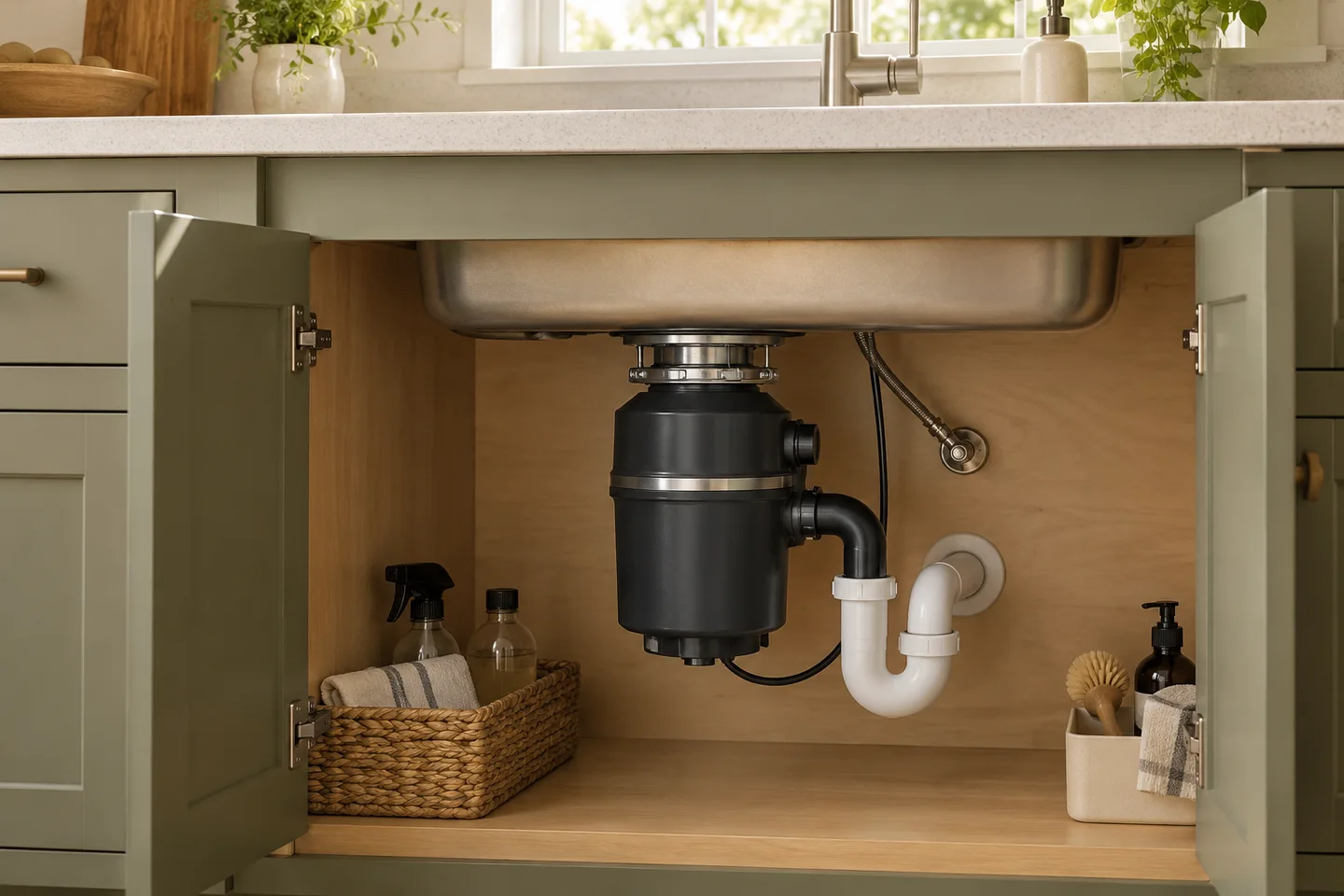
Continuous-feed and batch-feed designs
| Feed type | How it operates | Practical tradeoff |
|---|---|---|
| Continuous feed | A wall switch or air-actuated switch starts the motor; small scraps can be added while it runs. | Convenient for repeated small amounts of waste, but the sink opening remains accessible during operation. Keep hands and utensils clear. |
| Batch feed | Food is loaded before a special stopper or cover is engaged; the motor runs with that cover in place. | The cover closes the opening while grinding, but waste must be processed in separate loads and the matching stopper must be used. |
Both types use a motor-driven plate with impellers that push food against a stationary grind ring. They do not chop with exposed blender-style blades. Running water carries the resulting particles out through the discharge pipe, so the condition and arrangement of that pipe still matter.
What belongs in the drain?
- Appropriate use: Small amounts of food residue the disposer instructions permit, fed gradually with water running. Follow the specified water and shutdown sequence.
- Remove separately: Large quantities of leftovers, packaging, utensils, glass, plastic, and other nonfood objects. A disposer is not a general trash grinder.
- Keep out of the plumbing: Cooking fat, oil, and grease, even if hot water or a disposer is running. Grease can coat pipes and contribute to blockages. Coffee grounds and other troublesome material are better collected separately than washed down the drain.
- Check before grinding: Tough, fibrous, or hard scraps may be handled differently by different disposer designs. Use the actual allowed-material instructions rather than assuming every food item is acceptable.
Check the sink, drain, and electrical arrangement
Before adding or replacing a disposer, verify these connections as a set:
- Sink mount and cabinet: The sink opening must accept the specified flange and mounting assembly, with enough space beneath the sink for the motor housing and future service access.
- Drain alignment: The disposer outlet must connect correctly to the trap and existing drain piping. Check outlet height and pipe condition, not just whether the unit fits under the sink.
- Power and control: Confirm the required electrical supply and a suitable wall, air-actuated, or cover-operated switching arrangement. An air switch changes how the motor is controlled; it does not eliminate the need for electrical power.
- Dishwasher connection, if used: Confirm a compatible dishwasher drain inlet and the required hose routing, air gap, or other backflow protection under the applicable plumbing rules.
Where the drain goes matters as much as the motor. On a septic system, the EPA advises eliminating or limiting disposer use because food solids add to tank loading and can affect the drainfield. On a sewer connection, ground scraps and grease still pass into the drainage system; local wastewater restrictions may also apply. Check the wastewater arrangement before treating disposer capacity or motor horsepower as the deciding specification.
Kitchen water filtration: match the treatment to the water
The right kitchen water treatment depends on what you need to reduce, not on the filter's shape or the number of stages advertised. For public water, start with your utility's annual water-quality report; if the concern may come from household plumbing, water testing at the tap can add useful information. Private well water calls for appropriate laboratory testing. Then match the identified substance to a verified reduction claim. Better taste or clearer water alone does not establish safety.
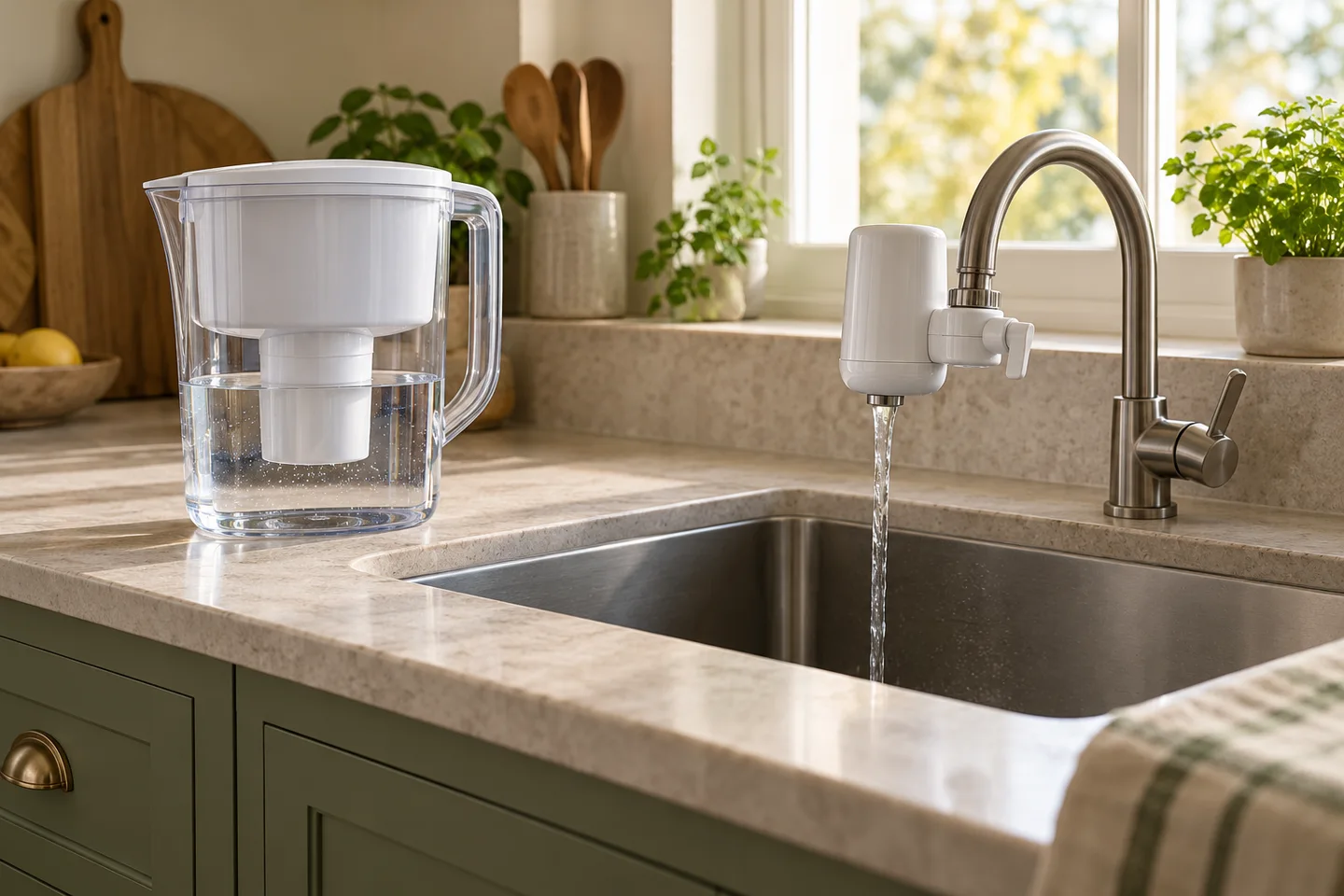
What the treatment method can change
| Treatment method | What it can address | What it cannot be assumed to do |
|---|---|---|
| Activated carbon or other adsorptive media | Often improves chlorine-related taste and odor; specific media may also reduce selected chemicals or lead when certified for those claims. | Disinfect water or reliably remove dissolved salts and nitrate without a separate, supported treatment method. |
| Particle and fine-membrane filtration | Screens sediment and, with an appropriate membrane and verified rating, can reduce certain microorganisms. | Remove dissolved chemical contaminants merely because the pores are small; different membranes have different microbial limits. |
| Reverse osmosis (RO) | Forces water through a semipermeable membrane and can reduce many dissolved substances, including selected salts and metals. | Remove every contaminant; the system's verified claims still control. RO also produces a reject-water stream. |
| Ultraviolet (UV) treatment | Inactivates specified microorganisms when the equipment and incoming water meet its operating requirements. | Remove dissolved chemicals, sediment, or minerals. Pretreatment may be needed so particles do not interfere with disinfection. |
Water softening is a separate task: ion-exchange softeners primarily address hardness minerals such as calcium and magnesium. Softened water is not necessarily filtered for drinking-water contaminants.
Match the filter format to the kitchen
- Pitcher or pour-through dispenser: Needs no plumbing connection and can serve a small drinking-water volume, but requires manual filling, storage space, and cartridge changes.
- Faucet-mounted or countertop unit: Treats water at an existing tap or nearby appliance. Check faucet compatibility, available counter clearance, water flow, and whether untreated water can bypass the filter.
- Under-sink system: Connects to the supply line and sends treated water to a compatible faucet, often a dedicated drinking-water tap. Allow room for the filter housings, shutoff access, and cartridge or membrane replacement. RO systems also need an approved drain connection for reject water.
- Refrigerator filter: Treats water supplied to the refrigerator dispenser or ice maker, not necessarily water from the main kitchen faucet. Its reduction claims and replacement requirements still need checking.
Match the certification to the specific concern
NSF/ANSI 42 addresses aesthetic effects such as chlorine taste and odor. NSF/ANSI 53 addresses specific health-related contaminant reductions; NSF/ANSI 58 applies to reverse osmosis systems; NSF/ANSI 401 covers claims for certain emerging compounds. A standard number by itself is not a promise to remove every substance within that standard. Check an independent certification listing and the system's performance data sheet for the exact contaminant, such as lead, rather than accepting a broad "purifies water" claim.
Ordinary pitcher and refrigerator carbon filters should not be treated as disinfection systems. If testing shows harmful microorganisms or a drinking-water advisory is in effect, use the treatment or alternative water source specified by the responsible health authority; routine taste-and-odor filtration is not a substitute.
Finally, account for the treated flow you actually need and the service the system requires. Cartridges have finite capacities, membranes and UV components have maintenance requirements, and RO reject-water volume varies by design. A system is suitable only if its treatment claim, plumbing needs, water use, and upkeep all fit the same household.
How to compare labels and performance specifications
A useful appliance specification names what was measured, in which unit, and under what conditions. Compare numbers within the same appliance class and test basis. An efficiency label, an airflow rating, motor horsepower, and a water-filter certification answer different questions; none is an overall quality score.
The measurements worth reading
| Appliance family | Useful measurements | What they do not prove |
|---|---|---|
| Dishwashers | Annual energy consumption in kilowatt-hours per year (kWh/year), water use in gallons per cycle, rated dish capacity, and sound in A-weighted decibels (dBA). | A lower energy figure does not guarantee better washing or drying. Place-setting counts do not show whether your pans and tall glasses fit. |
| Range hoods | Exhaust airflow in cubic feet per minute (CFM), operating speed, sound in sones, and the conditions under which airflow and sound were rated. | CFM does not state how much cooking pollution the hood captures. Fan noise and airflow at different speeds are not one comparable operating point. |
| In-sink disposals | Motor horsepower (hp), continuous-feed or batch-feed operation, grind mechanism, sound-control construction, and physical dimensions. | Horsepower or a claimed number of grinding stages does not establish jam-free operation, pipe compatibility, or septic suitability. |
| Kitchen water treatment | Specific certified contaminant-reduction claims, rated service capacity in gallons, treated-water flow in gallons per minute (gpm), and, for RO, reject-water volume per gallon of treated water. | A filter's stage count or certification standard number alone does not prove reduction of every contaminant or establish useful flow after installation. |
What the certification marks mean
- EnergyGuide: Gives a standardized estimate of a dishwasher's yearly energy use and operating cost. The estimate supports comparison under its assumptions, not a prediction of every household's bill.
- ENERGY STAR: Indicates that the dishwasher meets the program's efficiency requirements for its defined capacity class and test method. It is not a cleaning or drying grade.
- HVI Certified: Identifies independently rated ventilation airflow and sound under specified laboratory procedures. Compare the relevant speed and conditions; actual ductwork and hood coverage still determine the installed result.
- NSF/ANSI water-treatment certification: Verifies performance for the particular contaminant-reduction claims listed for the system. A general reference to NSF/ANSI 42, 53, 58, or 401 is not a complete list of what it removes.
- WaterSense for point-of-use RO: Identifies systems meeting EPA water-efficiency and performance criteria. RO water efficiency is different from a claim that the system is necessary or treats every water concern.
Three comparisons that need extra care
- Different dishwasher classes: A compact dishwasher and a full-size dishwasher may have different energy and water allowances. Read the capacity class and test basis before comparing kWh/year or gallons/cycle; then check actual rack fit separately.
- Different hood settings: A hood's maximum CFM and its sound rating at a lower fan speed describe different operating conditions. Prefer airflow and sound figures tied to the same speed and a recognized rating procedure.
- Different water-filter claims: A rated flow or service capacity is meaningful only alongside the contaminant claim and its test conditions. Check the performance data sheet for the exact substance, cartridge or membrane identity, and replacement limit. For RO, a lower reject-water-to-treated-water ratio means less water goes to drain per gallon delivered.
Use dimensions, required connections, and service access as separate fit checks. A verified performance number cannot resolve an installation mismatch.
Installation and compatibility checks before committing
An appliance is installation-ready only when its space, supply, discharge path, controls, and service access all work in the actual kitchen. A nominal cabinet width, high airflow rating, or compact housing cannot compensate for an incompatible connection. Check the installation instructions against measurements and existing utilities before planning cabinet cuts, new plumbing, wiring, or an exterior vent.
Five checks in the right order
- Measure the full operating space. Record available width, height, and depth, then allow for the appliance's stated clearances. A dishwasher needs room for its door to open and racks to load. A hood needs the specified height above the cooking surface and adequate burner coverage. A disposer or under-sink filter must leave room for pipes, valves, and hands to reach serviceable parts.
- Identify water and electrical connections. Confirm the required supply line, shutoff access, water-pressure range where specified, and suitable electrical arrangement. A built-in dishwasher typically uses permanent supply, drain, and power connections; a portable or countertop format may use a compatible faucet and temporary drain setup. Disposers need appropriate powered controls. Plumbed-in drinking-water systems must connect to the water supply specified for that treatment unit.
- Trace the wastewater route. A dishwasher drain hose needs the routing and backflow protection required by its instructions and local plumbing rules, which may include an air gap or a correctly positioned high loop. A disposal outlet must align with the trap and branch drain; an attached dishwasher must use the intended inlet and connection. A plumbed-in reverse osmosis system also needs a compliant route for its reject water.
- Trace the ventilation route. A ducted range hood needs a suitable metal duct, the specified size and allowable run, and a termination outdoors - not into an attic, wall cavity, or crawl space. Check bends, cabinet obstructions, and whether a new exterior opening is feasible. Recirculating operation eliminates the exhaust duct, but it does not remove cooking moisture and combustion gases from the home.
- Check the safety and service conditions. Confirm required grounding, circuit and switching arrangements, access to shutoffs, filter or grease-screen removal, and any local permit or inspection requirements. Large exhaust flows may require make-up air and combustion-safety assessment. Do not assume an existing outlet, duct, or drain meets the requirements simply because a previous appliance used it.
Common physical mismatches
| Appliance | Mismatch to catch before installation | Check that resolves it |
|---|---|---|
| Dishwasher | The cabinet opening is nominally the right width, but the floor, counter, door swing, or drain route leaves inadequate clearance. | Compare actual opening and connection locations with the full installation drawing, including door-open space. |
| Range hood | A hood fits between cabinets, but the existing duct is undersized, too restrictive, or does not exhaust outdoors. | Verify duct size, route, termination, mounting height, and cooktop coverage together. |
| In-sink disposal | The sink accepts a mounting flange, but the motor housing or discharge outlet conflicts with the trap, cabinet, or another under-sink appliance. | Measure the under-sink envelope and check outlet-to-drain alignment before relying on sink-opening fit. |
| Kitchen water filter | The housing fits under the counter, but the faucet connection, water supply, cartridge removal space, or RO drain path does not. | Check the plumbing diagram, treated-water outlet, installation clearances, and service access. |
If a proposed setup requires new electrical work, major plumbing alterations, exterior ducting, or changes that could affect fuel-burning equipment, have the relevant qualified installer assess it against the applicable requirements. After installation, the specified leak, drainage, exhaust, and operating checks still matter; a physically attached appliance is not automatically a correctly functioning system.
Which setup fits your kitchen and habits?
Match each appliance to the task, the available connections, and how often you will use it. A compact kitchen does not automatically need compact versions of everything, and a permanent installation is not always possible or useful. The dishwasher, ventilation, food-scrap, and drinking-water decisions can be made separately. Resolve safety and plumbing limits first, then choose the capacity and convenience that fit your routine.
Match the situation to a practical setup
| Kitchen situation | Sensible category direction | Important condition or tradeoff |
|---|---|---|
| Rental or temporary kitchen with no dishwasher opening | A wheeled portable or countertop dishwasher can avoid a permanent undercounter installation. A pitcher or compatible faucet-mounted filter can address a verified drinking-water concern without under-sink plumbing. | Check the lease, faucet adapter, drain arrangement, appliance storage space, and electrical supply. Neither option solves inadequate cooking ventilation. |
| Narrow cabinet space but permanent hookups are possible | A narrow built-in dishwasher can preserve counter space while serving regular dish loads. | Measure the actual opening and door clearance; check whether the narrower rack holds your everyday pans and dishes. |
| Frequent large dish loads or bulky cookware | A standard-width built-in dishwasher with usable lower-rack space and suitable loading flexibility is a logical starting point. | A place-setting rating alone cannot establish pan, baking-sheet, or tall-glass fit. |
| Frequent frying, searing, or other smoke-producing cooking | Favor a properly sized overhead hood that captures the cooking plume and exhausts outdoors. | Check burner coverage, duct path, usable fan speeds, and possible make-up air needs; advertised CFM alone does not measure capture. |
| Outdoor hood ducting is not feasible | A recirculating hood may reduce some grease and odors, paired with other appropriate ventilation when possible. | It returns air to the kitchen and cannot replace removal of cooking moisture or combustion gases. |
| Small food scraps at a sink connected to a suitable sewer | A continuous-feed or batch-feed disposer can handle permitted residue after larger scraps are collected separately. | Verify plumbing and local wastewater rules; keep grease and bulk leftovers out of the drain. |
| Home with a septic system | Collect food scraps separately and avoid or minimize disposer use. | Ground food adds solids to the septic tank and can increase pumping needs; a disposer label does not remove this load. |
| Drinking water has an unpleasant chlorine taste or odor | A point-of-use carbon filter with a verified claim for the specific aesthetic concern may be enough. | Choose pitcher, faucet, or under-sink format by water volume and access; taste improvement is not proof of broader contaminant removal. |
| Testing or a water report identifies a contaminant of concern | Choose treatment certified for that named contaminant, then select a format that supplies the needed drinking and cooking water. | A broad filtration claim is insufficient. Reverse osmosis may be appropriate for some targets but also requires more plumbing, maintenance, and reject-water handling. |
Settle competing priorities in this order
- Nonnegotiable limits: Identify any unsafe water concern, missing exhaust route, septic restriction, incompatible faucet, or prohibited alteration. These decide which approaches are viable.
- Actual daily volume: Consider dish loads and cookware shapes, how much cooking creates smoke and steam, food-scrap quantity, and how much treated water is used for drinking and cooking.
- Long-term usability: Check noise at a realistic operating setting, where portable equipment will be stored, and whether filters, grease screens, and other serviceable parts can be reached and maintained.
The outcome may be a combination of formats rather than one uniform appliance set. For example, a portable dishwasher can coexist with a permanent ducted hood, while drinking-water treatment remains a separate decision based on the water itself.
Maintenance, safe use, and common mistakes
The most useful maintenance schedule is the one specified for the appliance and how heavily it is used. Dishwasher filters, range-hood grease screens, disposer splash guards, and drinking-water filter cartridges serve different purposes and need different care. A clean-looking part or normally running motor is not proof that the system is working as intended.
Keep dishwasher water and spray paths clear
- Clean the filter as directed. Where the dishwasher has a user-removable filter, remove trapped food and wash it according to the instructions. Do not assume every machine has the same filter design or cleaning interval.
- Load for spray access. Keep dishes from blocking spray-arm rotation or the detergent dispenser. Place bowls and cups so water can reach their soiled surfaces and drain away afterward.
- Use the correct cleaning products. Use detergent intended for automatic dishwashers, with rinse aid if the machine calls for it. Check that delicate items, plastics, and cookware are labeled or otherwise suitable for dishwasher cleaning.
- Watch for warning signs. Standing water after a cycle, persistent residue, or a new leak calls for checking the filter, loading, and drain arrangements described in the manual rather than simply repeating cycles.
Clean hood grease filters and maintain the air path
- Wash reusable grease filters. Remove accumulated grease from metal mesh or baffle filters using the approved cleaning method. More frequent greasy cooking calls for more frequent inspection and cleaning.
- Replace odor filters when required. Carbon filters used in recirculating hoods generally cannot be washed back to full effectiveness. Replace them on the specified service schedule and use the compatible type.
- Keep capture unobstructed. Clean accessible hood surfaces, keep the intake clear, and check that an outdoor vent termination is not visibly blocked. Have inaccessible duct contamination, a damaged exhaust route, or persistently poor airflow assessed by a qualified professional.
Common mistake: Treating a cleaned carbon filter or a high fan setting as a substitute for outdoor exhaust. Recirculation still returns moisture and remaining cooking pollutants to the room.
Use and clear a disposer safely
- Grind permitted scraps with cold running water. Feed small amounts rather than a sinkful of leftovers, and keep water running for the period specified after grinding. Collect grease, coffee grounds, packaging, and nonfood objects separately.
- Keep hands out of the grinding chamber. If the disposer jams, turn it off and disconnect its electrical supply before attempting to clear the blockage. Use only the designated release tool and long-handled tongs or pliers as directed; never reach inside with fingers.
- Investigate recurring jams or backups. A tripped overload protector, repeated stoppage, or slow drain is a reason to follow the troubleshooting instructions or arrange service, not to force material through with more scraps or harsh drain chemicals.
Maintain the water treatment claim, not just the flow
- Track service life. Replace cartridges at their specified time or treated-volume limit, whichever the system instructions require. A filter may continue flowing after its contaminant-reduction media is exhausted.
- Use compatible, verified parts. Similar-looking cartridges are not necessarily interchangeable and may allow water to bypass the treatment media. Follow the instructions for cartridge seating, flushing, sanitation, and leak checks after service.
- Service the whole system. Under-sink and RO systems may also require membrane, prefilter, tubing, or storage-tank attention; UV systems require the specified lamp and component maintenance. Follow the actual treatment system's service plan.
- Respond correctly to a water advisory. A routine taste-and-odor filter is not a substitute for the treatment or alternative water source directed by public health officials when drinking-water safety is in question.
Across all four appliance families, stop use when there is an electrical hazard, uncontrolled water leak, damaged connection, or other unsafe condition. Isolate the affected utility only when safe to do so, and arrange qualified help for faults beyond normal user maintenance.