Refrigerator Buying Guide: Layout, Capacity, and Fit
What refrigerator should you buy?
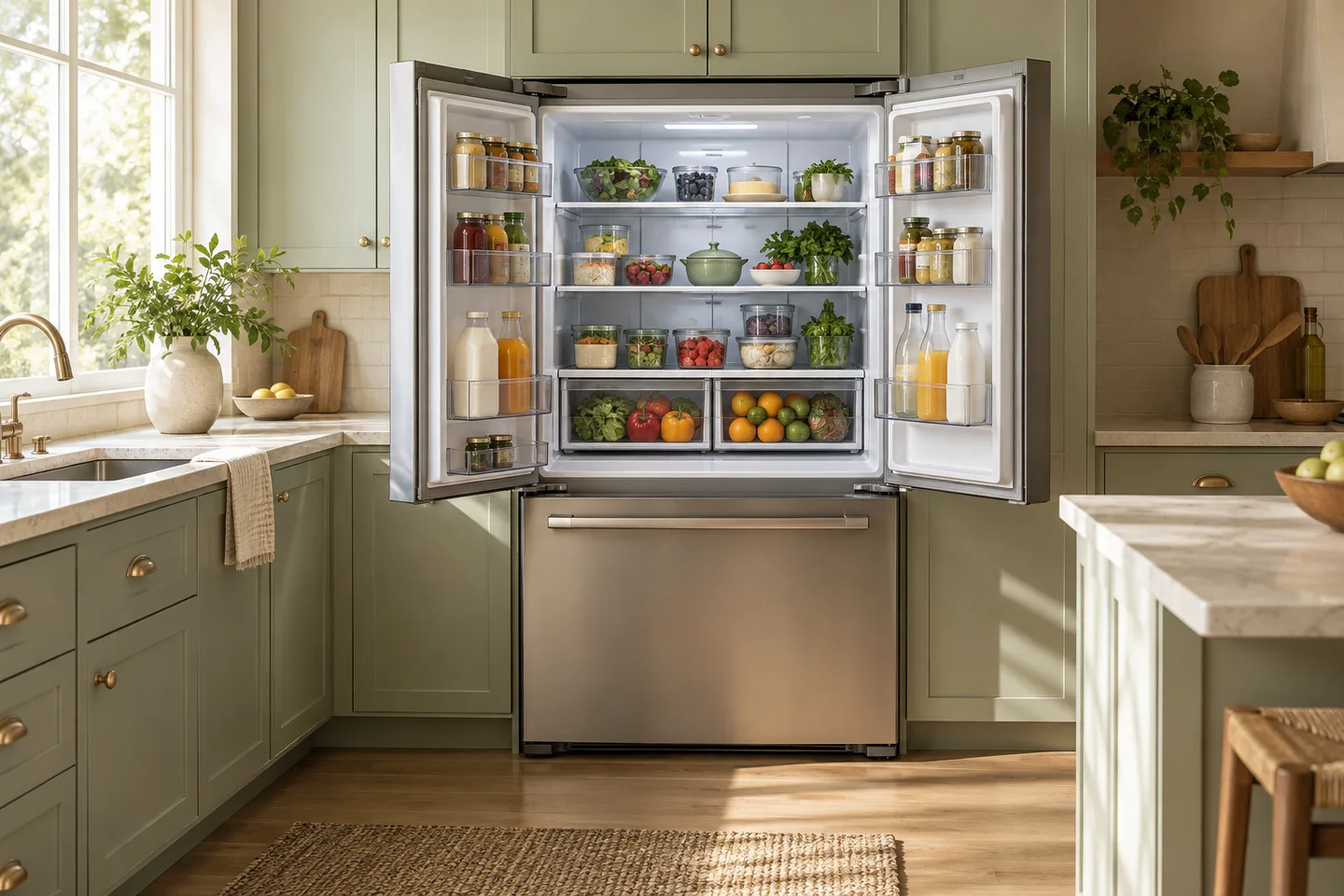
For a family that buys mostly fresh groceries, our first choice is a French-door refrigerator if it fits the kitchen and budget. Two upper doors reveal wide, eye-level shelves, while a lower drawer holds frozen food. For a simpler and often less expensive choice, we prefer a top-freezer refrigerator. ENERGY STAR says top-freezer models tend to use less electricity than other common layouts, but compare specific models using their EnergyGuide labels.
Consider a bottom-freezer refrigerator for fresh-food access without a pair of upper doors. A side-by-side model has narrower door swings and upright freezer shelves but less width for large containers. A four-door model offers separately organized compartments; temperature-adjustable zones are available only on certain models.
Measure the kitchen and delivery route before choosing a capacity or configuration. Advertised cubic feet will not help if the refrigerator blocks an adjacent drawer or cannot open far enough to remove its bins.
Refrigerator layouts at a glance
These are our recommended configurations for different household needs. Counter-depth and built-in are installation formats, not competing door layouts.
| Rank | Configuration | Best for | Arrangement | Main limitation |
|---|---|---|---|---|
| 1 | French-door | Households storing fresh food and wide dishes | Two upper refrigerator doors, lower freezer drawer | Low freezer access; frequently higher purchase price |
| 2 | Top-freezer | Lower-cost, energy-conscious shopping | Freezer above refrigerator | Low fresh-food shelves; wide door swing |
| 3 | Bottom-freezer | Easy access to frequently used fresh ingredients | Refrigerator above lower freezer | Bending to reach frozen food; single upper door swing |
| 4 | Side-by-side | Narrow door swings and organized frozen food | Tall refrigerator and freezer compartments alongside each other | Narrow shelves and freezer cavity |
| 5 | Four-door | Separate food-storage compartments | Two upper doors and two lower doors or drawers | Dividers can restrict large-item storage |
Prices vary substantially within each category. Compare exact model prices, installation costs, and dimensions rather than assigning a fixed price tier to a door layout.
Best refrigerator layout by need
| If your priority is... | Our first layout to investigate | What to check before buying |
|---|---|---|
| A main refrigerator for a fresh-food-heavy family | French-door | Shelf width, crisper space, freezer-drawer organization |
| Lower purchase cost and lower energy use | Top-freezer | Actual EnergyGuide kWh/year and door-swing clearance |
| Fresh ingredients without a premium feature package | Bottom-freezer | Hinge orientation, upper-door reach, lower-freezer access |
| A refrigerator next to an island or busy walkway | Side-by-side or French-door | Full door-open and drawer-open dimensions, not just closed depth |
| Frequent frozen-food access | Side-by-side or top-freezer | Frozen-food shelf width, freezer capacity, and eye-level access |
| Bulk produce, meal prep, and wide platters | French-door | Clear shelf width and tall-item adjustments |
| Separate snack, drink, or specialty zones | Four-door | Whether compartments have independent or convertible temperatures |
| A shallow cabinet run | Counter-depth version of a suitable layout | Depth with doors and handles, plus hinge projection |
| A narrow refrigerator opening | Narrow top-freezer or bottom-freezer | Exact width and required side clearance |
| A fully integrated kitchen | Built-in or panel-ready model | Cabinet cutout, ventilation, custom panel, and service access |
Always confirm these choices against a model's specification sheet and installation instructions.
What matters when comparing refrigerator layouts
Check these six factors before settling on a design:
- Installation feasibility: width, height, depth, ventilation, door travel, drawers, and delivery access. An impossible fit disqualifies a model.
- Storage suitability: separate refrigerator and freezer capacities, wide-item fit, shelf adjustability, and realistic grocery habits.
- Daily access: whether frequently used fresh and frozen foods are easy to see and reach.
- Kitchen circulation: how open doors affect islands, counters, other appliance doors, and walkways.
- Purchase and running costs: actual selling price, installation requirements, and model-specific energy use.
- Complexity and maintenance: whether water, ice, specialized drawers, and connected features provide enough benefit to justify their upkeep.
More doors, cubic feet, or features do not necessarily mean more usable storage.
1. French-door refrigerators - Best for fresh-food storage
A French-door refrigerator suits households that use fresh food more than frozen food and regularly store wide dishes. Two shorter upper doors open onto one full-width refrigerator cavity, while a lower freezer drawer holds frozen items. The upper doors need less swing space than one large door of comparable overall width, but the freezer drawer must still extend fully.
Key layout facts
| Attribute | French-door configuration |
|---|---|
| Fresh-food location | Upper, generally eye-level compartment |
| Freezer location | Lower pull-out drawer, sometimes multiple drawers |
| Door pattern | Two side-hinged refrigerator doors |
| Wide-item fit | Usually favorable because the main refrigerator cavity spans the cabinet |
| Common design variations | Standard-depth, counter-depth, additional drawer, interior or through-door ice/water |
| Main fit measurements | Width, height to hinges, closed depth with handles, both doors at 90 degrees, freezer drawer fully open |
Fresh-food access and shelf width
The full-width upper compartment accepts wide trays, produce boxes, and meal-prep containers that may not fit side-by-side shelves. Two shorter doors can also help around an island. Consumer Reports cautions that actual usable capacity may be less than the advertised volume, so inspect interior dimensions before buying.
Best for: Families with frequent fresh-food access; people storing trays or wide containers; kitchens where two smaller upper doors clear surrounding cabinetry.
Limitations
- Freezer items sit low, and stacked drawer bins can obscure food beneath them.
- Models with multiple ice makers, dispensers, or specialty drawers can cost more and consume useful storage space.
- Many French-door models are wide; a particular 36-inch opening does not guarantee a 36-inch-nominal refrigerator will fit with clearances.
2. Top-freezer refrigerators - Our value and efficiency choice
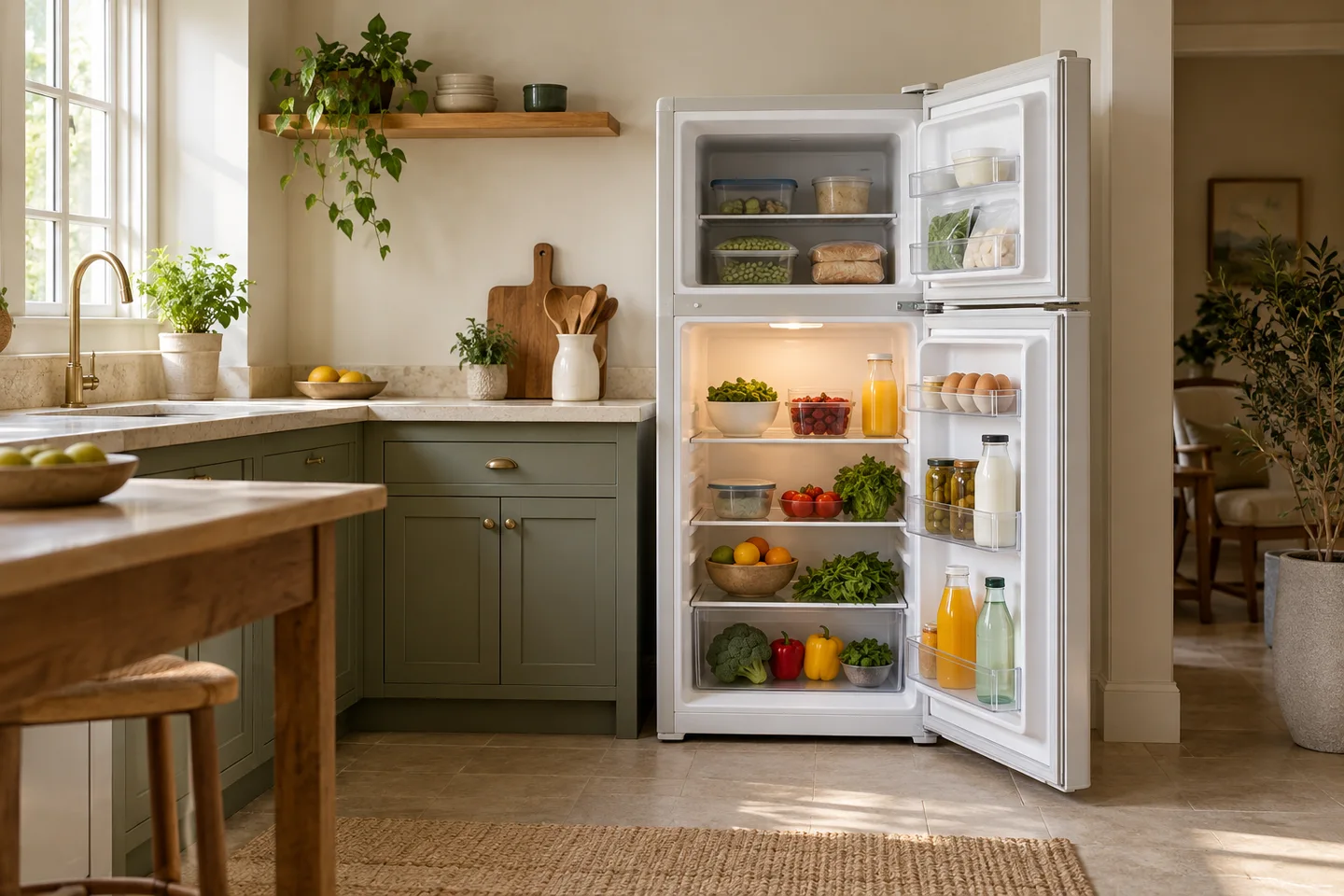
A top-freezer refrigerator is our pick when purchase cost and energy use outweigh premium features. Its freezer sits above the refrigerator, with a separate side-hinged door for each section. ENERGY STAR reports that this configuration tends to use less electricity than bottom-freezer and side-by-side designs; the exact model's EnergyGuide label determines the comparison.
Key layout facts
| Attribute | Top-freezer configuration |
|---|---|
| Fresh-food location | Lower main compartment |
| Freezer location | Upper compartment |
| Door pattern | Separate side-hinged doors |
| Wide-item fit | Often good within a simple full-width compartment |
| Common design variations | Compact and full-size widths; reversible doors on some models; optional ice maker on some models |
| Main fit measurements | Door-swing width, hinge side, overall depth, and overhead clearance |
Cost and energy considerations
Top-freezer designs generally have fewer premium features and lower entry prices than feature-rich French-door refrigerators. They also give straightforward access to frozen food. Their category-level efficiency advantage does not establish the annual energy use of an individual unit.
Best for: A first full-size refrigerator; apartments and smaller kitchens; buyers who would rather pay for adequate storage than dispensers or screens; households that reach for frozen foods frequently.
Limitations
- Frequently used produce drawers and lower refrigerator shelves require more bending.
- A single wide door can interfere with a wall or island.
- Water dispensers, specialized drawers, and premium organization features are less common in this format.
3. Bottom-freezer refrigerators - Best for straightforward fresh-food access
A bottom-freezer refrigerator puts fresh food at eye level without requiring the twin upper doors of a French-door model. Most designs have one full-width refrigerator door with a freezer drawer or door below.
Key layout facts
| Attribute | Bottom-freezer configuration |
|---|---|
| Fresh-food location | Upper compartment |
| Freezer location | Lower drawer or door |
| Door pattern | Usually one upper hinged door; lower opening varies |
| Wide-item fit | Full-width refrigerator cavity |
| Common design variations | Slim models, reversible upper hinges on some models, different lower-bin arrangements |
| Main fit measurements | Upper-door swing, freezer extension, hinge clearance, and height |
Fresh-food ergonomics
This arrangement reduces bending for frequently used produce, dairy, and leftovers, provided the upper door opens fully. The trade-off is more bending for frozen food and a potentially wide swing from the single upper door.
Best for: Couples or households prioritizing fresh produce; shoppers who want wide shelves in a narrower appliance; people who do not need many premium features.
Limitations
- Bending is still necessary to reach lower freezer items.
- The single upper door may need more lateral clearance than a French-door pair.
- The bottom compartment's baskets may be inconvenient for very frequent freezer use.
4. Side-by-side refrigerators - Best for narrow door swings and visible frozen food
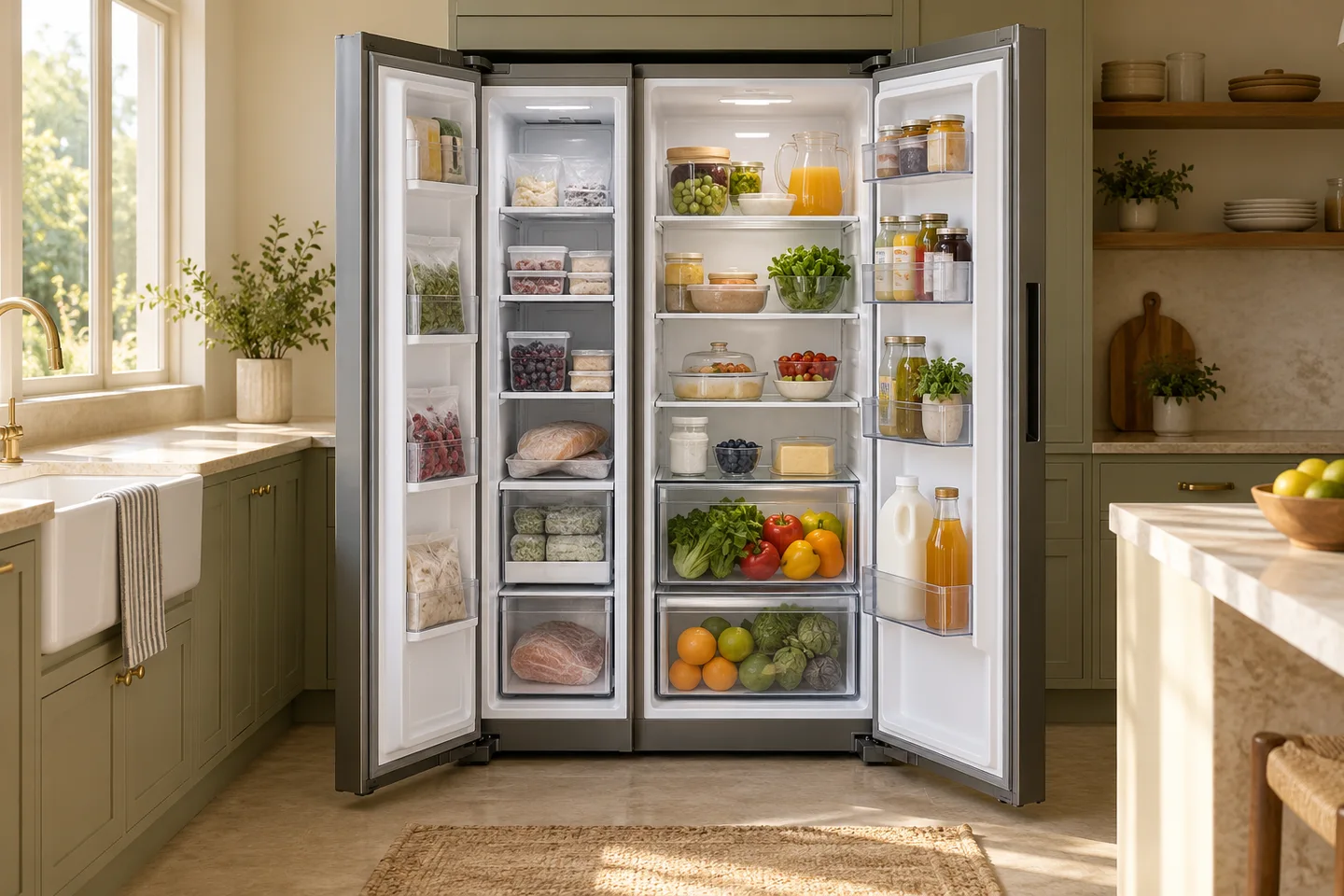
A side-by-side refrigerator is our pick for limited door-swing clearance when the household's food fits narrower shelves. Two tall compartments sit next to each other, one refrigerated and one frozen. Each door is narrower than a full-width single door, and both sections have shelves at eye level.
Key layout facts
| Attribute | Side-by-side configuration |
|---|---|
| Fresh-food location | One full-height vertical side |
| Freezer location | Opposite full-height vertical side |
| Door pattern | Two tall side-hinged doors |
| Wide-item fit | Limited by the narrower individual compartment widths |
| Common design variations | Counter-depth and standard-depth; interior or exterior ice/water on select models |
| Main fit measurements | Both doors at 90 degrees, hinge clearance, width with doors open, and usable shelf width |
Door clearance and freezer access
The smaller outward sweep of each door can preserve room near an island. Freezer shelves also make packages visible at multiple heights. Consumer Reports notes the compromise: wide frozen boxes, platters, and baking dishes may not fit.
Best for: High-traffic or narrow kitchens; people who want visible freezer shelves; households with many small or medium frozen-food packages.
Limitations
- Large baking sheets, pizza boxes, and wide storage containers may not fit either side.
- Through-door dispenser assemblies may reduce freezer-door or shelf storage, depending on the model.
- A narrow door still needs hinge clearance to open far enough for bins to be removed.
5. Four-door refrigerators - Best for compartment-based organization
Four-door refrigerators offer separate compartments that can help organize different types of food. Common designs have two upper refrigerator doors and two lower openings. Some models offer a section that switches between refrigeration and freezing; this feature is not standard on every four-door model.
Key layout facts
| Attribute | Four-door configuration |
|---|---|
| Fresh-food location | Usually upper section, potentially other adjustable sections |
| Freezer location | Typically one or more lower compartments |
| Door pattern | Four separate openings; lower doors or drawers vary |
| Wide-item fit | Depends on internal dividers and shelf geometry |
| Common design variations | Fixed lower freezer zones or convertible-temperature sections |
| Main fit measurements | All four openings, lower-drawer extension, hinge and handle projection |
Separate storage compartments
Separate freezer compartments can make it easier to organize frozen meals, ingredients, and snacks. Inspect the lower-compartment dimensions and controls: partitions reduce the space available for large objects, and convertible temperature controls vary by model.
Best for: Households organizing meals by category; users who want more freezer subdivisions; buyers who can benefit from verified temperature-flexibility features.
Limitations
- Extra doors and dividers can make large objects awkward to fit.
- Convertible temperature functions and separate control zones are not universal.
- Added features can raise cost without increasing useful capacity.
How much refrigerator capacity do you need?
Start with eating and shopping habits, then use household size as a rough check. Whirlpool suggests 4-6 cubic feet per person as a general rule of thumb and around 20 cubic feet for a four-person household. The split between refrigerated and frozen storage can matter more than the combined figure.
| Household pattern | Our capacity approach | Reason to move up or down |
|---|---|---|
| One person or a couple who shops frequently | Consider a smaller full-size model before paying for extra volume | Frequent grocery trips and limited frozen storage may reduce the need |
| Three or four people with mixed groceries | Use roughly 20 cu. ft. as an initial comparison point | Bulk shopping, packed lunches, and leftovers may require more |
| Five or more people, or a household buying in bulk | Investigate larger-capacity models and a separate freezer if needed | Total volume alone may not solve a freezer-heavy storage problem |
| Home cooks who store wide platters | Prioritize uninterrupted shelf width over headline cubic feet | A wider cavity can accept containers a narrow compartment cannot |
| Households with extensive frozen-food storage | Compare freezer cubic feet separately | A high total capacity may still be concentrated in fresh food |
Advertised cubic feet are not the same as usable storage. The total may combine refrigerator and freezer volume, while shelves, drawers, door bins, and an icemaker influence what actually fits. Consumer Reports cautions that advertised and usable capacity can differ. Measure large containers and inspect adjustable shelf positions in person if possible.
Check the space you will actually use
- List what currently does not fit: weekly produce, lunch containers, tall bottles, bulk meat, frozen boxes, or party trays.
- Separate fresh-food complaints from freezer complaints. These call for different layouts or an additional freezer.
- Compare the candidate's fresh-food volume and freezer volume separately, not just the total.
- Check adjustable-shelf positions and the clear height and width of the shelves you will use.
- Leave working room for air circulation. The FDA warns against packing refrigerators so tightly that cold air cannot circulate around food.
How to measure a refrigerator so it actually fits
Measure the installation opening, the open-door footprint, and the delivery route. The width, height, and depth printed on a retail card are not enough. GE Appliances advises checking hinge-side clearance, ventilation, and whether open doors allow bins to be removed.
1. Measure the cabinet opening
Record these dimensions in inches:
- Width: Measure near the top, middle, and bottom; use the narrowest dimension.
- Height: Measure floor to the lowest obstruction, including upper-cabinet trim. Check whether the floor slopes.
- Depth: Measure from the back wall to the front of the countertop, then account for a water line, outlet, or any projecting trim.
- Surroundings: Note a wall on the hinge side, nearby countertop returns, handles on adjacent appliances, and a kitchen island.
2. Compare all the relevant appliance dimensions
| Specification to find | Why it matters |
|---|---|
| Width of cabinet | Determines whether the refrigerator body fits the opening |
| Width with doors open | Checks hinge and sidewall interference |
| Height to top of case | May differ from height to top of hinge |
| Height to top of hinge | Often the critical overhead-cabinet dimension |
| Depth without door | Useful for comparing cabinet-body projection |
| Depth with door, without handle | Shows how far the closed front extends |
| Depth with handle | Shows the actual closed projection into the room |
| Depth with door open 90 degrees | Checks island and walkway interference |
| Depth with freezer drawer open | Checks whether the drawer can extend and its baskets can be reached |
Whirlpool and GE publish measurement diagrams distinguishing these values. Door and drawer dimensions differ by model, so use the selected model's installation instructions or dimensional drawing.
3. Allow the clearances in that model's manual
Clearance requirements vary by model. GE's general guidance calls for space above and behind the appliance and additional room beside a hinge near a wall. Follow the selected refrigerator's installation guide for side, top, rear, and door-opening requirements.
Worked example: If the narrowest opening is 36 inches and a candidate's instructions require 1/2 inch on each side, the cabinet itself must be no wider than 35 inches. That arithmetic does not establish adequate hinge, top, rear, or open-door clearance. Do not assume a product advertised as "36-inch wide" will fit a 36-inch opening.
4. Open the doors on paper before ordering
Mark the door arcs and freezer-drawer travel on a floor plan. Verify that the refrigerator doors can open far enough to pull out crispers and bins, not merely far enough to reach for milk. Also check the remaining passage around the open doors and the clearance to the island.
5. Measure the delivery route and utilities
Check every doorway, hallway, stair landing, turn, and elevator on the path from delivery vehicle to kitchen. Ask whether the delivery team can remove and reinstall doors, and whether doing so is permissible for the selected model. For an icemaker or dispenser, verify the water-supply location, connection requirements, and any needed shutoff or filter access in the installation manual. Confirm that the required outlet remains accessible according to the manufacturer's instructions.
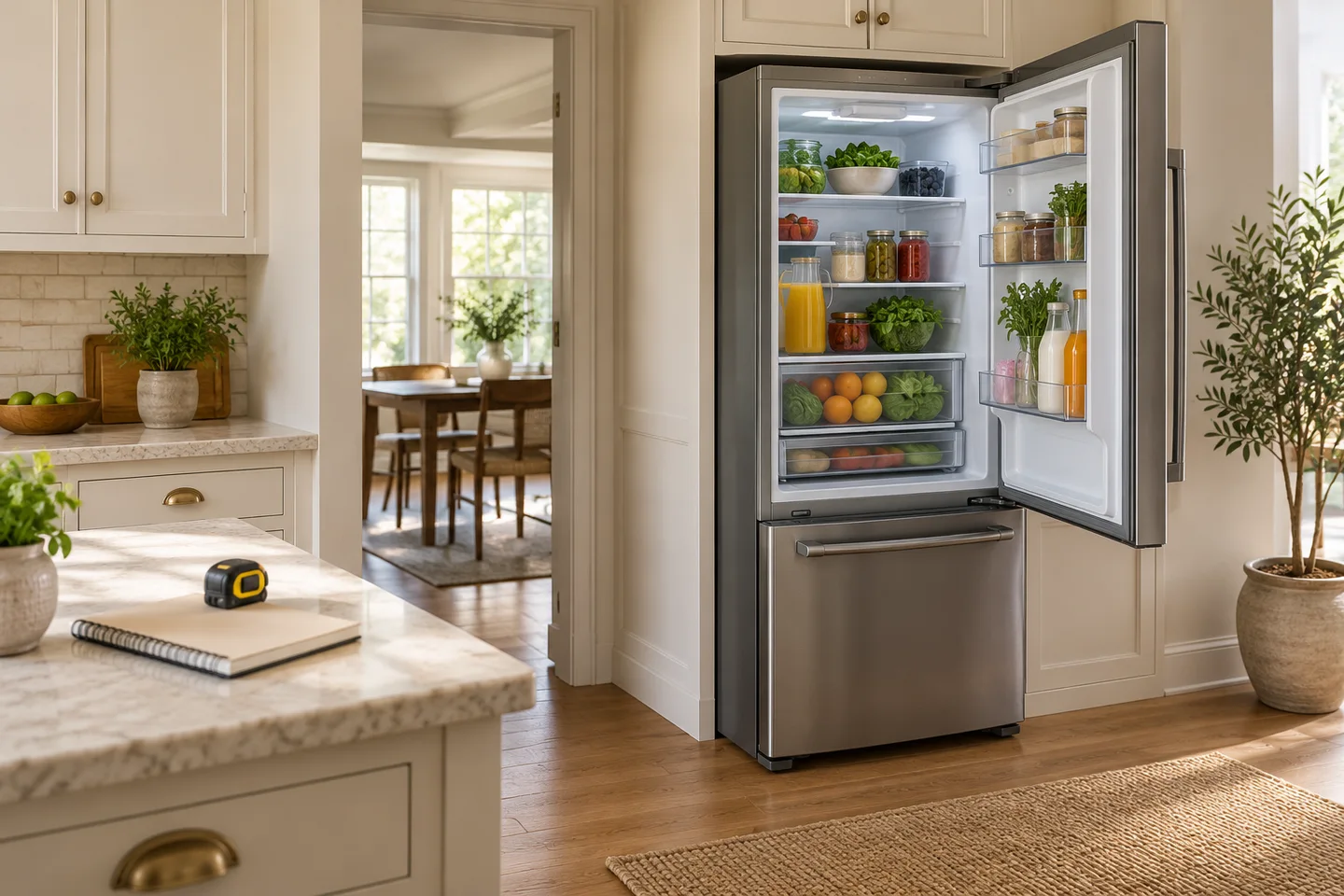
Counter-depth vs. standard-depth refrigerators
Choose counter-depth if less projection into the kitchen matters more than maximum volume. Standard-depth is the better starting point if storage capacity and price are the priorities. Counter-depth describes the refrigerator body relative to the counters; doors and handles may still extend outward. GE describes the cabinet front, excluding doors, as a common reference for the term.
| Question | Counter-depth | Standard-depth |
|---|---|---|
| How far does it project? | Generally shallower cabinet body | Generally projects farther into the room |
| Usable capacity at similar width? | Often less, although height or width can compensate | Often more |
| Does the door still stick out? | Often yes; inspect door and handle measurements | Yes, and usually farther |
| Does it require a custom opening? | Not necessarily | Not necessarily |
| Best reason to choose it | Traffic flow and visual alignment | Storage capacity and value |
Depth ranges overlap across products. Use the individual model's drawing to establish fit.
What about built-in and panel-ready refrigerators?
Built-in describes an installation designed around cabinetry; panel-ready means the appliance accepts a compatible custom panel. Built-in models may use different door configurations. Cabinet openings, ventilation, electrical placement, panel weight, and service access are model-specific. Sub-Zero's design guide, for example, specifies separate dimensions and panel requirements for its products.
Consider built-in refrigeration when cabinetry integration is a priority. For a routine replacement, start with models designed for the existing opening.
Which features are worth paying for?
| Feature | When it helps | Main thing to verify |
|---|---|---|
| Adjustable shelves and bins | Prioritize them if you store tall bottles or unusually shaped containers | Real adjustment range and shelf support |
| Full-width pantry drawer | Useful for platters, deli items, and low-profile containers | Clear drawer width, height, and access with doors open |
| Exterior ice and water | Buy for frequent use, not simply because the model has it | Plumbing, filter cost, ice-bin footprint, and maintenance |
| Interior water dispenser | Consider if you want filtered water without an exterior opening | Door access and lost interior space |
| Convertible refrigerator/freezer compartment | Worth considering for seasonal freezer or fresh-food changes | Confirm exact modes and temperature limits for the model |
| Door-in-door access or screen | Lowest priority unless it solves a clear daily need | Whether it crowds door bins and changes cost |
| ENERGY STAR certification | A useful efficiency filter | Model-specific EnergyGuide kWh/year still matters |
ENERGY STAR advises considering fewer doors for efficiency. EnergyGuide labels provide estimated annual energy use for individual models. For daily utility, we would prioritize accessible, adjustable shelves over connected extras.
How to compare refrigerator energy costs
Use the yellow EnergyGuide label, especially its annual electricity consumption estimate in kilowatt-hours (kWh/year). The label's dollar figure uses a standardized electricity-rate assumption, so your bill will depend on your rate and usage. Compare refrigerators of similar capacity and configuration.
For a rough personal running-cost estimate:
Annual electricity cost = EnergyGuide kWh/year x your electricity price per kWh.
At 400 kWh/year and $0.18/kWh, the estimated cost is $72 per year. If two candidate labels differ by 100 kWh/year, the estimated annual cost difference at the same rate is $18. These are calculation examples, not costs quoted for particular models.
ENERGY STAR says its certified refrigerators are about 9% more energy efficient than models meeting the U.S. federal minimum standard. It also advises buying an appropriately sized refrigerator: more volume usually means more energy consumption, and the most efficient models are commonly in the 16-20 cu. ft. range. Certification helps narrow the list, but annual kWh allows the final model-to-model comparison.
French-door vs. side-by-side: Which is better?
Choose French-door for a wide, shared fresh-food compartment and large trays; choose side-by-side for vertically organized freezer shelves and narrower door swings. French-door freezers usually sit in a lower drawer, while side-by-side freezers run top to bottom. Neither is always better for a tight kitchen: the French-door freezer drawer can interfere with an island even if its upper doors clear it.
Top-freezer vs. bottom-freezer: Which is better?
Choose top-freezer for budget and the category's typical energy advantage; choose bottom-freezer for more convenient access to fresh food. A top-freezer puts frozen items high and often-used refrigerator shelves lower. A bottom-freezer reverses that relationship but moves the freezer to a low drawer or door. Energy use still needs to be checked at the model level.
French-door vs. bottom-freezer: Which should you buy?
Choose French-door when two shorter upper door swings and wider-feature selections justify the premium. Choose a single-door bottom-freezer when you want eye-level fresh food in a simpler format. Both can offer a full-width refrigerator compartment and a low freezer, so the major difference is upper-door access, available models, and often feature complexity rather than the fundamental fresh-food position.
Counter-depth vs. built-in: Are they the same?
No. A counter-depth refrigerator is a shallower freestanding design intended to project less beyond adjacent counters. A built-in appliance is designed around a specified cabinetry installation and may accept a custom panel. Neither term tells you the door layout, capacity, or exact open-door projection. Check the installation documents, particularly if replacing a built-in unit.
Refrigerator buying checklist
Before paying a deposit, verify all of the following for the exact model and finish:
- [ ] Narrowest opening width, lowest opening height, and available depth
- [ ] Model-specific side, top, and rear installation clearances
- [ ] Hinge-side clearance and width with doors open
- [ ] Clearance with freezer drawers fully extended
- [ ] Route through all doorways, turns, stairs, and elevators
- [ ] Required water connection and accessible electrical outlet
- [ ] Separate refrigerator and freezer capacities
- [ ] Fit of your widest and tallest regularly stored items
- [ ] Whether shelves and door bins can be removed at the planned door angle
- [ ] EnergyGuide kWh/year and ENERGY STAR status, if relevant
- [ ] Warranty, service terms, delivery, installation, and haul-away costs for the exact seller and model
- [ ] Return policy for an appliance that fits physically but not operationally
Keep the candidate's dimensional drawing and installation guide with your order. A retailer's one-line "width x height x depth" listing does not replace them.
Frequently asked questions
What is the best refrigerator layout for a family of four?
Our first recommendation is a French-door refrigerator if the family uses fresh groceries heavily and has sufficient clearance. Use around 20 cubic feet as an initial capacity comparison, then adjust for shopping habits and freezer demand. A top-freezer refrigerator may be a better match when cost and energy use matter more. The 20-cubic-foot figure is a rough household starting point, not a minimum.
How many cubic feet of refrigerator space does one person need?
A common manufacturer guideline is about 4-6 cubic feet per person, but do not multiply that number and treat the result as an exact appliance specification. Consider grocery frequency, freezer habits, and whether the listed figure combines freezer and refrigerator volume.
Does a counter-depth refrigerator have less space?
Often, yes, compared with a similarly wide standard-depth model. A shallower cabinet reduces depth, although some models compensate with different widths or heights. Always compare actual section volumes and shelf geometry rather than assuming every counter-depth unit is small.
Will a 36-inch refrigerator fit a 36-inch opening?
Not necessarily. Nominal width is not the complete installed width. The model may need space at its sides, above and behind it, and additional clearance on the hinge side. Use the specific installation guide and the narrowest measured opening.
How much space should be behind a refrigerator?
Use the model-specific installation requirement. GE's general guide mentions at least an inch at the back for its measuring advice, but clearances differ among products. Do not apply one brand's illustration as a universal building rule.
Can a refrigerator door open against a wall?
Only if the specific hinge geometry and required clearance permit full use. A door may reach 90 degrees yet block removal of a crisper or shelf. Check the open-door width and bin-removal instructions; pulling the cabinet forward may be an option only where the installer permits it.
Which refrigerator layout uses the least electricity?
Top-freezer models tend to be the most efficient configuration, according to ENERGY STAR. That is a category tendency, not a guarantee. Compare the actual kWh/year values of specific models with similar capacity and features.
Is ENERGY STAR enough to choose between two refrigerators?
No. ENERGY STAR certification identifies products that meet efficiency criteria. Two certified models can still have different annual energy use. Consult their EnergyGuide labels for model-specific estimates and account for capacity differences.
Do water dispensers and ice makers affect the buying decision?
Yes, if they require plumbing, filters, maintenance, or storage volume that you would otherwise use. Check the specific model's interior layout and water-line installation requirements. We would not pay extra for an ice feature unless the household regularly uses it.
Is a bottom-freezer refrigerator good for older adults?
It may be easier for someone who accesses fresh food more often and prefers those shelves higher up. It is less convenient for anyone who has difficulty reaching into a lower freezer. Personal reach height, strength, mobility, and the actual handle and drawer force matter more than the category name.
Can a compact refrigerator replace a full-size refrigerator?
Only when its storage volume, freezer performance, and food-safety capability match the intended use. Many compact or undercounter designs provide much less freezer space. Use appliance thermometers to verify that the refrigerator stays at or below 40°F and the freezer, if used for frozen storage, at 0°F.
What temperature should a new refrigerator maintain?
The FDA recommends 40°F (4°C) or below for the refrigerator and 0°F (-18°C) for the freezer. Verify actual temperatures with appliance thermometers rather than assuming a control dial or setpoint reflects every shelf's temperature.
How we researched this guide
The recommendations compare configuration, fit, capacity, and energy guidance from manufacturer specifications, ENERGY STAR, the Federal Trade Commission, and Consumer Reports.
Sources and references
- Whirlpool: What Types of Refrigerators Are Best for Your Kitchen? - layout descriptions and variants.
- ENERGY STAR: Refrigerators - efficiency and sizing guidance.
- Federal Trade Commission: How To Use the EnergyGuide Label To Shop for Home Appliances - comparison and cost-estimate guidance.
- GE Appliances: Measuring for the Perfect Refrigerator Fit - dimensions and installation clearance.
- Whirlpool: Refrigerator Sizes: How to Measure Fridge Dimensions - household capacity and delivery planning.
- Consumer Reports: Choose the Right Refrigerator for Your Kitchen - configuration trade-offs.
- Whirlpool: French Door vs. Side-by-Side Refrigerators - compartment and door-swing comparisons.
- Whirlpool: Bottom-Freezer Fridges: A Guide - fresh-food and freezer access.
- GE Appliances: What Is a Counter-Depth Refrigerator? - depth definitions.
- Whirlpool: Counter-Depth Refrigerator Dimensions & Sizes - dimensional variation.
- Sub-Zero: Sub-Zero Design Guide - built-in opening and panel requirements.
- Food and Drug Administration: Refrigerator Thermometers - Cold Facts about Food Safety - temperatures and safe storage.