Range Hood Buying Guide: Ventilation, Size, and Installation
For most kitchens, we recommend a ducted overhead range hood at least as wide as the cooking surface, with a canopy that covers as much of the front burners as practical and a correctly sized exhaust route outdoors. An undercabinet hood suits a wall range with upper cabinets; a chimney-style canopy suits an open wall. Verify airflow, duct requirements, and mounting height for the exact model before ordering.
If outdoor ducting is impractical, a ductless hood with grease and charcoal filters is a compromise. It recirculates filtered air but does not carry cooking moisture or combustion emissions outside.
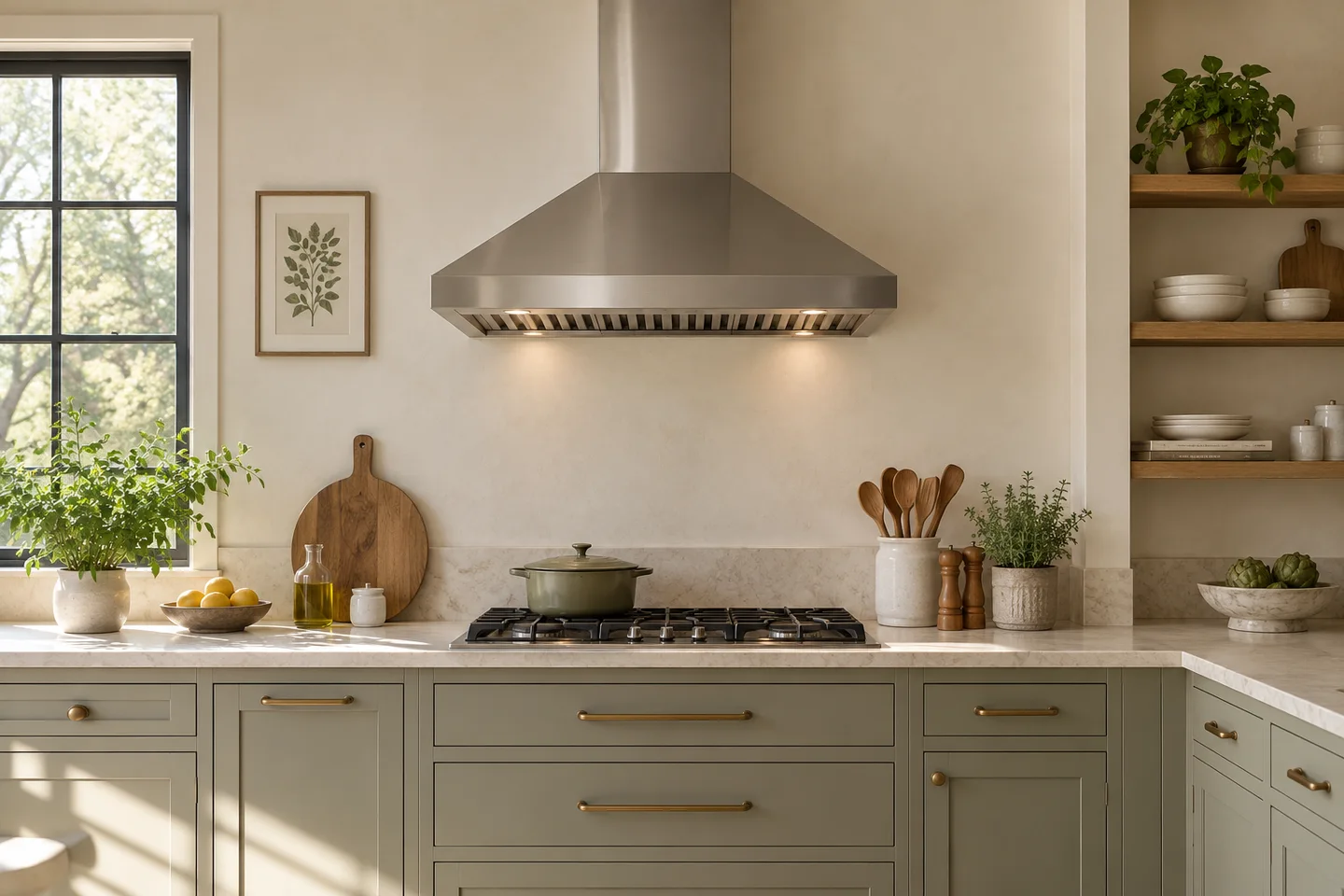
Range hood options at a glance
The layout and duct route determine which design makes sense. These are alternatives for different kitchens, not a performance ranking.
| Hood type | Best for | What to check | Main limitation |
|---|---|---|---|
| Ducted undercabinet hood | Range against a wall with upper cabinets | Cabinet opening, depth, duct outlet, rated airflow | Shallow or flat-bottom designs may cover front burners poorly |
| Ducted wall-mount canopy | Range against a wall without upper cabinets | Width, canopy depth, chimney/ceiling clearance, duct path | Needs open wall space and often more finishing work |
| Ducted built-in insert | Custom wood or metal hood enclosure | Insert-to-liner fit, approved enclosure, blower compatibility | Performance depends on the complete enclosure |
| Ducted island canopy | Cooktop on an island or peninsula | Ceiling support, coverage on exposed sides, duct path | More exposed to room currents and often needs greater airflow |
| Ducted downdraft | Overhead hood is impractical | Cooktop compatibility, cabinet space, underfloor duct path | Generally captures rising emissions less effectively |
| Ductless recirculating hood | No permitted or practical outdoor duct route | Listing, charcoal-filter availability, other ventilation | Does not exhaust pollutants or moisture outdoors |
Which range hood should you choose?
| Your kitchen or cooking pattern | Recommended approach | Why |
|---|---|---|
| High-output gas range or frequent searing | Broad, deep ducted canopy matched to the range manufacturer's ventilation requirements | Captures more of the plume before it escapes into the room |
| Induction or electric cooktop | Appropriately sized ducted overhead hood | Cooking still produces particles, grease aerosols, steam, and odors |
| Frequent light cooking and noise sensitivity | Multispeed hood with independently rated airflow and sound | Allows a quieter low setting and a stronger setting when needed |
| High ceiling or long duct path | Model and blower selected with the duct design | Restrictive ducts can reduce delivered airflow |
| No feasible outdoor duct | Listed recirculating hood; assess separate outdoor ventilation | Filters some grease and odors without exhausting the room's air |
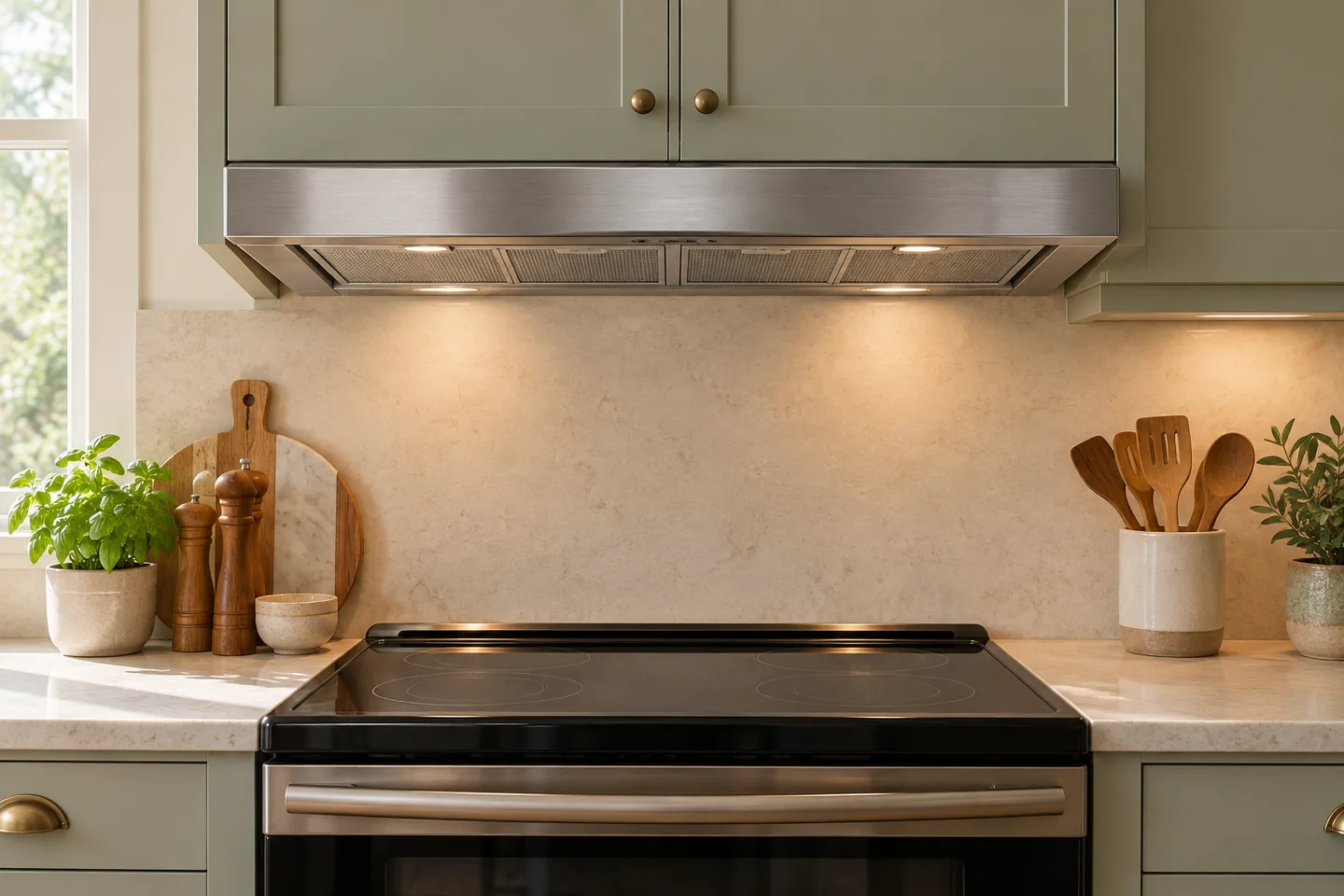
Ducted undercabinet hoods - for ranges beneath upper cabinets
An undercabinet hood fits beneath the existing cabinetry and can exhaust through a wall or roof. We favor a canopy with substantial front-to-back coverage over an ultra-thin, flat-bottom design: installed-home research found that devices without a true capture hood could capture less at comparable airflow.
Check before buying:
- Hood width and depth against the cooktop and cabinet opening.
- Rated airflow and sound, duct diameter, and top or rear outlet position.
- Whether the exact configuration vents outdoors or is designed for recirculation.
Upper cabinets can constrain mounting clearance and duct routing. A replacement hood may fit the opening while requiring a larger duct than the one already installed.
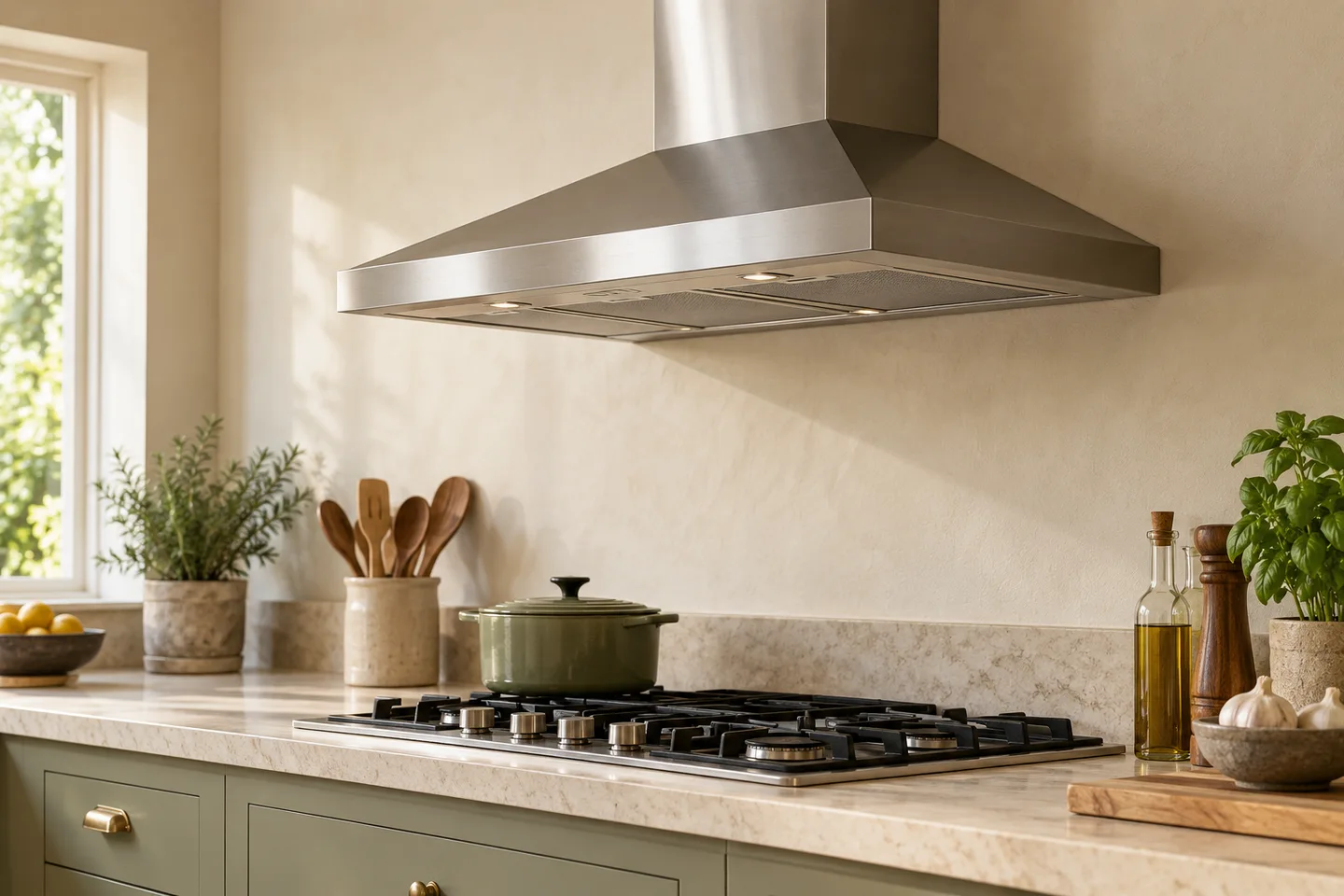
Ducted wall-mount canopies - for open walls
A wall-mount canopy fits above a range without overhead cabinetry. Its open collection area can extend over more of the burners, although appearance alone cannot establish capture performance.
Check before buying:
- Width and depth of the canopy relative to the burners.
- Chimney adjustment range, ceiling height, and duct dimensions.
- Wall support, electrical location, and the outdoor duct route.
Wall-mount models often need more finishing work than replacements under existing cabinets. Confirm the installation drawing before finalizing tile, electrical placement, and adjacent cabinetry.
Ducted hood inserts - for custom enclosures
An insert, also called a power pack in some product lines, mounts inside a decorative hood or cabinet enclosure. It allows a concealed appearance while retaining an overhead capture area.
Check before buying:
- The specified enclosure cutout, liner, and heat-clearance requirements.
- Compatibility among the insert, blower, duct, and cooking appliance.
- Access to grease filters and serviceable parts after cabinetry is complete.
The enclosure must provide enough capture coverage, not simply hide a fan. Coordinate the exact model's dimensions and instructions with the cabinet builder before fabrication.
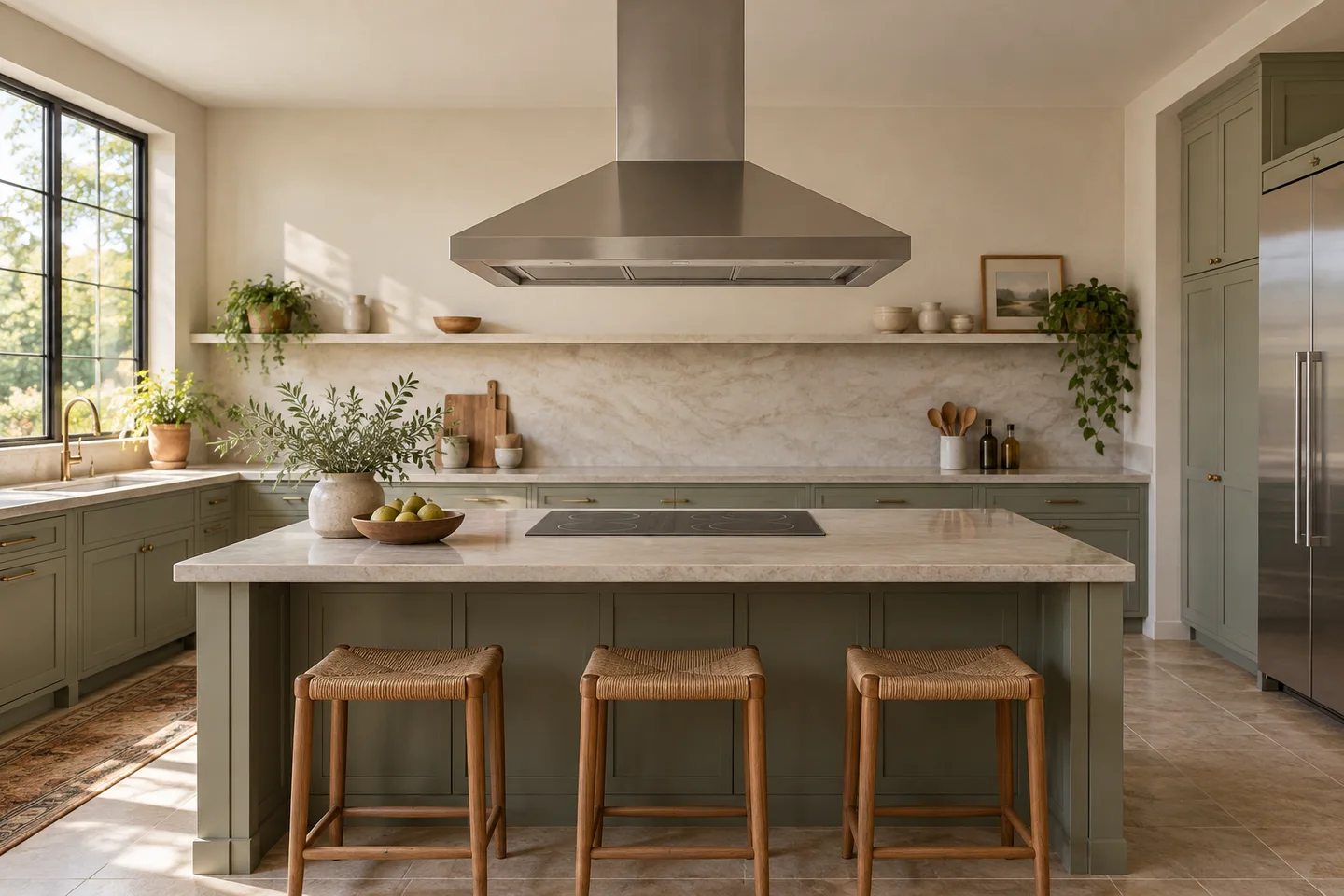
Ducted island canopies - for island cooktops
An island canopy hangs above a cooktop away from a wall. Because the plume is exposed to air movement on all sides, canopy coverage and a stable overhead capture area are especially important. The Home Ventilating Institute (HVI) recommends a higher planning airflow for islands than for wall installations of the same width.
Check before buying:
- Width and depth, with extra overlap where space allows.
- Ceiling support, mounting height, and the route to an outdoor termination.
- Rated airflow, cross-drafts, and possible makeup-air requirements.
High ceilings and long duct runs can complicate the design. A ceiling-flush extractor should be assessed on its own documented performance rather than assumed to capture like a suspended canopy.
Ducted downdrafts - when overhead capture is impractical
Downdraft systems pull air sideways or downward near the cooktop. They preserve overhead sightlines but must redirect a naturally rising plume. HVI reports that downdraft systems generally cannot match the capture of a well-positioned overhead canopy.
Check before buying:
- Exact cooktop compatibility and cabinet cutout requirements.
- Rise height, if retractable, and its position relative to tall cookware.
- Cabinet or underfloor space for the duct and blower.
Downdrafts can perform poorly at front burners and with tall pots. Treat them as a layout alternative, not a ventilation upgrade over an effective overhead hood.
What size range hood do you need?
Start with a hood at least as wide as the range or cooktop. A 30-inch cooktop generally calls for a hood at least 30 inches wide; a 36-inch cooktop calls for at least 36 inches. Additional width can help where space permits, especially over islands or with frequent high-heat cooking. The canopy should also reach over as much of the front-burner area as practical.
Width alone is not a full sizing plan. A 36-inch hood with a shallow bottom can capture less effectively than a deeper hood with the same airflow. Laboratory and installed-home studies show that burner position and hood coverage can materially change capture efficiency.
How many CFM should a range hood have?
CFM means cubic feet of air per minute. HVI recommends the following general planning airflow rates by cooking-surface width and position.
| Cooking-surface width | Against a wall: HVI-recommended airflow | On an island: HVI-recommended airflow |
|---|---|---|
| 24 inches | 200 CFM | 300 CFM |
| 30 inches | 250 CFM | 375 CFM |
| 36 inches | 300 CFM | 450 CFM |
| 48 inches | 400 CFM | 600 CFM |
The rates use 100 CFM per linear foot against a wall and 150 CFM per linear foot for an island. They are guidelines, not tested delivery rates or legal minimums. High-output ranges, indoor grills, heavy wok cooking, and unusual ducts require the cooking-appliance and hood manufacturers' specific guidance.
For comparison, the 2024 International Residential Code (IRC) model code specifies a minimum local kitchen exhaust rate of 100 CFM intermittently or 25 CFM continuously. Adopted local codes can differ. Meeting a code minimum does not, by itself, establish good capture of cooking emissions.
Is a higher CFM rating always better?
No. More airflow can improve capture, but duct resistance, hood shape, depth, and burner position influence real performance. An exhaust fan that moves a high volume of air under favorable test conditions can deliver much less once connected to a long or restrictive duct.
When comparing models, prioritize:
- A hood canopy that covers the active burners.
- An outdoor duct route that supports the proposed airflow.
- An independently verified airflow rating at a clearly stated test condition.
- Several useful fan speeds with acceptable sound.
- A makeup-air plan when required.
Do not purchase a very high-CFM hood before confirming whether the home and local code require additional makeup air or other work.
Ducted vs. ductless: which actually ventilates the kitchen?
A ducted hood carries captured cooking emissions outdoors. A ductless hood passes air through filters and returns it to the room. The Environmental Protection Agency (EPA) recommends running an outdoor-vented hood while cooking and for 10 to 20 minutes afterward.
| Question | Ducted hood | Ductless hood |
|---|---|---|
| Sends captured air outdoors? | Yes, if installed and functioning correctly | No |
| Removes cooking moisture from the house? | Yes, through exhausted air | No |
| Needs an exterior exhaust route? | Yes | No |
| Needs grease-filter cleaning? | Yes | Yes |
| Usually needs disposable charcoal filters? | No, not for ordinary ducted exhaust | Yes, for odor filtration |
| Best application | Most permanent kitchens with feasible duct routing | Layouts where outdoor ducting cannot be provided |
Recirculating charcoal filters can reduce some odors but cannot be assumed to remove all fine particles or gas-phase pollutants. If outdoor cooking exhaust is unavailable, use other ventilation and air-cleaning measures appropriate to the home, recognizing that they are not identical to source capture.
Range hood mounting height, depth, and coverage
Install at the height specified for the exact hood and cooking appliance. HVI reports that manufacturer instructions commonly specify heights in the 20- to 30-inch range, but individual models can require different clearances for gas and electric cooktops. Never substitute a general range for the model's safety instructions.
Check four measurements before ordering:
- Width: The physical cooking surface and available side clearances.
- Depth: How much of the front burners sits beneath the capture area.
- Vertical clearance: The permitted distance from cooking surface to hood bottom for that model and cooktop.
- Duct exit: The actual top or rear outlet position and clearance needed for elbows and transitions.
If a hood is mounted higher than its approved installation range, smoke and steam may escape before reaching it. Never lower the hood below its required safety clearance to gain capture.
What makes a range hood quiet enough to use?
Compare noise ratings at the fan setting you expect to use, not only the quietest advertised setting. Sound is often expressed in sones. HVI publishes certified sound ratings for listed models; ENERGY STAR criteria address efficiency and sound under specified test conditions. Neither label by itself establishes front-burner capture efficiency.
A useful design has a low setting for light cooking and a stronger setting for searing or frying. Compare the corresponding CFM and sone figures, and ask which test speed and duct resistance they represent. An inline or exterior blower may shift the sound source, but it still needs compatible ducts, mounting, and access for service.
How to plan the duct and installation
Plan the outdoor route before selecting the hood. A short, properly sized duct with few bends generally offers less resistance than a long route with repeated elbows and restrictive transitions. Manufacturer installation instructions warn that long duct runs and turns can reduce performance.
Use this sequence:
- Identify the cooktop and hood locations. Record width, burner positions, available hood height, cabinets, joists, and possible wall or roof exits.
- Select the exhaust path. Confirm a dedicated route to an approved outdoor termination rather than an attic, crawl space, or other interior space.
- Size and design the duct for the chosen model. Use the manufacturer's required diameter or rectangular equivalent, permitted duct length, fittings, and termination details. Do not reduce duct size just to reuse an undersized opening.
- Check the actual building-code requirements. Confirm the code edition, permit requirements, exhaust termination clearances, and any ventilation or makeup-air provisions with the local authority.
- Coordinate structure and electrical work. Wall-mounted and island hoods may need supporting framing; electrical supply must match the hood's installation requirements.
- Verify the finished operation. Check fan speeds, damper movement, exterior exhaust, filter fit, vibration, and airflow if measurement is needed to demonstrate required performance.
The 2024 IRC model code describes domestic kitchen exhaust ducts as smooth, airtight, metal ducts with backdraft dampers and independent outdoor discharge, subject to defined exceptions. Actual projects must comply with the version adopted locally and the product's listing and instructions.
When is makeup air required?
Makeup air is replacement outdoor air supplied to compensate for exhaust. Large exhaust fans can depressurize a tight home and interfere with naturally vented fuel-burning appliances. Requirements depend on the adopted code, exhaust capacity, and other equipment in the home.
The 2024 IRC model code's Section M1503.6 addresses exhaust systems capable of more than 400 CFM when specified nondirect-vent, nonmechanical-draft fuel-burning equipment is within the dwelling's air barrier. This is a conditional model-code provision, not a blanket national rule that every hood over 400 CFM automatically needs the same equipment. Earlier editions and local amendments can differ. Ask the installer and code official about the specific house before choosing a high-capacity blower.
For a tight home, a qualified HVAC contractor may also need to assess pressure balance even where a particular threshold does not mandate an automatic system.
Common buying comparisons
Undercabinet vs. wall-mount range hood
Choose an undercabinet hood if upper cabinets remain; choose a wall-mount canopy if the wall above the cooking surface is open. Both can exhaust outdoors. Compare the actual canopy depth, rated airflow, duct outlet, and installation instructions, rather than assuming that either mounting style has universally better capture.
Island canopy vs. downdraft
Our choice is an overhead island canopy when it can be installed correctly. A downdraft is useful when overhead equipment is impractical, but it must draw a rising cooking plume sideways or down. HVI and laboratory research favor effective overhead capture for most situations.
Dedicated hood vs. over-the-range microwave fan
Our preference for heavy cooking is a dedicated capture canopy. An over-the-range microwave saves wall space, but some flat-bottom microwave/exhaust combinations have shown relatively weak front-burner capture in installed-home measurements. That finding does not mean every microwave fan performs equally. Compare the specific appliance's exhaust configuration, coverage, and ratings.
Mesh filters vs. baffle filters
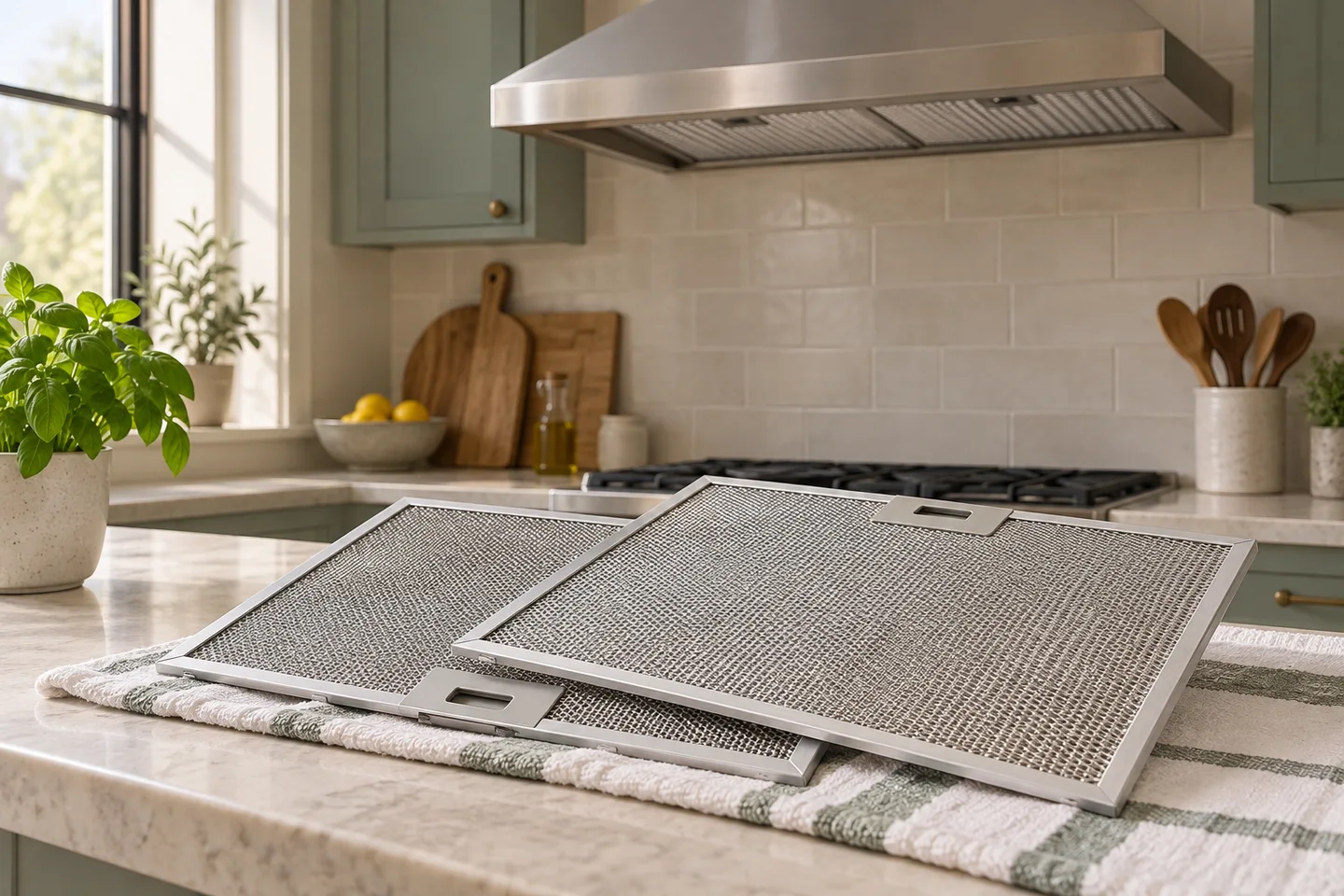
Both metal mesh and baffle filters are intended to collect cooking grease and require cleaning. Baffles are common in professional-style residential hoods, while mesh filters are widespread in conventional hoods. Choose a design that provides easy access for cleaning and follow that manufacturer's maintenance schedule. Neither filter type substitutes for a correct outdoor exhaust route.
What does a range hood really cost to install?
The full installed cost includes the hood, ductwork, electrical work, and any changes needed for a compliant installation. The scope depends heavily on the existing duct route and surrounding construction.
Ask for an itemized quote covering:
- The exact hood, blower configuration, liner or chimney accessories, and filters.
- Duct material, diameter, transitions, wall or roof cap, and weatherproofing.
- Cabinet alterations, structural support, drywall or tile repair, and finish work.
- Dedicated electrical work or relocation of an existing connection, where needed.
- Permits, inspection, airflow verification, and makeup-air provisions where required.
- Replacement charcoal filters for a ductless model, or other regular maintenance parts.
A cheaper hood that needs a new roof penetration and extensive duct reconstruction can cost more to install than a more expensive replacement suited to a compliant existing exhaust route. Get the entire scope priced before ordering.
Questions to ask before buying
- What are the cooktop's exact width, fuel type, and manufacturer ventilation requirements?
- Does the canopy cover most of the front burners at an approved mounting height?
- Is the selected model approved for ducted use, ductless use, or both?
- What are its independently certified CFM and sone ratings, and at which speeds and test conditions?
- What duct diameter, maximum equivalent run, outlet orientation, and termination does it require?
- Is a suitably sized, independent outdoor duct already present?
- Can the cabinet, wall, or ceiling support the complete hood assembly?
- Does this home's adopted code require makeup air, a permit, or airflow testing?
- Are replacement grease filters, charcoal filters, lighting parts, and service instructions available?
- Does the quote cover ducting, exterior work, electrical changes, and finish repairs?
Frequently asked questions
Do gas ranges need more ventilation than induction ranges?
Gas burners produce combustion emissions in addition to particles and odors from cooking. Induction avoids the burner's combustion emissions, but frying, searing, and other cooking still release particles and grease aerosols. Both benefit from outdoor exhaust; high-output gas ranges also need ventilation compatible with the appliance manufacturer's instructions.
Is 400 CFM enough for a range hood?
It can be. HVI's general recommendation is 400 CFM for a 48-inch range against a wall, but its island guidance is higher. Canopy geometry and installed airflow matter more than an isolated blower rating.
Is 600 CFM too powerful for a home kitchen?
Not inherently, but a 600-CFM hood can need larger ducts and may trigger makeup-air or inspection requirements. Confirm the local code and the home's combustion appliances before selecting that capacity.
Does a range hood have to vent outside?
Outdoor exhaust is preferable. Some listed ductless hoods are allowed under specified code conditions, but recirculation does not remove kitchen moisture and combustion products outdoors. Check the requirements adopted for the home.
Can a range hood vent into the attic or crawl space?
No. A domestic cooking exhaust duct should terminate outside, not in an attic, crawl space, garage, or other interior area. The IRC model code prohibits those discharge locations.
How often should range hood filters be cleaned or changed?
Follow the model's instructions and adjust for how often you cook. HVI suggests washing aluminum mesh filters about monthly and replacing non-washable charcoal filters roughly every three to six months. Regenerable odor filters have their own cleaning or regeneration instructions; the disposable-filter replacement interval does not apply to all filter types. Heavy frying may require more frequent cleaning.
What does HVI certification tell me?
HVI certification provides third-party-tested airflow and sound ratings for listed products. It helps compare models, but restrictive ducting can reduce airflow after installation, and the rating is not a direct measure of cooking-emission capture efficiency.
Does ENERGY STAR certification guarantee better smoke capture?
No. ENERGY STAR's range hood criteria address fan efficiency and sound. They do not rank hoods by front-burner smoke capture; coverage and duct design remain separate considerations.
Can I use an existing duct with a new range hood?
Only if it meets the replacement model's size, routing, condition, and termination requirements. A larger blower may require new ductwork or a makeup-air plan even when the hood fits the cabinet opening.
Our final recommendation
Before ordering, match the hood's width and depth to the burners, check certified airflow and sound ratings at usable speeds, and confirm the duct size, mounting clearance, and makeup-air requirements. A well-matched canopy with a workable outdoor exhaust route is a better starting point than the highest advertised CFM.
How we made these recommendations
Our recommendations weigh burner coverage, certified airflow, duct feasibility, safe installation clearance, sound at usable speeds, and filter maintenance. They draw on published standards, manufacturer instructions, and independent research.
What the cited research shows
Two studies published in 2012 help explain why coverage and installation matter alongside the CFM label. Delp and Singer's laboratory comparison of seven hoods found capture below 15% in some conditions and above 98% in others, with hood design, airflow, and burner position affecting the result. Rear burners were generally captured more effectively.
Singer and colleagues also examined 15 devices installed in homes. Ten delivered a maximum airflow no greater than 70% of the figure in their product literature. At comparable airflow, devices with an open capture canopy generally collected emissions more effectively than flat-bottom designs, including some microwave/fan combinations.
These are findings about those samples and conditions, not ratings of current models. They support checking burner coverage and the installed duct route rather than choosing from the advertised airflow alone.
Sources and references
- Environmental Protection Agency. Strategies for Improving Indoor Air Quality While Cooking. Outdoor-vented hood use and alternatives.
- Home Ventilating Institute. How Much Ventilation Do I Need?. General wall and island range-hood CFM guidance, downdraft and recirculation limitations.
- Home Ventilating Institute. HVI-Certified Products Directory. Independently tested residential ventilation product ratings and directory.
- Delp, W. W., and Singer, B. C., Lawrence Berkeley National Laboratory. Performance Assessment of U.S. Residential Cooking Exhaust Hoods. Environmental Science & Technology (2012), DOI: 10.1021/es3001079. Laboratory airflow, sound, and capture-efficiency measurements.
- Singer, B. C., Delp, W. W., Apte, M. G., and Price, P. N., Lawrence Berkeley National Laboratory. Performance of Installed Cooking Exhaust Devices. Indoor Air (2012), DOI: 10.1111/j.1600-0668.2011.00756.x. Measurements in installed homes.
- International Code Council. 2024 International Residential Code, Chapter 15: Exhaust Systems. Model provisions on domestic cooking exhaust, ducts, local exhaust rates, termination, and makeup air. Check the locally adopted and amended code for a specific project.
- Home Ventilating Institute. Frequently Asked Questions. Hood mounting-height guidance, sound ratings, and grease/charcoal filter maintenance.
- Broan-NuTone. Kitchen Ventilation Buying Guide. Manufacturer descriptions of undercabinet, wall-mount, island, insert, professional-style, and downdraft arrangements.
- Broan-NuTone. Range Hood Specifications Explained. Manufacturer guidance on hood width, coverage, mounting height, and enclosure fit.
- ENERGY STAR. Ventilation Fans Key Product Criteria. Residential ventilation fan efficiency and sound requirements, including range hoods.
- Broan-NuTone. Wall-Mount Range Hood Installation Guide (BW5030SSL/BW5036SSL). Example of model-specific mounting and duct design requirements, not a universal installation specification.
- Environmental Protection Agency. Sources of Indoor Particulate Matter. Cooking particle sources and outdoor-vented kitchen exhaust.
- Elica. Filter Maintenance for Your Elica Hood and Cooktop. Differences between disposable odor filters and regenerable filter types; follow the instructions for the exact compatible filter.