How to Choose an Air Fryer: Types, Size, and Trade-Offs
Our recommendation: For most people who regularly cook small batches of crispy food, a single-basket air fryer with roughly 4-6 quarts of advertised capacity is our starting point. The pull-out drawer lets you shake food during cooking, and circulating hot air browns fries, vegetables, wings, and leftovers. Choose two cooking zones if you regularly prepare foods requiring different times or temperatures. Choose an air fryer toaster oven if toast, baking, and tray-shaped foods matter as much as crisping. If you rarely prepare these foods or are satisfied with your convection oven, you may not need an air fryer.
This guide explains whether to buy an air fryer and which form factor and size to buy. Named models illustrate the differences among designs.
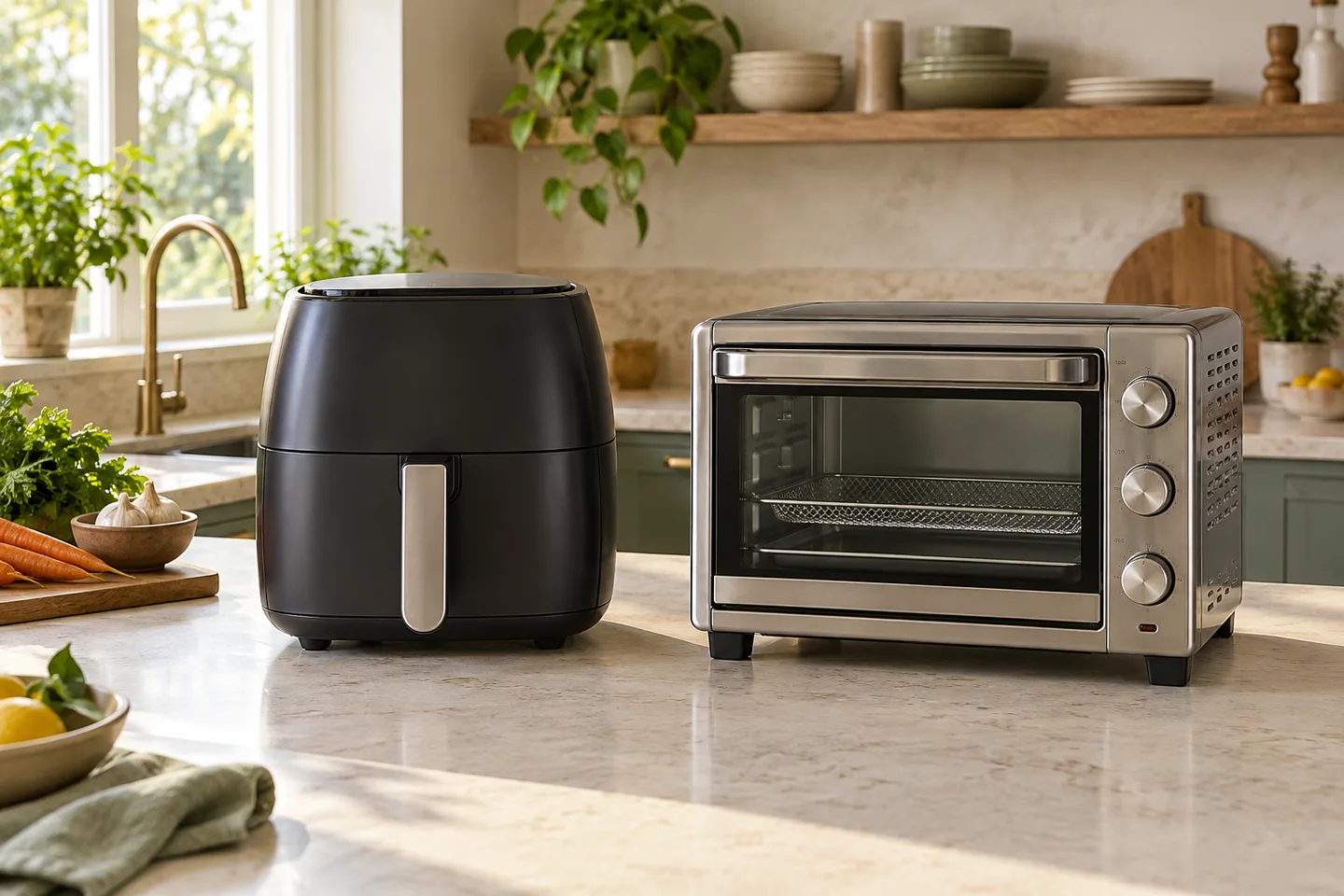
Air fryer types at a glance
| Type | Best suited to | Capacity to consider | Main advantage | Main limitation |
|---|---|---|---|---|
| Compact single basket | One person, a small kitchen, or occasional snacks | About 2-4 qt | Smaller housing and one cooking area | Can require repeated batches even for two people |
| Standard single basket | Everyday small to medium batches | About 4-6 qt | One cooking zone and removable drawer | One time-and-temperature setting at a time |
| Large single basket | One large batch or bulky pieces | About 6-8 qt or more | Undivided space for larger foods | More counter space; advertised volume may not translate to a broad cooking surface |
| Fixed dual basket | A main and side with different settings | Often 8 qt total, split between two drawers | Two independently controlled zones | Each individual zone can be narrow; two baskets to wash |
| Convertible divided basket | Alternating between two foods and one large item | Often around 7 qt total | Divider in for two zones, out for one larger zone | Zone controls and cooking behavior vary by model |
| Oven-style air fryer | Toast, pizza, baking, and flat trays | Compare rack and pan dimensions, not quarts | Accommodates racks and shallow pans | Basket designs generally performed better at crisping fries in independent comparisons |
The same quart rating can conceal very different basket shapes and usable cooking areas. Consumer Reports measures usable capacity because manufacturer volume claims can overstate practical space.
Which air fryer should you choose?
| If you usually... | Our preferred choice | Why |
|---|---|---|
| Reheat one or two servings or make a quick snack | Compact single basket | Small batches are the entire job |
| Cook fries, vegetables, chicken pieces, or leftovers for one to three people | Standard single basket | Concentrated airflow without extra controls or drawers |
| Cook for four or more and prefer one large batch | Broad, large single basket | An uninterrupted food surface can matter more than extra compartments |
| Cook protein and vegetables at different temperatures | Fixed dual basket | Independent settings reduce sequential cooking |
| Alternate between simultaneous sides and an uncut roast | Convertible divided basket | It can change from two zones to one larger space |
| Need a countertop toaster, small oven, and air-fry function | Oven-style air fryer | Multiple everyday tasks can justify its footprint |
| Mostly prepare soups, rice, wet-battered foods, or large sheet-pan meals | Keep your existing appliances | Air frying is not the right cooking method for these jobs |
| Already have a convection toaster oven that meets your needs | Try its convection or air-fry mode first | Avoid buying a second appliance for a marginal gain |
Is an air fryer worth buying?
An air fryer is worth buying when you regularly want a crisp exterior on small to medium portions without deep-frying, especially if turning on a full-size oven feels excessive for that meal. It moves heated air around food to brown and dry the surface. The USDA describes air fryers as countertop convection appliances and cautions that crowding can interfere with even cooking.
An air fryer makes particular sense for frozen fries, potatoes, breaded foods whose packaging allows air frying, roasted vegetables, chicken wings, and leftovers that become soft in a microwave. Basket models also make it easy to shake small pieces during cooking. They do not reproduce every feature of oil frying, and a crisp surface does not prove that meat is cooked safely.
Skip the purchase if your typical meals are large casseroles, soup, pasta, steamed foods, or full baking sheets. The same applies if you rarely make crisp foods, lack a safe place to operate the appliance, or already get the results you want from a countertop convection oven.
What an air fryer replaces - and what it does not
| Appliance or method | What an air fryer can do | What remains different |
|---|---|---|
| Deep fryer | Crisp many foods using circulating hot air and often little added oil | It does not immerse food in oil, so coating and texture differ |
| Full-size oven | Roast and reheat smaller portions | Full-size ovens fit large pans and multiple dishes |
| Toaster oven | Reheat, roast, and sometimes bake | Most baskets are awkward for toast, pizza, and broad baking pans |
| Microwave | Warm many leftovers | Microwaves are more convenient for liquids and moisture-rich reheating; air fryers prioritize surface browning |
| Grill or skillet | Brown some meats and vegetables | Air fryers do not provide the same direct pan contact or grill setup |
1. Single-basket air fryers - for one cooking zone
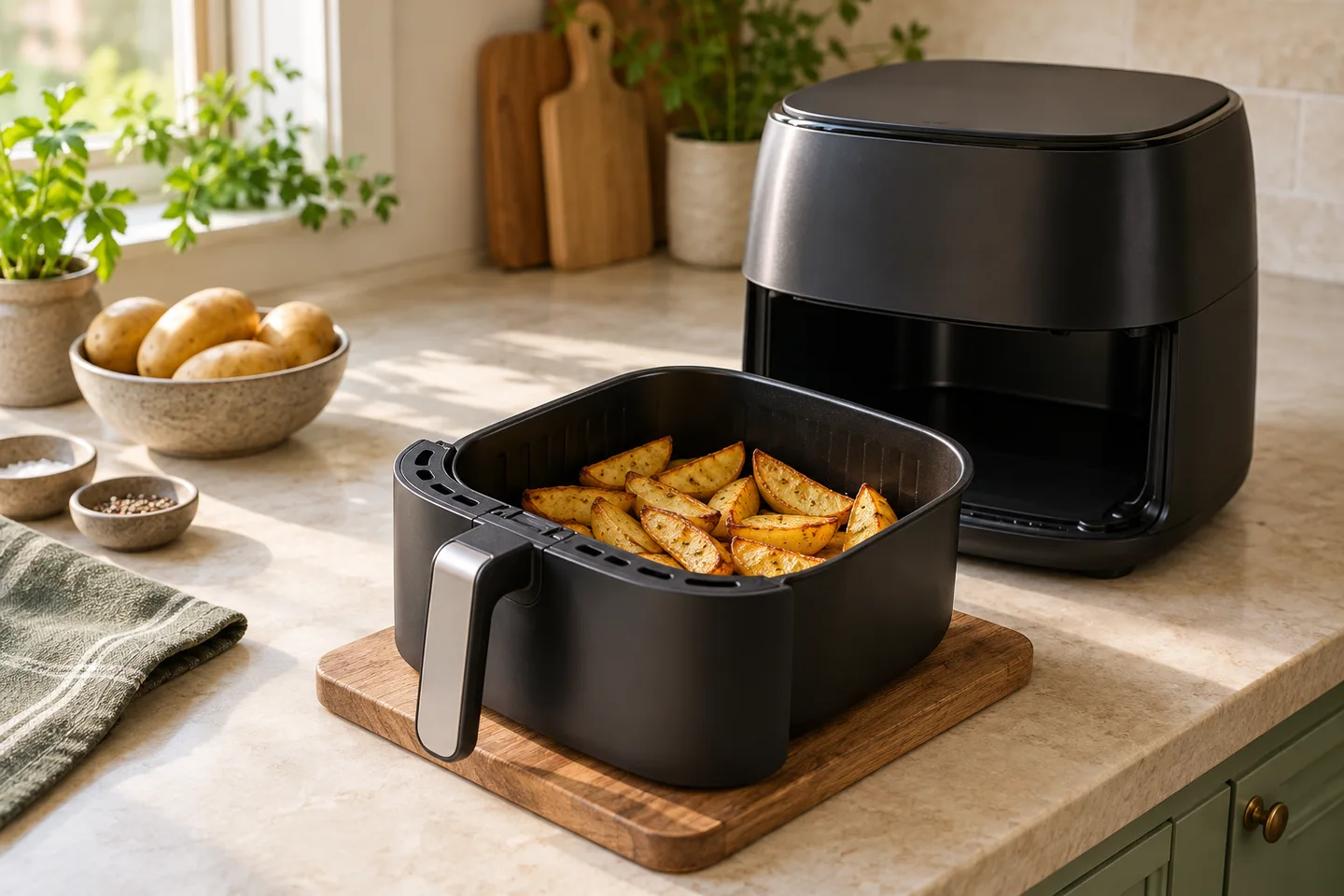
Choose a single-basket air fryer if you mainly cook one type of food at a time. A basket advertised around 4-6 quarts is our recommended starting point, provided its base is broad enough for the portions you cook. A shallow, wide cooking area can fit more food in one layer than a deeper basket with the same stated volume.
Ninja Air Fryer Pro AF141: an example
The Ninja Air Fryer Pro AF141 illustrates the standard single-drawer layout. Its published specifications list a 5-quart basket, four cooking functions (air fry, roast, reheat, and dehydrate), and 1,750 watts. The listed limited warranty is one year.
The single drawer lets you shake potatoes and vegetables during cooking without coordinating two cooking zones.
Best for: First-time buyers, one- to three-person households, and people who value simplicity.
Limitations: A single basket cannot independently run a main and side at different temperatures. A heaped basket can also turn an apparently generous quart figure into several cooking batches. If you routinely cook whole meals simultaneously, investigate a dual-zone design.
2. Fixed dual-basket air fryers - best for simultaneous dishes
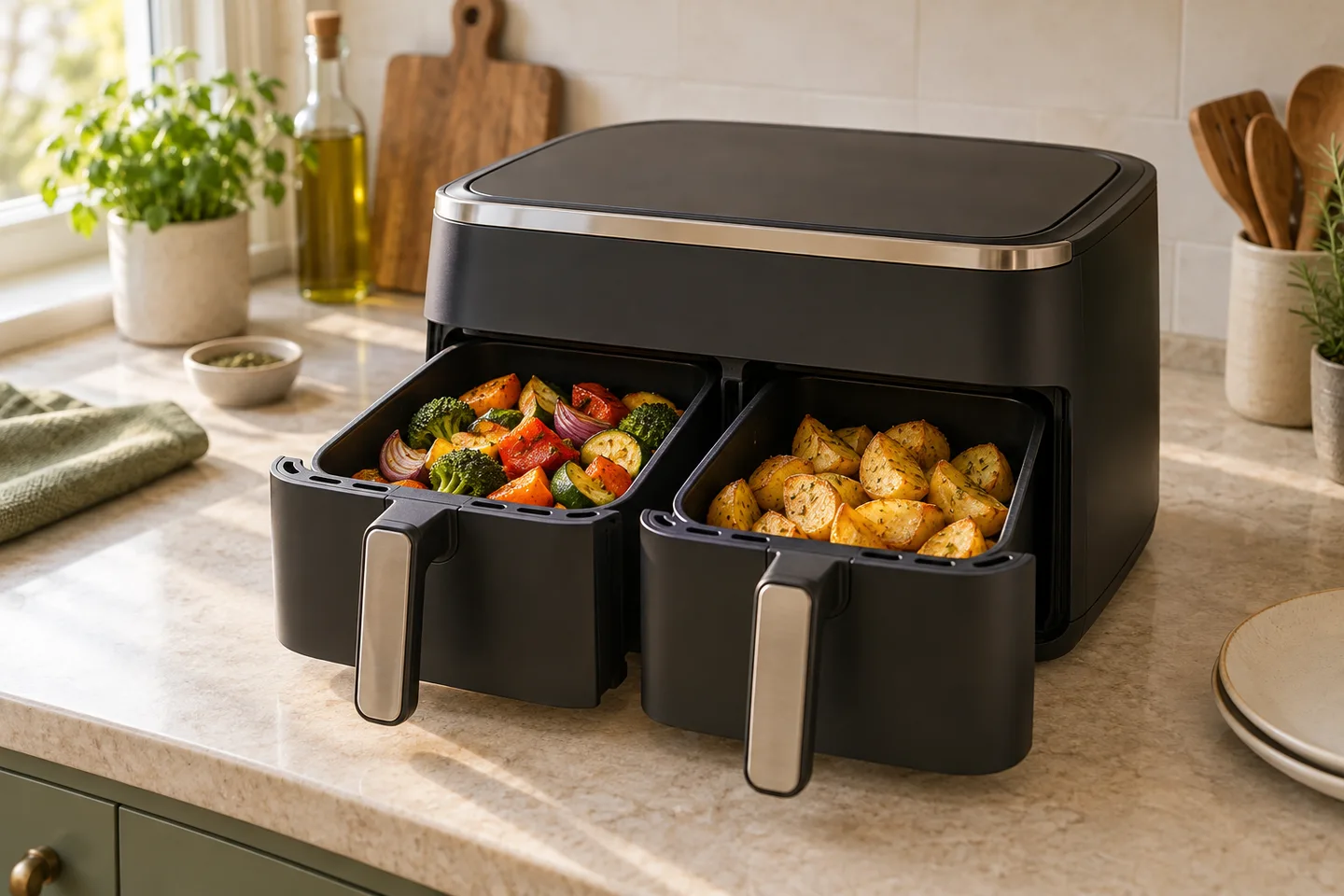
Choose a fixed dual-basket air fryer if you repeatedly cook two foods that need different times or temperatures and want them to finish together. Two zones make sense for salmon plus vegetables, chicken plus potatoes, or meat and a separate vegetarian dish. That convenience is the feature you are paying for, not merely the combined quart count.
Ninja Foodi DZ201: an example
The Ninja Foodi DZ201 has two independent 4-quart baskets, giving an advertised 8-quart total. Its published specifications identify separate fans and heaters for the zones, a simultaneous-finish feature, six cooking programs, and 1,690 watts of rated power. Its listed limited warranty is one year.
You can set one drawer for vegetables and the other for chicken, then coordinate their finish times without removing a completed side early.
Best for: Families serving two-component dinners, cooks who separate foods, and households that regularly use two different temperatures.
Limitations: An 8-quart dual fryer does not provide an 8-quart undivided basket. Large pieces may not fit either 4-quart compartment, even though the combined number sounds ample. The appliance also has two drawers and crisper plates to handle and wash.
3. Convertible divided-basket air fryers - best for flexible layouts
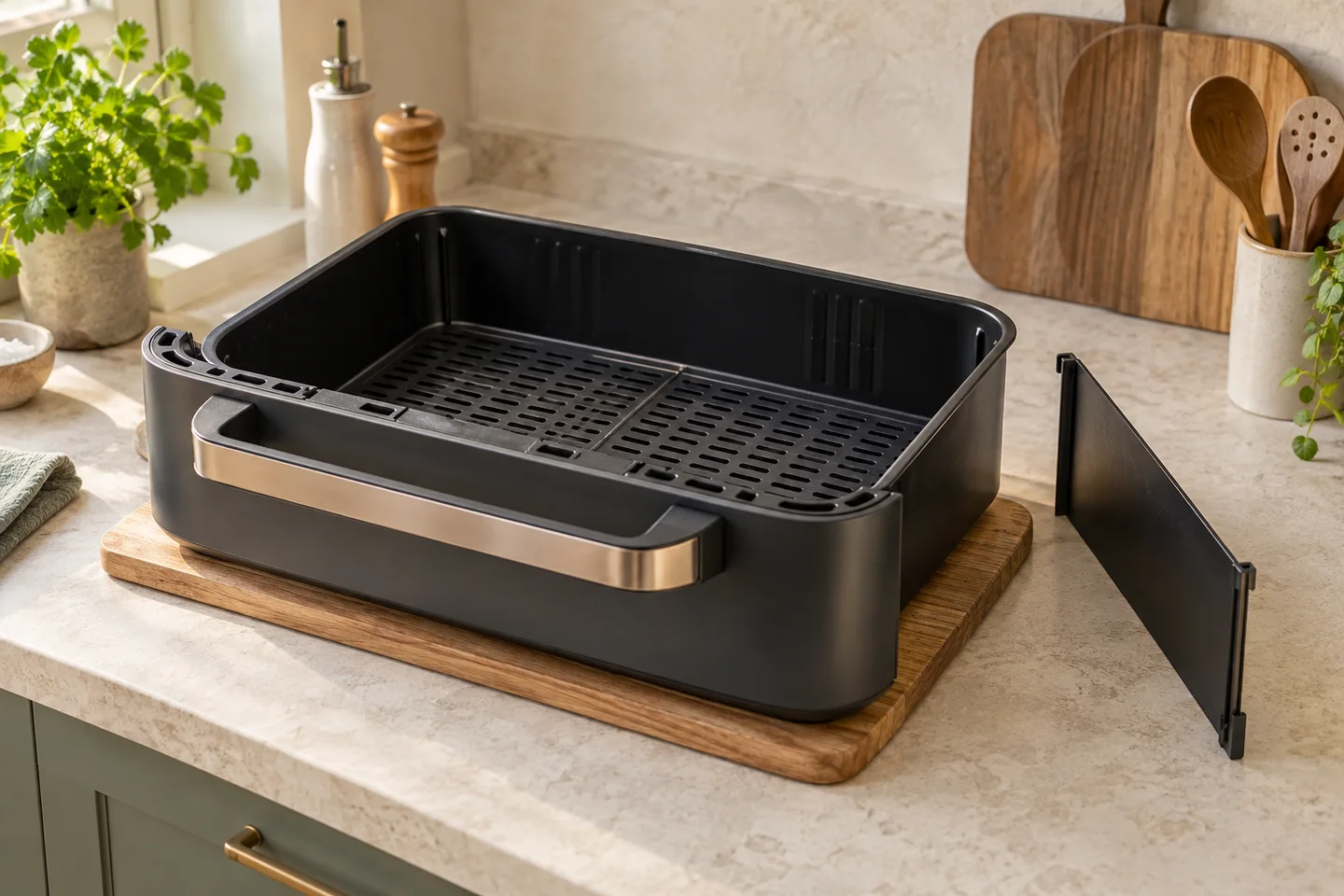
Choose a convertible divided-basket air fryer when your cooking alternates between two independent foods and one larger item. The divider is useful only if you will actually remove it often; otherwise a conventional single or fixed dual basket is easier to justify.
Ninja Foodi FlexBasket DZ071: an example
The Ninja Foodi FlexBasket DZ071 uses a removable divider to switch between two 3.5-quart zones and one 7-quart cooking area. Ninja specifies six cooking functions, synchronized finish or matching settings for the two-zone arrangement, and 1,690 watts of rated power. It lists dishwasher-safe crisper plates and basket and a one-year warranty.
You can separate foods for a weeknight dinner, then reclaim the full cooking area for a larger cut of meat on another day.
Best for: Households whose meal shapes and schedules change throughout the week.
Limitations: Measure the DZ071's housing, space to pull out the drawer, and required ventilation clearances before buying. Its 7-quart capacity does not mean that food can be stacked throughout the chamber while crisping evenly. The divider adds another part to clean. Check whether other convertible models actually have independently controlled zones.
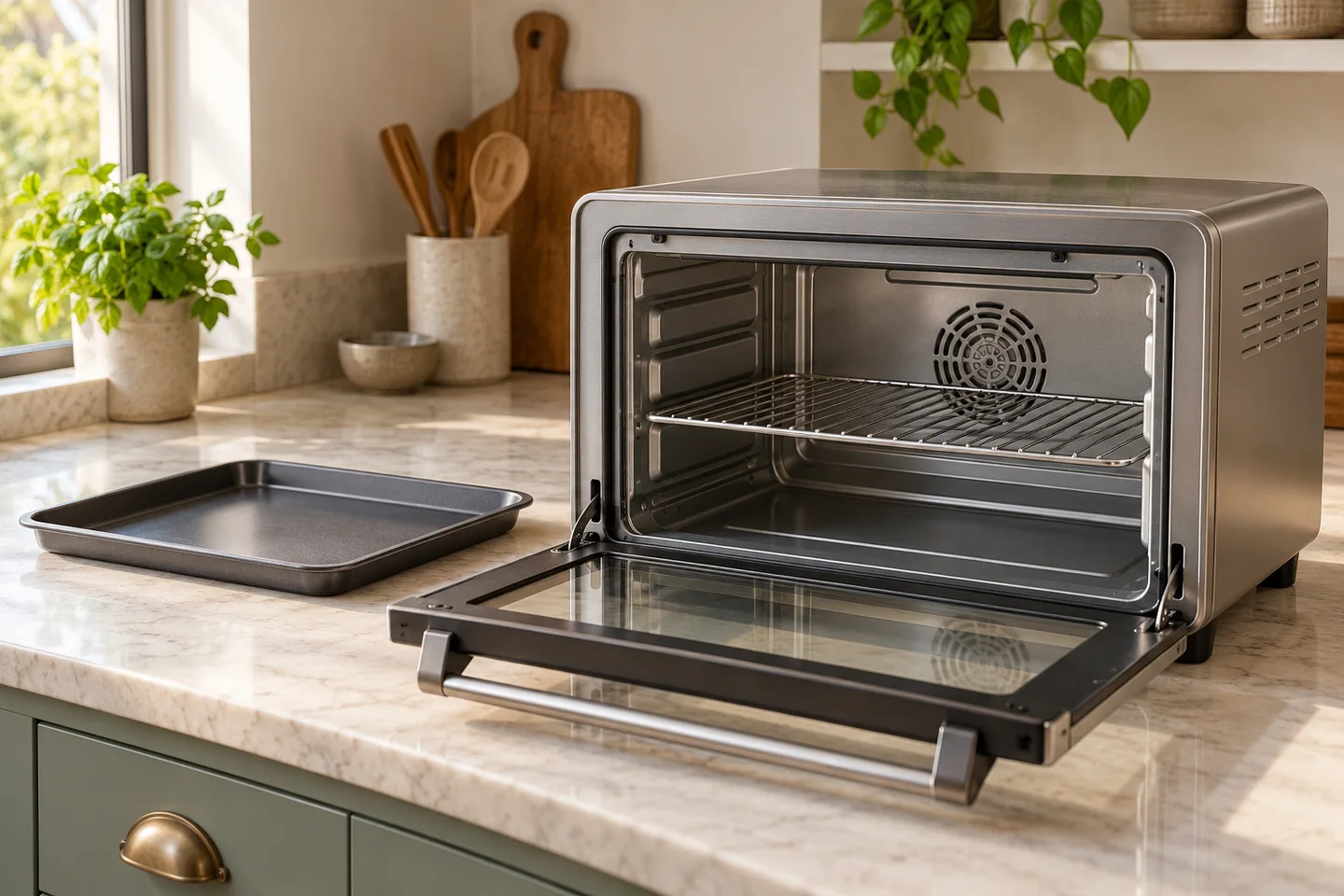
4. Oven-style air fryers - best for all-around countertop cooking
Choose an oven-style air fryer if you want one countertop device for toast, pizza, roasting, baking, and some air frying. Its racks and shallow trays accommodate foods that are awkward to arrange in a deep basket. Independent comparisons generally favor dedicated basket designs for crisping fries.
Cuisinart Air Fryer Toaster Oven with Grill TOA-70NAS: an example
The Cuisinart TOA-70NAS illustrates this category with a 0.6-cubic-foot interior, air-frying basket/rack, oven rack, baking pan, and grill/griddle plate. Cuisinart lists eight functions, 1,800 watts, a three-year limited warranty, and exterior dimensions of 12.25 x 15.75 x 13.75 inches (length x width x height). The manufacturer says its interior fits a 12-inch pizza or up to 3 pounds of wings; those figures describe fit, not crisping performance.
A rack-and-door design can replace a traditional toaster oven while adding air-fry capability. It makes sense when horizontal pan space and several cooking methods matter more than optimizing one crisping task.
Best for: People replacing an old toaster oven, cooks who frequently toast and bake, and households that prepare flat foods.
Limitations: Oven-style models can take more effort to clean around racks, doors, crumbs, and interior surfaces. Their larger chambers and airflow layouts may produce less even or slower air frying than strong basket models. Capacity measures such as cubic feet, rack dimensions, and pounds of food are not directly interchangeable.
How big should your air fryer be?
Buy for the amount of food you need to spread out, not for the number of people printed on the box. Quart capacity measures volume, while many crisp foods cook best when hot air can reach their surfaces. A deeper basket can advertise a large capacity without fitting much more food in one effective layer. USDA warns against overcrowding.
Use these ranges to narrow the choices:
| Typical need | Start by examining | Check before buying |
|---|---|---|
| One serving or occasional snacks | 2-4 qt | Does your usual frozen-food portion lie reasonably flat? |
| One to three people, everyday sides | 4-6 qt | Can the base hold your normal potatoes, vegetables, or chicken pieces? |
| Larger family portions or one large food item | 6-8 qt or more, preferably a broad single area | Can you fit your largest usual food without stacking or cutting it? |
| Two foods at once | Two independently controlled zones | Is each zone large enough for its assigned dish? |
| Pizza, toast, and baking pans | Oven-style, sized by rack and pan | Does the usable rack area fit your actual cookware and food? |
Serving counts depend on food shape, thickness, and how it is arranged in the basket.
Five size checks that prevent a bad purchase
- Measure the food. Think about the chicken pieces, vegetables, or pizza you really make, not the largest meal shown in advertising.
- Check the basket floor. Favor published internal length and width or a credible independent surface-area measurement over volume alone.
- Check the outside, too. Include the handle, room to pull out the drawer, and the clearance required around vents.
- Plan for batches. Two crisp batches may be better than one crowded one, but that can erase the convenience of a small unit for a family meal.
- Do not add split-zone capacities together as if they were one space. Two 4-quart drawers cannot necessarily hold an item that fits an undivided 8-quart basket.
Features worth paying for - and features you can skip
Prioritize these
- Useful food surface and airflow: Check how much food fits across the basket floor. More watts alone do not prove better food; the system has to circulate heated air effectively.
- Adjustable time and temperature: Manual controls let you follow specific recipes. Presets provide a starting setting; food temperature must still be checked where safety requires it.
- A basket you can clean easily: Check whether the removable basket and crisper plate are dishwasher-safe on the exact model and whether replacements are sold. Instant Pot, for example, specifies dishwasher-safe components for its Vortex Plus 6QT ClearCook, while cleaning instructions remain model-specific.
- Comfortable access: Check drawer weight, handle clearance, hot surfaces, and whether you can safely move the crisper plate after cooking.
- An appropriate layout: Independent zones allow different time and temperature settings; removable dividers can make room for a larger item.
Treat these as optional
- Windows and interior lights: Convenient for watching browning without repeatedly opening the chamber, but not substitutes for checking food temperature.
- App controls and dozens of presets: They add ways to select or monitor settings but do not increase usable cooking area.
- Very high maximum temperatures: The ability to select a high number does not establish precise temperature control or superior crisping.
- Extra racks, rotisserie parts, and specialty trays: Useful for particular recipes but can create more parts to clean and store.
- A particular coating or basket material: If nonstick coatings matter to you, verify the precise material statement for the current model. Do not assume every product from one brand uses the same coating.
Basket vs. oven-style air fryer
Our choice is a basket-style air fryer for fries, wings, vegetables, and crisp reheating, or an oven-style model for toast, pizza, and baking. The basket's pull-out drawer supports shaking food; the oven's racks hold flatter items. Crisping results still vary by model.
| Decision point | Basket-style | Oven-style |
|---|---|---|
| Strong crisping on a moderate batch | Generally faster and crispier in RTINGS' comparison | Some models match basket results; compare individual tests |
| Shaking fries or small vegetables | Pull-and-shake drawer is convenient | Usually requires opening door and moving a tray |
| Toast and pizza | Often awkward or impossible at useful sizes | Usually a natural fit if the rack is large enough |
| Baking dishes and flat foods | Limited by basket shape | More flexible rack/pan layout |
| Cleanup | Fewer large removable pieces, depending on model | Trays, racks, crumbs, door, and interior surfaces |
| Counter-space value | Specialized tool | Potentially replaces a toaster oven |
Single basket vs. dual basket vs. removable divider
Pick one undivided basket if batch size is your problem. Pick two independently controlled baskets if meal timing is your problem. Pick a removable divider if both problems happen regularly. These designs solve different constraints.
A fixed dual basket can prepare chicken and vegetables with separate settings, but each drawer still has its own width and depth. A removable divider can restore a larger space, but it may not offer the exact same performance or access as a purpose-built large single basket. The Ninja Foodi DZ201 and Ninja Foodi FlexBasket DZ071 show how different the layouts can be even within one brand.
Before paying for a two-zone design, ask: Can I name three recent dinners for which two independently controlled zones would have helped? If not, a single basket removes a second set of parts to clean.
What do wattage and fan speed really tell you?
Wattage is a useful specification, but not a standalone performance score. A capable heating element helps replenish heat after cold food is added. Fan airflow also determines how quickly surface moisture is removed.
For example, the published ratings are 1,750 watts for the Ninja Air Fryer Pro AF141 and 1,690 watts for the Ninja Foodi DZ201. That difference does not establish which model cooks faster or uses more electricity per meal: basket geometry, food load, heating cycles, cooking duration, and airflow also matter.
Energy use depends on the whole cooking session, not only the wattage on the label. Kilowatt-hours = average power in kilowatts multiplied by operating hours. Heating elements cycle, so rated power may exceed average power. A claim that an air fryer saves a specific percentage of electricity requires measurements of the same food and cooking task in both appliances.
Safety, placement, and cleaning
An air fryer needs enough counter space for safe use, not just enough space to fit its body. Follow the exact model's manual for ventilation, distances from walls and cabinets, acceptable surfaces, power-cord use, and cleaning. Some manufacturers require several inches of free space around the appliance, but there is no single clearance figure appropriate for every model. An Instant Pot Vortex manual, for example, specifies 5 inches of clearance.
For food safety, do not rely on a browned exterior. USDA guidance calls for measuring safe internal temperatures with a food thermometer and warns against overloaded baskets. It specifically cautions not to air-fry raw, stuffed, breaded chicken breast products; follow the package's cooking instructions for these foods.
| Food | Safe internal temperature or doneness guidance |
|---|---|
| Poultry, including ground poultry | 165°F |
| Ground beef, pork, veal, or lamb | 160°F |
| Fish | 145°F |
| Shrimp, lobster, crab, and scallops | Cook until the flesh is opaque and pearly or white |
| Clams, oysters, and mussels | Cook until the shells open |
| Whole cuts of beef, pork, veal, or lamb | 145°F, followed by a 3-minute rest |
| Leftovers | 165°F |
The temperatures above are minimum internal temperatures, not air-fryer dial settings; shellfish have separate doneness guidance. Use a food thermometer in the thickest part of foods with a temperature target, and follow additional package instructions.
Other practical checks:
- Put the appliance on a stable, manufacturer-approved surface with unobstructed vents. Keep heat and steam away from vulnerable materials.
- Follow the manual on direct wall-outlet use, extension cords, and other appliances sharing the circuit; do not guess from wattage alone.
- Remove greasy crumbs and residue as directed after the appliance cools. Confirm which parts, if any, can go in the dishwasher.
- Keep lightweight parchment, liners, and accessories out of the heating element and vents; only use items the manufacturer approves for that model.
- Look up the exact model number in the Consumer Product Safety Commission's recall database, especially for a used or older appliance. A recall applies only to the models identified in its notice.
Air fryer buying checklist
Before checking out, answer these questions in order:
- [ ] Will I use it? Can I name several regular meals or leftovers that would genuinely benefit from crisp hot-air cooking?
- [ ] Which shape? Do I need a basket, two independent zones, a removable divider, or oven-style trays?
- [ ] How much flat cooking space? Will my normal portion fit without piling food so high that air cannot circulate?
- [ ] Where will it operate? Have I measured the appliance, drawer movement, vent clearance, and nearby outlet?
- [ ] Can I clean it easily? Are the basket, plate, trays, and surrounding interior accessible, and what does the manual permit in a dishwasher?
- [ ] Do I need its extras? Will I actually use the window, probe, app, racks, or unusual programs?
- [ ] What is the full cost? Does the price make sense for my frequency of use, warranty, and available replacement parts?
- [ ] Is the exact model safe to buy? Have I read its manual and checked current CPSC recall information?
If you cannot answer the first two questions, list the meals you usually cook before choosing an appliance.
Frequently asked questions
What type of air fryer is best for most people?
A standard single-basket air fryer with roughly 4-6 quarts of advertised capacity is our choice for most households, assuming it has enough usable cooking surface for normal portions. It handles common crisping jobs without the added space and controls of two cooking zones. Compare basket floor dimensions before deciding from quarts alone.
Do I need an air fryer if I have a convection oven?
Not necessarily. First try your oven's convection or air-fry setting on the small foods you cook most often. Dedicated basket models can concentrate heated airflow and often crisp small batches more effectively, but that improvement may not justify another countertop appliance if you are already satisfied.
Is a 4-quart air fryer big enough for two people?
It can be, particularly for sides, snacks, or smaller meals. Check the usable basket floor against two normal servings of your actual food. A deep but narrow 4-quart basket may need multiple batches for fries or wings; a broader basket can fit more pieces in one layer.
Is a 6-quart air fryer enough for a family of four?
Sometimes, but do not treat six quarts as a four-serving promise. A broad 6-quart single basket may work for certain mains or sides; a full dinner for four may still require batches or another appliance. Decide by the area occupied by the food and your willingness to cook sequentially.
Should I buy the largest air fryer I can afford?
No. Buy the smallest model that comfortably handles your usual food while allowing airflow, with enough extra room for occasional larger batches. A huge appliance that is awkward to store, clean, or ventilate may get less use than a well-sized one.
Is one big basket better than two small baskets?
For one large batch, choose a broad undivided basket. For a main and side with different settings, choose two zones. The Ninja Foodi DZ201 has two 4-quart cooking areas, not one continuous 8-quart area.
Are removable dividers worth it?
Yes, if you frequently switch between two separately timed foods and one larger food. The Ninja Foodi FlexBasket DZ071 demonstrates a switch from two 3.5-quart zones to one 7-quart area. If you consistently use only one arrangement, a simpler fixed layout may be a better value.
Are air fryer toaster ovens as good as basket air fryers?
Independent comparisons found that basket models generally crisped fries faster, while oven-style machines accommodated toast, pizza, and baking pans. Results vary by individual model.
Can an air fryer replace a microwave?
Not for most households. An air fryer is our choice for restoring a crisp exterior to fries or breaded leftovers. A microwave remains more convenient for soups, sauces, beverages, and other moisture-rich foods. Keep both if you regularly need both results.
Can an air fryer replace a toaster oven?
An oven-style air fryer often can, provided its rack dimensions and functions meet your needs. A conventional deep-basket air fryer is less convenient for evenly toasting bread or accommodating broad pizza and baking pans. Compare the actual foods you toast and bake before consolidating appliances.
Is an air fryer the same as a deep fryer?
No. An air fryer uses heated moving air rather than immersing food in a bath of hot oil. It can make food crisp with little added oil, but the result is not identical to deep frying. If a particular deep-fried texture is your main goal, keep that distinction in mind.
Are higher-wattage air fryers always better?
No. Heating power matters, but basket area, airflow, food load, and temperature regulation also affect results.
Do air fryers always use less electricity than ovens?
No fixed saving applies to every meal. A smaller chamber and shorter session can help for small portions, but actual electricity depends on power over time, preheating, food quantity, and the comparison oven. Compare complete sessions for the same amount of food before claiming a percentage saved.
Do I have to preheat an air fryer?
Follow the model and recipe instructions. Some recipes and appliances benefit from preheating; others allow food to go straight into the basket. For example, Instant Pot recommends preheating its Vortex Plus 6QT ClearCook for many foods, while models vary in how they guide this step.
Is an air fryer safe for raw chicken?
Raw chicken can be cooked in an air fryer when the appliance and product instructions permit it, but it must reach 165°F internally. Do not judge safety from surface color or a preset timer. USDA specifically says not to air-fry raw, stuffed, breaded chicken breast products; follow the cooking method required on those packages.
Can I put parchment paper or foil in an air fryer?
Only if the specific appliance instructions permit it and the material is safely secured by food. Loose liners can interfere with airflow or reach a heating element. Use the supplied crisper plate or manufacturer-approved accessories.
Is a dishwasher-safe air fryer easier to own?
Usually, but check the parts that are actually dishwasher-safe. A manufacturer may approve the basket and crisper plate but not the powered base, door, accessories, or coating care you expect. Review instructions for the exact model before using cleaning convenience as the deciding feature.
Should I buy a glass-basket air fryer to avoid nonstick coatings?
Only if the specific glass-basket model fits your cooking, handling, and cleaning needs. Basket material is a legitimate personal preference, but it does not establish cooking performance, coating composition elsewhere in the appliance, or universal safety. Verify manufacturer materials, approved accessories, and replacement availability for the exact product.
What is the best inexpensive air fryer?
For a budget purchase, our preference is a single-basket design with enough cooking surface for regular portions and removable parts you can clean. Compare the total price, warranty, and replacement-part availability instead of counting presets.
Our final recommendation
Start with a standard single-basket air fryer if crisping small meals is the main reason you are shopping. Move to a fixed dual-zone model for regular two-dish cooking, a convertible basket for genuinely changing layouts, or an oven-style model if you need a countertop oven first and an air fryer second. Give usable food area and safe counter placement more weight than quart labels, preset counts, or promotional claims.
If your current oven, toaster oven, skillet, or microwave already handles your regular meals, you may not need another appliance.
What independent testing shows
We compare published model specifications, independent research, and food-safety guidance to assess capacity, cooking layouts, and practical trade-offs. Performance comparisons draw on RTINGS and Consumer Reports; food-safety advice follows USDA and FoodSafety.gov guidance.
RTINGS' testing identifies cooking surface area, heating-element power, and fan airflow as major contributors to crisping. Its suggested starting point of at least 50 square inches of basket surface is a buying recommendation, not a universal minimum; the required area depends on the food and portion size.
In a separate comparison, RTINGS found that basket models generally produced crispier fries more quickly than air fryer toaster ovens, although results differed by model. Consumer Reports also documents the trade-off between toaster-oven versatility and dedicated air-frying performance.
Sources and references
- USDA Food Safety and Inspection Service: Air Fryers and Food Safety. Air frying, overcrowding, and safe handling.
- RTINGS: Air Fryer Buying Guide: We Sabotaged a Top Model to See What Really Counts. Independent basket-area, power, and airflow research.
- Consumer Reports: How to Pick the Perfect Air Fryer. Usable capacity, controls, cleaning, and format differences.
- RTINGS: Basket-Style Air Fryers Are Still Crispier Than Air Fryer Toaster Ovens. Independent comparative cooking study.
- Target: Ninja Air Fryer Pro AF141. Model-specific specifications and warranty.
- Best Buy: Ninja Foodi DZ201, 8-qt DualZone. Model-specific split-zone capacity, functions, and power.
- SharkNinja: Ninja Foodi FlexBasket DZ071, 7-qt MegaZone. Convertible zones, cleaning, and dimensions.
- Cuisinart: Air Fryer Toaster Oven with Grill TOA-70NAS. Oven configuration, cooking functions, and dimensions.
- Instant Pot: Vortex Plus 6QT ClearCook Air Fryer. Basket care, preheating, and features.
- FoodSafety.gov: Safe Minimum Internal Temperatures. Internal temperatures, rest times, and separate shellfish doneness guidance.
- Instant Pot: Vortex Plus 6-Quart User Manual. Example appliance-specific clearance requirement; check the manual for the exact model purchased.
- Consumer Product Safety Commission: Recalls and Product Safety Warnings. Model-specific recall lookup.